


The modern vehicle is no longer merely a mechanical apparatus propelled by internal combustion or electric motors; it is a rolling computer network, a digital living room, and an extension of our personal digital footprint. As automobiles evolve into software-defined platforms, the attack surface expands exponentially, moving beyond remote keyless entry vulnerabilities and Bluetooth exploits into the realm of complex supply-chain cyber attacks. In a watershed moment for automotive cybersecurity, security analysts have uncovered the first known instance of a malicious campaign explicitly designed to compromise Android-powered car head units, transforming everyday dashboard displays into unwitting participants in a global proxy botnet and ad-fraud operation.
According to technical analysis conducted by threat intelligence researchers, the campaign leverages a sophisticated supply-chain compromise to infiltrate aftermarket and factory-integrated automotive hardware. The primary vector for this operation relies on legitimate device-update applications manufactured by third-party suppliers, subverting trusted software channels to deliver malicious payloads straight to the dashboard. The threat actor behind this operation has been identified as the MoYu group, a cybercriminal collective previously tracked in connection with extensive illicit botnet infrastructure, including the widespread BadBox operations that historically targeted millions of consumer electronics and smart devices worldwide.
The focal point of this targeted assault centers on systems engineered by DoFun, an automotive software, cloud services, and hardware manufacturer owned by Shenzhen Driving Control Technology Co., Ltd. DoFun specializes in producing generic Android-based head units—the central computing modules that govern a vehicle’s multimedia infotainment, satellite navigation, Bluetooth connectivity, climate control interfaces, and various system preferences. Because these units are widely distributed across diverse automotive markets, a single compromise at the software development or supply-chain level can ripple outward, affecting thousands of vehicles scattered across global roadways.

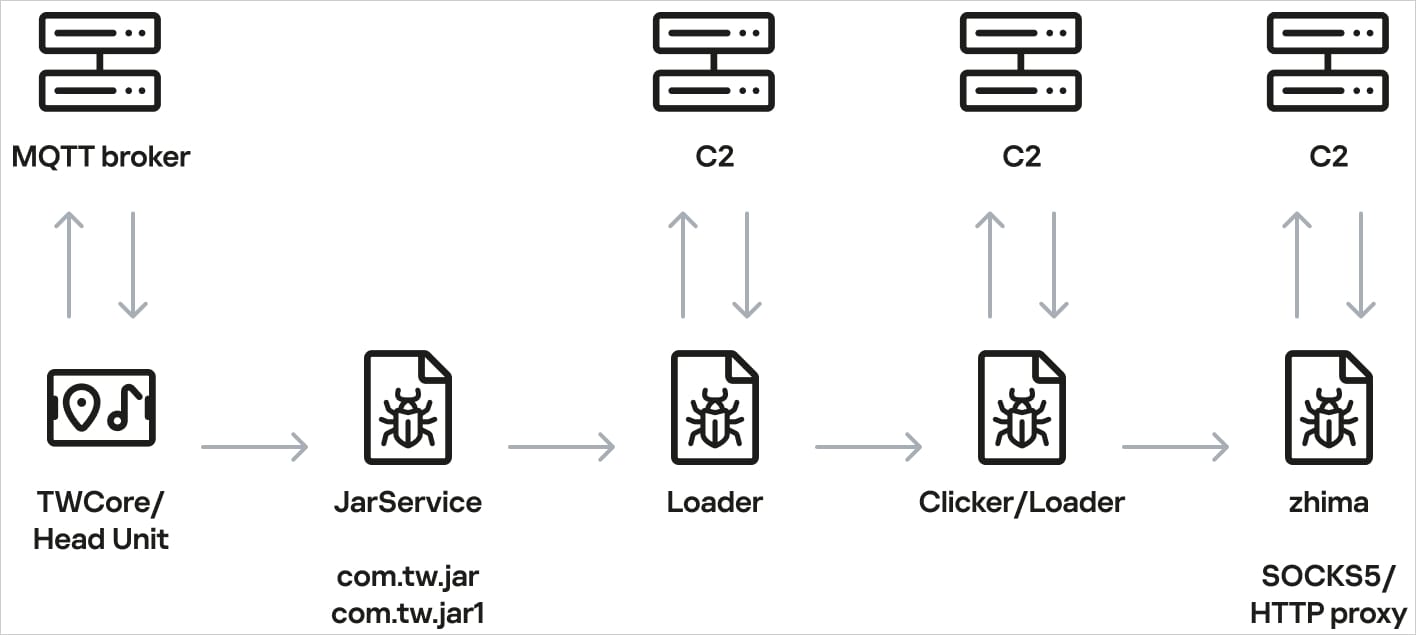
The infection mechanism discovered by researchers exhibits a high degree of operational stealth. During routine system behavior analysis, investigators uncovered a malicious Android Package (APK) file being silently pulled down by a legitimate system component known as TWCore. This core software application, embedded directly into the head unit’s firmware, routinely coordinates updates and communicates with backend infrastructure through a Message Queuing Telemetry Transport (MQTT) server hosted on domains associated with the infrastructure, specifically pointing toward the cardoor domain.
Once the rogue update cycle is initiated, the system downloads an interface-less application designated as JarService. Designed to operate completely out of sight from the driver or passengers, JarService functions as a sophisticated dropper. Upon execution, the malware unpacks and decrypts a second-stage loader. This loader promptly establishes secure, persistent communications with an external command-and-control (C2) server, paving the way for the retrieval of the final operational payload.
The ultimate payload is engineered to maintain persistent situational awareness of the host vehicle’s infotainment environment. It systematically harvests and transmits granular device telemetry back to the attackers, including the exact hardware model, screen resolution, local Wi-Fi SSID, and hardware MAC address. Furthermore, the payload features a modular architecture capable of processing a wide array of remote commands, enabling the threat actors to dynamically alter the behavior of the compromised head unit in real time.
Despite the invasive nature of the firmware compromise, rigorous technical evaluations have confirmed that the malware is carefully cordoned off from critical vehicle control systems. The rogue software does not interface with the vehicle’s CAN bus (Controller Area Network), engine management units, electronic stability control, or braking mechanisms. Consequently, drivers face no direct threat to physical safety or vehicle maneuverability. Instead, the malicious infrastructure is entirely financial and infrastructural in nature, pivoting around residential proxy monetization and automated advertising fraud.

The core objective of the MoYu group in this campaign is twofold: generating illicit revenue through programmatic click-fraud and expanding a lucrative residential proxy network. Investigators identified that the operators frequently deploy a reverse-proxy module known internally as "zhima." By integrating the compromised Android head unit into this proxy network, the attackers route third-party internet traffic through the vehicle’s cellular or Wi-Fi connection, masking malicious or scraping activities behind residential and automotive IP addresses. Simultaneously, the head unit executes automated web requests in the background, simulating human interaction with digital advertisements to siphon fraudulent payouts from ad networks.
When approached regarding these findings, security researchers coordinated disclosure with DoFun. Representatives from the Chinese hardware and software provider acknowledged the security advisory and indicated that remedial steps had been taken to secure their update pipelines and neutralize the identified vulnerabilities. Nevertheless, the incident underscores lingering structural weaknesses within the automotive software supply chain, where third-party components often lack the stringent, continuous security auditing demanded of traditional enterprise and consumer computing ecosystems.
The implications of this discovery stretch far beyond a single vendor or a localized ad-fraud scheme. As vehicles increasingly rely on customizable Android Open Source Project (AOSP) derivatives and third-party software layers for infotainment, the cockpit becomes an attractive target for cybercriminals seeking always-on, high-bandwidth nodes. Unlike a smartphone or a home router, which may be powered down or replaced frequently, a car’s head unit often maintains persistent cellular or Wi-Fi connectivity, substantial processing power, and uninterrupted power supplies during operation—making it an ideal, long-term asset for botnet operators.
Industry analysts emphasize that this campaign serves as a critical wake-up call for automotive manufacturers, tier-one suppliers, and aftermarket developers alike. Traditional automotive cybersecurity has historically focused heavily on protecting mission-critical networks, such as powertrain and braking systems, from remote tampering. However, as infotainment systems blur the lines between consumer electronics and vehicular architecture, the security perimeter must expand to encompass the entire software bill of materials (SBOM). Ensuring code integrity, enforcing cryptographic validation for all over-the-air (OTA) updates, and implementing robust endpoint detection and response (EDR) capabilities within automotive operating systems will be paramount in preventing future supply-chain compromises.
As the automotive sector marches further into the era of software-defined vehicles, threats like the MoYu proxy botnet campaign demonstrate that cybercriminals will continuously probe for the path of least resistance. Securing the modern dashboard requires a holistic defense strategy that treats every line of third-party code as a potential vector, ensuring that the technology designed to enhance our driving experience does not inadvertently compromise our digital sovereignty on the open road.
