

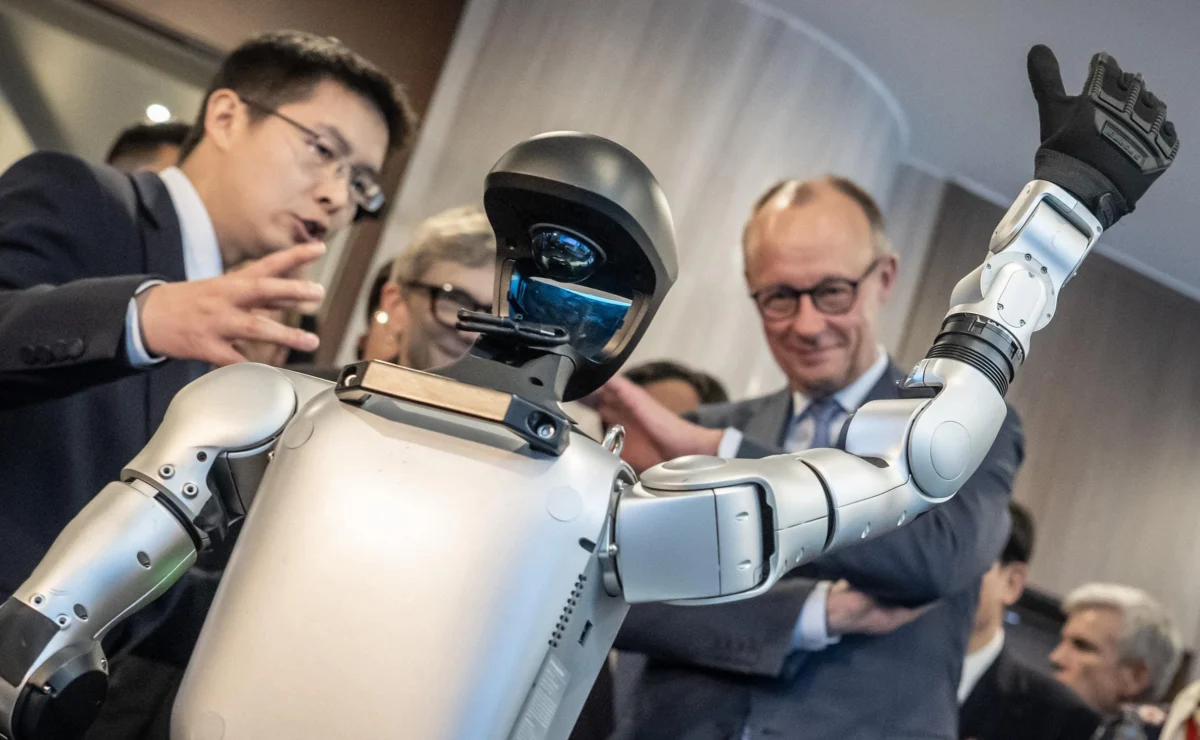
The landscape of global technology is often defined by "iPhone moments"—singular points in time where a nascent technology matures into a commercial juggernaut. In the specialized yet rapidly accelerating field of humanoid robotics, that moment may well be centered on the Shanghai Stock Exchange. Unitree Robotics, the Hangzhou-based powerhouse that has become the face of China’s bipedal and quadrupedal ambitions, is currently finalizing an initial public offering (IPO) that does more than just inject capital into a balance sheet. It has minted the industry’s first "humanoid billionaire," 36-year-old founder and CEO Wang Xingxing, while simultaneously signaling a shift from experimental laboratory prototypes to mass-market industrialization.
The IPO filing reveals a company at a critical juncture. Unitree is seeking to raise approximately 6.1 billion yuan ($904 million) by offloading 40.4 million shares at a price of 150.8 yuan each. For Wang, who retains a significant stake in the enterprise he built from the ground up, this valuation translates to a personal fortune estimated at $2.4 billion. However, for the broader technology sector, the listing serves as a litmus test for whether the high-intensity hype surrounding general-purpose robots can survive the scrutiny of public markets and the pressures of a cooling global economy.
From DJI to the Frontier of Kinematics
Wang Xingxing’s trajectory is a testament to the specialized talent pipeline that has fueled China’s hardware dominance. Before founding Unitree in 2016, Wang spent a formative period at DJI, the world’s leading drone manufacturer. It was there that he likely absorbed the "DJI playbook": aggressive vertical integration, rapid iteration cycles, and a relentless focus on bringing down the cost of complex electromechanical systems.
When Unitree was established, the world’s eyes were largely on Boston Dynamics and its viral videos of robots performing backflips. Yet, while Western firms focused on high-cost, hydraulic-powered marvels intended for research or defense, Wang pivoted toward electric-motor-driven systems that could be manufactured at scale. Unitree’s early success was built on the "robot dog" or quadrupedal platform. These machines, such as the Go1 and the later B2 models, became ubiquitous in tech demos and research labs worldwide due to their affordability. By the time of its IPO filing, Unitree had sold over 33,000 quadruped units, a figure that dwarfs most of its global competitors and provided the cash flow necessary to fund the more ambitious leap into humanoids.
The Humanoid Pivot and the Spring Festival Milestone
The transition from four legs to two is not merely a change in form factor; it is an exponential increase in algorithmic and mechanical complexity. Humanoids require sophisticated balance, high-torque actuators in compact spaces, and "dexterous hands" capable of interacting with a world designed for humans. Unitree’s entry into this space was aggressive. The company’s 2025 revenue surge of over 300%—reaching 1.7 billion yuan—was driven largely by its ability to productize humanoids at a price point that was previously unthinkable.
With an average selling price of 166,400 yuan (approximately $23,000), Unitree’s humanoids are positioned not as luxury research toys, but as potential tools for light manufacturing, logistics, and eventually, domestic service. This commercial viability was validated on the grandest possible stage during China’s 2025 Spring Festival Gala. The sight of a troupe of humanoid robots performing synchronized martial arts and running with fluid, human-like gates was more than entertainment; it was a declaration of industrial intent.
This cultural moment coincided with high-level political backing. In early 2025, Wang was invited to consult with top Chinese leadership, including President Xi Jinping, alongside other tech luminaries like Jack Ma and DeepSeek’s Liang Wenfeng. In the context of the ongoing technological "Cold War" with the United States, humanoid robotics has been identified by Beijing as a "future industry" equivalent in strategic importance to semiconductors and artificial intelligence.
The GD01: A Glimpse into the "Mecha" Future
While the industry focuses on utility, Unitree has also shown a penchant for the spectacular. The launch of the GD01—a transformable, three-meter-tall robot capable of carrying a human pilot—captured the public imagination and dominated social media discourse. Priced at $650,000, the GD01 is less a mass-market product and more a demonstration of Unitree’s engineering "flex." It showcases the company’s ability to handle massive payloads, complex transformable joints, and sophisticated pilot-interface software. More importantly, it signals Wang’s vision: that robots are not just autonomous tools, but extensions of human capability that can operate in environments too hazardous or complex for unassisted personnel.
Financial Realities and the "Red Ocean" of 2026
Despite the meteoric rise, the IPO prospectus highlights the growing pains of a maturing sector. While 2025 was a year of unbridled growth, the first quarter of 2026 showed signs of a "margin squeeze." Revenue growth, while still a healthy 68.5% year-on-year, has slowed compared to the triple-digit explosions of the previous year. More concerning to some analysts is the 52.6% drop in net profit during the same period.
This profitability dip is the result of two converging forces: skyrocketing R&D costs and a brutal domestic price war. As of mid-2026, China is home to over 200 humanoid robot manufacturers. Competitors like AgiBot and AI² Robotics are nipping at Unitree’s heels, often backed by significant venture capital and eyeing their own public listings in Hong Kong. This "Red Ocean" environment—a term used to describe a market crowded with competitors fighting over the same territory—is forcing Unitree to spend more on marketing and research to maintain its lead. The company has already warned investors that it may need to further slash prices to protect its market share, a move that could jeopardize short-term earnings in favor of long-term dominance.
Geopolitical Headwinds: The Trump Administration Ban
Perhaps the most significant threat to Unitree’s global ambitions lies not in the lab, but in Washington D.C. In July 2026, the Trump administration announced a sweeping ban on the import of new Chinese humanoid and quadruped robots, citing national security concerns. The rationale is centered on the dual-use nature of the technology; a robot that can carry a package in a warehouse can, in theory, be repurposed for battlefield logistics. Furthermore, concerns regarding the data collected by these robots’ arrays of Lidar and vision sensors have made them a target for trade restrictions.
For Unitree, which generated over 10% of its sales from the U.S. market in 2025, this is a significant blow. While the ban currently applies to "new" models, requiring a complex and uncertain federal approval process for future iterations, the chilling effect on American enterprise adoption is undeniable. This creates a bifurcated global market where Chinese firms dominate the domestic and "Global South" markets, while Western firms like Tesla (with Optimus) and Boston Dynamics (now owned by Hyundai) consolidate their hold on North America and Europe.
The Road Ahead: From "Sim-to-Real" to General Intelligence
As Unitree prepares for its Shanghai debut, the focus of its engineers is shifting from hardware to "embodied AI." The next frontier is the "Sim-to-Real" gap—the difficulty of training a robot in a digital simulation and having it perform flawlessly in the messy, unpredictable real world. Unitree’s prospectus emphasizes that a significant portion of the IPO proceeds will be channeled into refining software algorithms and Large Behavior Models (LBMs).
The goal is to move beyond pre-programmed movements toward true general-purpose intelligence. If a Unitree robot can eventually be told to "clean the kitchen" or "sort these mismatched components" without specific step-by-step coding, the addressable market moves from the billions into the trillions.
Conclusion: A High-Stakes Bet on the Future of Labor
The Unitree IPO is more than a financial milestone for Wang Xingxing; it is a coming-of-age for an entire class of technology. By transitioning from a private, venture-backed startup to a public entity, Unitree is inviting the world to bet on a future where mechanical labor is as ubiquitous as electricity.
The challenges are formidable: a domestic market nearing saturation, a geopolitical landscape fraught with hostility, and the inherent difficulty of making machines that can truly replicate the nuance of human movement. However, if Unitree can leverage its new capital to maintain its price advantage while cracking the code of embodied AI, it may not just be creating billionaires—it may be rewriting the rules of the global economy. For now, the eyes of the tech world remain fixed on Shanghai, waiting to see if the "Unitree model" can provide a sustainable blueprint for the age of the humanoid.
