

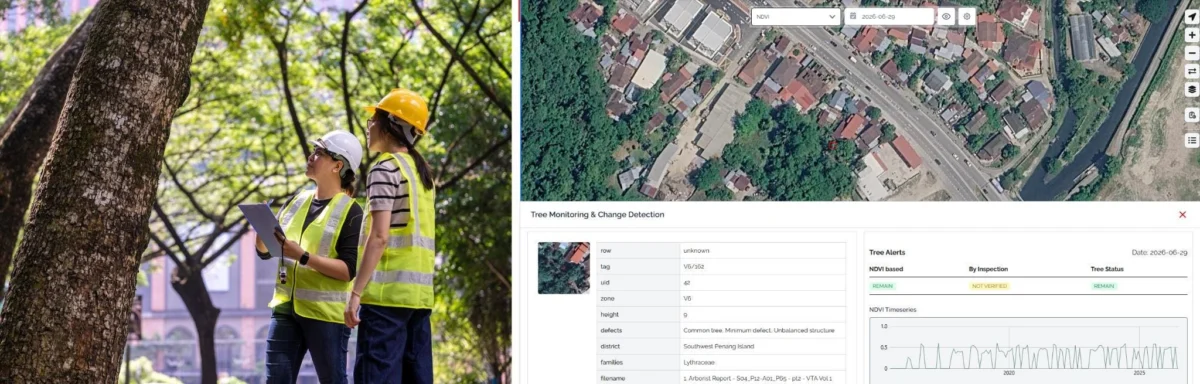
In the dense urban fabric of Penang, Malaysia, a 27-kilometer railway alignment serves as a microcosm for one of the most significant challenges in modern civil engineering: the friction between massive infrastructure development and environmental preservation. For decades, the construction industry has operated on a "react-and-report" basis, where environmental impact was measured through periodic site visits and retrospective documentation. However, as global climate goals tighten and the "Nature Positive" movement gains momentum, this manual approach is no longer sufficient. When a team of engineers is tasked with monitoring more than 3,000 individual trees—ranging from heritage specimens to mature roadside canopies—the traditional method of sending arborists on monthly site walks becomes a logistical bottleneck. It is labor-intensive, prone to human error, and, most importantly, provides only a snapshot in time rather than a continuous stream of actionable intelligence.
Recognizing this inefficiency, Gamuda, a global infrastructure and construction powerhouse, has pivoted toward a tech-driven model of environmental accountability. By transitioning from manual field inspections to a centralized digital dashboard, the company is not merely digitizing records; it is evolving the very rules of how construction firms interact with the ecosystems they inhabit. Through the use of Normalized Difference Vegetation Index (NDVI) analysis and real-time change detection, what was once a grueling physical task has been transformed into a data-driven operation accessible from a laptop screen. This shift marks a broader industry trend where "sustainability" is moving away from being a corporate social responsibility (CSR) narrative and toward becoming a core engineering discipline.
The Structural Gap in ESG Reporting
The impetus for this digital evolution was born from a realization that hit many large-scale developers in the early 2020s. As the global investment community—particularly in the U.S., U.K., and Australia—began demanding more rigorous Environmental, Social, and Governance (ESG) disclosures, companies found that their internal data systems were ill-equipped for the task. When Gamuda first engaged with the Dow Jones Sustainability Index (DJSI) assessment, the team encountered a series of granular questions regarding biodiversity and real-time impact that simply could not be answered with traditional reporting methods.
The problem was structural. Most ESG frameworks assume the existence of high-fidelity, operational data that can be verified on the ground. Yet, for most of the construction industry, reporting remained a form of historical record-keeping rather than an instrument of progress. As Ong Jee Lian, Gamuda’s Group Chief Communications and ESG Officer, aptly noted, there is a fundamental difference between recording what happened and measuring what is happening. Without real-time updates and a reliable audit trail, sustainability efforts remain defensive and retrospective. To bridge this gap, Gamuda developed SIGMA (Sustainability Information Management & Analytics), a platform designed to turn raw environmental data into strategic decisions.
SIGMA: A Multi-Layered Approach to Accountability
The SIGMA platform represents a departure from the "box-ticking" culture of compliance. It integrates two high-tech pillars that provide a level of visibility previously impossible in large-scale construction: satellite-based geospatial monitoring and Environmental DNA (eDNA).
The geospatial component utilizes satellite imaging integrated with Geographic Information Systems (GIS) and Google Earth Engine. This allows for continuous surveillance of project corridors, even in the most remote regions of Perak and Sabah. In these densely forested areas, manual surveys are not only slow but can be dangerous and imprecise. Satellite-based NDVI analysis allows engineers to monitor the health of vegetation by measuring how plants reflect or absorb different wavelengths of light. A drop in NDVI levels can serve as an early warning system, indicating environmental stress or unauthorized disturbance long before a human inspector would notice it on the ground.
Complementing this "eye in the sky" is the "fingerprint in the water"—eDNA technology. Traditionally, biodiversity surveys required physical trapping, sightings, or acoustic monitoring, all of which are time-consuming and often miss elusive or nocturnal species. eDNA works by analyzing genetic traces left by organisms in soil or water samples. This method is 30% to 50% more cost-efficient than traditional surveys and offers a far more comprehensive picture of local biodiversity.
In one notable project, eDNA findings revealed the presence of species that had previously gone unrecorded in the area. This discovery was not just a scientific win; it had immediate engineering implications. The data prompted a redesign of wildlife crossings and construction schedules to mitigate impact on these specific populations. This is the essence of precision ecology: using genetic data to inform the placement of concrete and steel.

Scaling Sustainability Through the Supply Chain
One of the most significant hurdles in the "Green Transition" of the construction sector is the fragmentation of the supply chain. While a multi-billion-dollar firm like Gamuda has the resources to invest in satellite imagery and genetic sequencing, the Small and Medium Enterprises (SMEs) that make up 90% of the Malaysian business landscape often do not. If the lead contractor is the only one with a digital ESG framework, the overall project’s accountability is only as strong as its weakest link.
To solve this, Gamuda has taken the unusual step of extending free access to its digital sustainability platform to its supply chain partners. By embedding ESG requirements into contracts and providing the tools to meet them, the company is effectively upskilling an entire ecosystem of subcontractors. This democratization of data ensures that ESG-related information is captured in a standardized, auditable form across the entire project lifecycle. It moves the industry closer to a "Digital Twin" model for the environment, where every cubic meter of earth moved is tracked against its ecological cost in real-time.
The Financial Imperative of Verifiable Data
The shift toward high-tech environmental monitoring is not solely driven by ecological altruism; it is an economic necessity. In the modern financial landscape, the cost of capital is increasingly linked to ESG performance. Banks and institutional investors now view environmental risk as a material financial risk. A project that lacks demonstrable, verifiable risk management is a project that carries a higher risk premium.
Gamuda’s commitment to data rigor—evidenced by its six consecutive years of independent climate disclosures aligned with the Taskforce on Climate-related Financial Disclosures (TCFD)—has earned it a Morgan Stanley Capital International (MSCI) AA rating. Furthermore, it is the only Malaysian company in its sector to have its emissions targets validated by the Science Based Targets initiative (SBTi). These are not just badges of honor; they are financial assets that add value for clients and lenders alike.
The company’s role as a pilot participant in the "A LEAP for Nature" initiative—a collaboration between Bank Negara Malaysia, the World Bank Group, and the UNDP—further underscores the growing convergence between high finance and high-tech conservation. The initiative uses the TNFD (Taskforce on Nature-related Financial Disclosures) framework to help financial institutions understand how nature loss affects the economy. By providing real-world data from its construction sites, Gamuda is helping to create the benchmarks that will eventually govern how all infrastructure projects are funded.
The Future: Transparency as a Standard
As we look toward the next decade of infrastructure development, the "rules of the game" are being permanently altered. We are moving toward a future where "real-time transparency" will be a standard requirement in every government tender and private contract. The era of the glossy, annual sustainability report is giving way to the era of the live dashboard.
The implications for the global construction industry are profound. Companies that fail to invest in geospatial intelligence and biometric monitoring will find themselves locked out of high-value markets. Conversely, those that embrace these tools will find new opportunities not just in construction, but in "ecosystem services"—the active restoration and management of the environments they once merely built upon.
Ultimately, the evolution of environmental accountability is about moving from observation to verification. When we can track a single tree from a laptop and identify a marine species from a liter of water, we remove the ambiguity that has long shielded the construction industry from its ecological responsibilities. The data does not just tell us what we have lost; it tells us what we can save, and more importantly, how to build a world where progress and preservation are no longer in conflict. In the heart of Penang and the forests of Sabah, the blueprint for the future is being drawn—not in ink, but in data.
