

SAN FRANCISCO — In a bid to shatter Nvidia’s near-monopolistic grip on the artificial intelligence infrastructure market, Advanced Micro Devices (AMD) has unveiled its most ambitious hardware architecture to date: Helios, an ultra-dense, rack-scale computing platform engineered explicitly to power the next generation of frontier AI models.
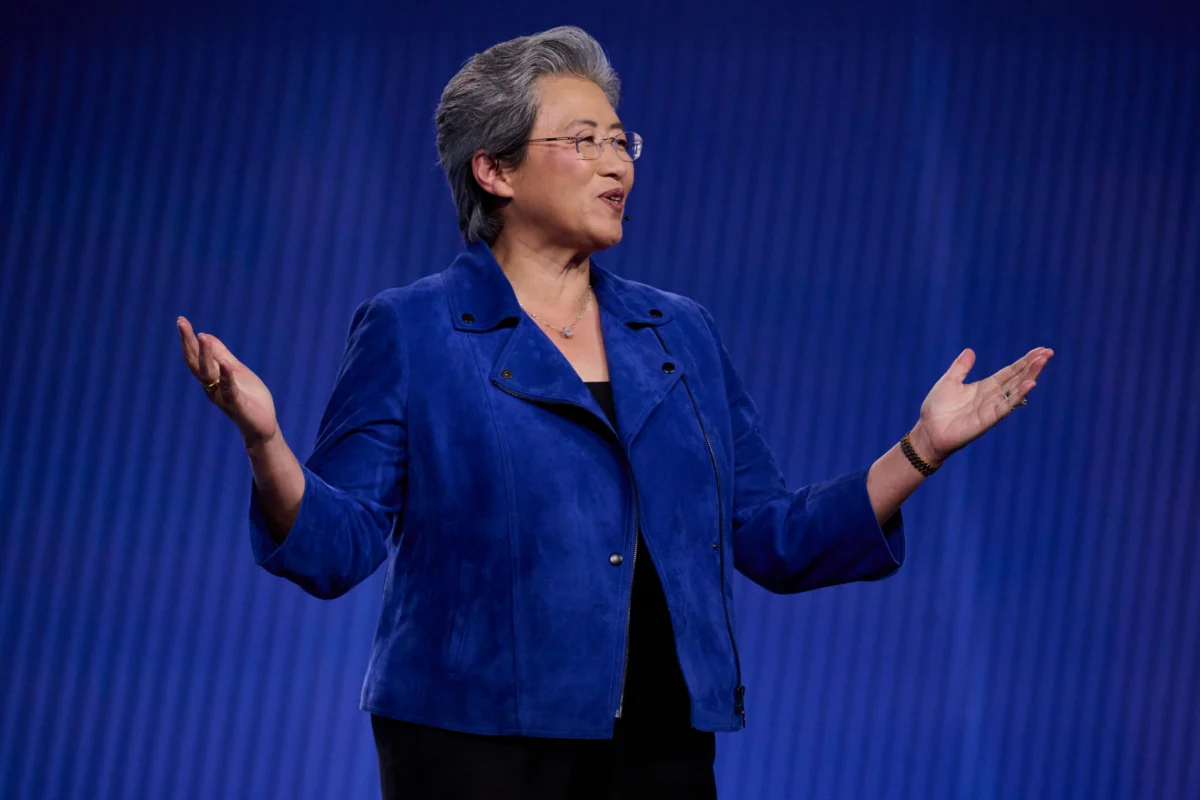
Speaking before a packed audience at the company’s annual Advancing AI conference in San Francisco, AMD Chair and Chief Executive Officer Dr. Lisa Su presented the Helios platform as a cornerstone of the enterprise data center’s future. Capable of scaling to multi-gigawatt installations, Helios represents a decisive pivot in AMD’s enterprise strategy. Rather than selling standalone graphics processing units (GPUs) or central processing units (CPUs), the semiconductor designer is now delivering fully integrated, system-level architecture designed to solve the immense thermal, bandwidth, and computational bottlenecks plaguing top-tier artificial intelligence laboratories worldwide.
The rollout comes at a critical juncture for the tech sector. As frontier AI models transition from simple conversational agents to complex autonomous systems capable of deep multi-step reasoning, the hardware requirements powering these platforms are expanding exponentially. By shipping Helios later this year, AMD is offering hyper-scalers and research institutions an immediate, high-performance alternative to Nvidia’s flagship compute clusters.
The Paradigm Shift to Rack-Scale Architecture
For years, the battle for semiconductor supremacy was fought at the chip level, measured in transistor counts, die sizes, and clock speeds. However, the sheer scale of modern artificial intelligence training and inference workloads has rendered individual chip metrics insufficient. Contemporary AI clusters require tens of thousands of interconnected processors working in tight synchronization, creating severe networking, power distribution, and memory access challenges.
Rack-scale computing addresses these physical limits by treating an entire cabinet of server blades, interconnect fabrics, liquid cooling conduits, and power distribution units as a single cohesive processing engine. By tightly coupling accelerators, CPUs, and high-bandwidth memory (HBM) over unified fabric topologies, rack-scale systems minimize latency and maximize energy efficiency—two factors that dictate the viability of modern data centers.
AMD’s Helios architecture is built specifically to compete in this high-density environment. Engineered around the company’s latest Instinct MI450 series accelerators, Helios clusters integrate cutting-edge memory bandwidth and low-latency interconnects, enabling vast arrays of GPUs to function as a unified compute node.
In her keynote address, Su described Helios as the tech industry’s "highest-performance AI rack," asserting that its architectural framework was purposefully designed to train and execute the world’s most complex artificial intelligence models at unprecedented scale.
Crucially, preliminary performance assessments suggest AMD’s engineering strategy is yielding tangible results. According to industry analyses and technical benchmarking reports, Helios demonstrates competitive superiority over Nvidia’s current Vera Rubin and Grace Blackwell platforms across several key computational and memory throughput metrics. By offering higher memory capacity per node and optimized power utilization profiles, AMD is targeting the precise operational pain points currently confronting data center architects.
Hyperscale Validation: Microsoft, Anthropic, and the Multi-Gigawatt Push
The commercial viability of any new data center hardware hinges on adoption by hyperscalers—the handful of technology giants that control global cloud infrastructure and fund the world’s largest AI research labs. In a stark demonstration of market momentum, AMD confirmed that several of the industry’s most prominent players have committed to integrating Helios into their production environments, including OpenAI, Meta, Oracle, Anthropic, and Microsoft.
The depth of these commitments underscores a growing desire among hyper-scalers to diversify their hardware supply chains and reduce their exposure to Nvidia’s persistent supply constraints.
Microsoft, which has invested heavily in expanding its global Azure footprint, confirmed plans to deploy Helios systems across its cloud data centers. Microsoft Chief Executive Officer Satya Nadella affirmed that integrating AMD’s rack-scale systems into Azure will provide customers with greater flexibility and compute density, particularly as enterprise demand for large-scale AI applications continues to outstrip available capacity.
Simultaneously, AI safety and research pioneer Anthropic announced a major strategic partnership with AMD. Under the agreement, Anthropic will deploy up to two gigawatts of computing power driven by AMD Instinct MI450 series GPUs housed within Helios rack systems. A deployment of this magnitude represents a massive vote of confidence in AMD’s hardware and software stack, signaling that non-Nvidia hardware can reliably handle the heaviest training workloads in the industry.
The Silicon Roadmap: Venice-X and the Evolution of Zen 6
While Helios dominated the immediate hardware spotlight, AMD also provided a detailed look into its long-term enterprise silicon pipeline, introducing the Venice-X processor scheduled for commercial release in 2027.
Designed for high-performance computing (HPC) and data center management, Venice-X is built upon AMD’s upcoming Zen 6 microarchitecture. The processor is engineered to deliver exceptional serial and parallel compute capabilities, featuring 96 high-performance cores, boost clock speeds reaching up to 5.15 GHz, and an unprecedented 1,152 megabytes of stacked 3D V-Cache memory.
The introduction of Venice-X highlights an essential, often overlooked dynamic in modern AI infrastructure: the co-dependent relationship between CPUs and GPUs. While GPUs perform the heavy matrix math required for deep learning, host CPUs are critical for orchestrating data pipelines, managing host-to-device memory transfers, handling non-vectorized algorithmic tasks, and maintaining system security.
By pairing future iterations of Helios with advanced server processors like Venice-X, AMD aims to eliminate systemic bottlenecks, ensuring that ultra-fast GPUs are never starved of data by lagging CPU host subsystems.
The Rise of Agentic AI and the $1.4 Trillion Horizon
The aggressive hardware investments championed by AMD are driven by a fundamental shift in how artificial intelligence software operates. The tech industry is currently transitioning away from traditional static models—which simply predict the next word in a sequence—toward "agentic AI."
Agentic systems are designed to operate autonomously, executing complex, multi-step workflows to solve non-trivial problems. An agentic model does not merely generate a response; it formulates a multi-part plan, writes and tests code, queries databases, calls external software APIs, evaluates intermediate outcomes, and iteratively corrects its own mistakes until a task is completed.
This iterative, loop-based execution model fundamentally alters data center compute economics. Where a simple query to a standard LLM might consume a fraction of a cent in power and compute time, an autonomous agent working through a multi-step task can require hundreds or thousands of sequential inference steps, dramatically increasing the load on underlying accelerator arrays.
"When you ask the agent to do something, it actually has dozens of steps," Su explained during her presentation. "It has to reason, it has to call tools, it has to access data, and it has to keep doing it over and over until it solves the problem. You need lots of GPUs to do all that."
This fundamental evolution in software design underpins AMD’s explosive growth projections for the semiconductor industry. Su revealed that AMD now expects the global market for AI accelerators to reach approximately $1.4 trillion by the year 2030. Should that forecast materialize, the specialized market for AI chips alone will approach the monetary value of the entire global semiconductor market today.
Furthermore, Su emphasized that programmable GPUs will remain the dominant hardware paradigm within this trillion-dollar ecosystem, far outstripping application-specific integrated circuits (ASICs) or dedicated fixed-function chips. Because artificial intelligence algorithms, neural network topologies, and mathematical frameworks are evolving at a breakneck pace, data center operators require flexible, fully programmable hardware capable of adapting to software shifts via firmware and compiler updates.
Strategic Implications for the Semiconductor Landscape
AMD’s aggressive push into full-rack systems like Helios signifies a deeper maturity in the competitive landscape for high-performance computing. Historically, enterprise adoption of AMD GPUs was hindered by software maturity, as Nvidia’s proprietary CUDA software platform created a formidable moat that locked developers into the Nvidia hardware ecosystem.
However, through sustained investment in its open-source ROCm software stack, co-designed software compilers, and direct partnerships with major AI frameworks like PyTorch and TensorFlow, AMD has steadily eroded CUDA’s competitive advantage. Modern frontier models are increasingly abstracted away from underlying low-level hardware languages, allowing developers to train and deploy complex models on AMD silicon with minimal code modification.
Furthermore, the physical realities of the current tech boom—specifically electrical grid capacity, power distribution limits, and facility cooling constraints—are forcing hyperscalers to prioritize compute density and total cost of ownership (TCO). A rack-scale architecture that delivers superior memory bandwidth and computational output per megawatt of power offers immediate financial and operational advantages to enterprise operators struggling to secure raw electrical capacity for their facilities.
As Helios prepares to ship to major cloud partners and enterprise facilities in the coming months, the semiconductor industry stands at the threshold of a new era. AMD’s transition from a secondary chip vendor to an architecture-defining leader in rack-scale systems ensures that the race for artificial intelligence dominance will no longer be a one-company show. With multi-gigawatt deployments on the immediate horizon and a $1.4 trillion market target set for 2030, the battle for the core engine of the global digital economy has truly begun.
