

For decades, the field of observational astronomy has grappled with an unrelenting physical obstacle: host stars are blindingly bright, while the planets orbiting them are astonishingly faint. Direct imaging of exoplanets—capturing actual photons originating from or reflecting off worlds outside our solar system—has consequently been restricted to extreme, atypical systems. Astronomers have predominantly photographed young, self-luminous gas giants several times the size of Jupiter, situated hundreds of astronomical units away from their stars, where the stellar glare is minimally intrusive.
That technological ceiling is about to shatter. With the upcoming launch of NASA’s Nancy Grace Roman Space Telescope, space-based astronomy is preparing to deploy a transformational optical payload: the first space-borne active coronagraph. Utilizing a combination of deformable, shape-shifting mirrors, high-density actuator arrays, and photon-trapping nanostructures, this instrument is designed to actively cancel out scattered starlight in real time. By achieving unprecedented levels of starlight suppression, the mission aims to capture direct images of mature, cool gas giants—true Jupiter analogues—and establish the engineering foundation required to eventually discover Earth-like worlds.
The Physics of Starlight Suppression: Passive vs. Active Coronagraphy
To appreciate the leap forward represented by the Nancy Grace Roman Space Telescope, one must understand why direct imaging of planetary systems is inherently difficult. In an optical system, light passing through an aperture undergoes diffraction, creating complex wave patterns that scatter photons across the focal plane. Furthermore, microscopic imperfections in primary and secondary mirrors, subtle thermal expansions of spacecraft components, and mechanical jitter introduce phase errors into the incoming light waves.
In conventional space observatories like the Hubble Space Telescope and the James Webb Space Telescope (JWST), coronagraphs operate passively. They rely on stationary physical masks placed directly in the optical path to block the central core of a star’s light cone. While highly effective, passive coronagraphy suffers from speckle noise—stray photons that leak around mask edges or scatter off microscopic optic flaws. These optical speckles can easily mimic the faint point-source signal of an exoplanet or hide it entirely within a shroud of light. Observing a dim exoplanet with a passive coronagraph is akin to holding a finger up to block a powerful stadium searchlight while searching for a firefly hovering inches from the bulb; the primary beam may be obscured, but the ambient glare remains overwhelming.
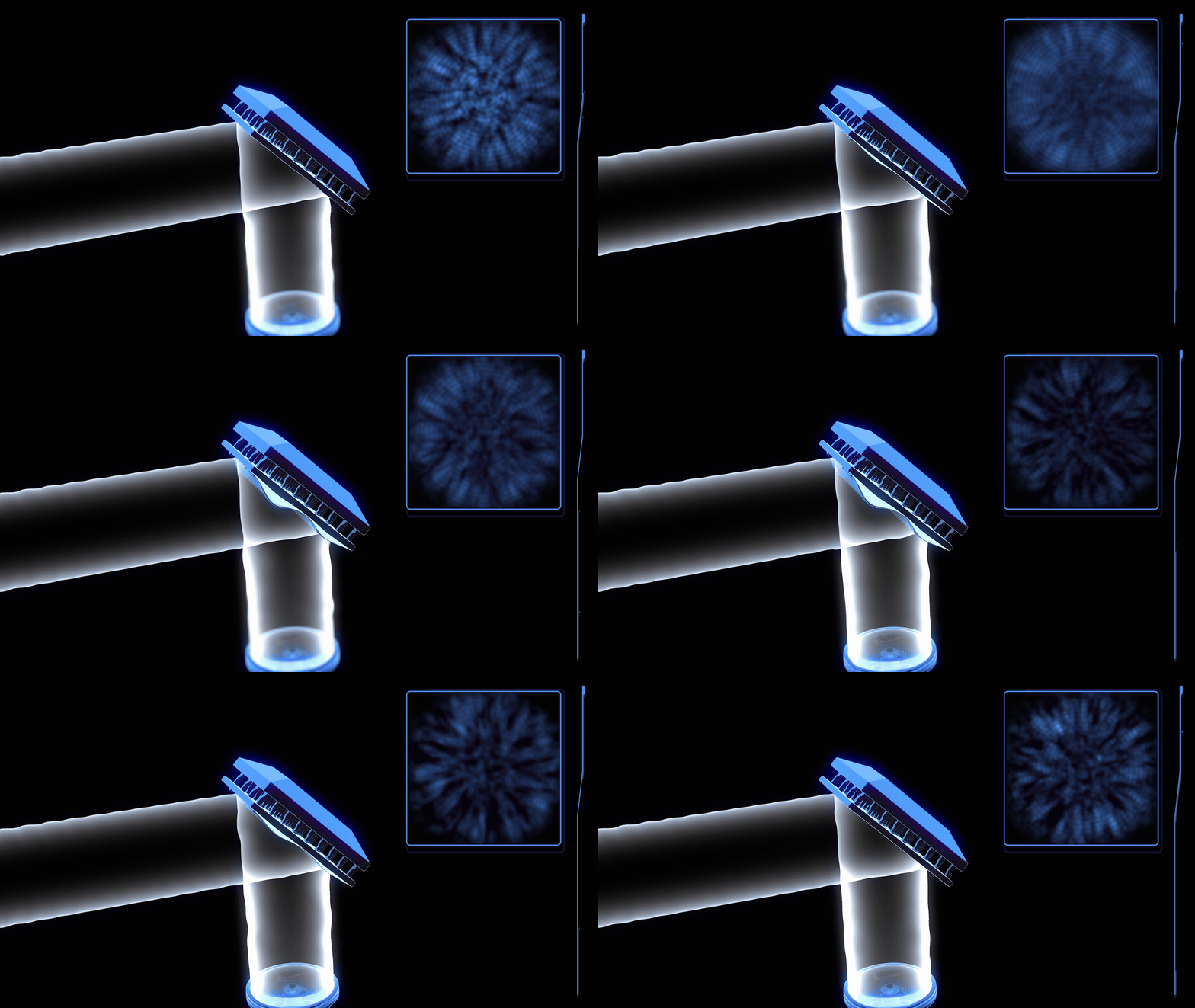
The Roman Space Telescope’s Coronagraph Instrument (CGI) solves this challenge through active wavefront control. Rather than relying solely on static blocking masks, CGI dynamically measures the exact phase and amplitude distortions of incoming light waves and actively alters the optical path to neutralize them.
At the center of this capability are two state-of-the-art deformable mirrors. Positioned beneath the ultra-thin glass substrate of each mirror is a 48-by-48 grid of piezoceramic actuators, yielding a total of 2,304 tiny mechanical pistons per mirror. By applying precise electrical voltages to individual actuators, engineers can pull or push micro-sections of the mirror surface backward and forward with sub-nanometer accuracy.
The mechanical precision required for this operation borders on the atomic scale. Each mirror segment can deform by up to 0.5 micrometers—a fraction of the width of a single bacterial cell—with positional adjustments made in increments as small as 10 picometers. To put this in perspective, 10 picometers is roughly one-tenth the diameter of an individual hydrogen atom. By sculpting the surface of the mirrors with this hyper-fine granularity, CGI creates an inverse optical phase shift. The light waves reflecting off the deformed mirror interfere destructively with the incoming stray starlight, canceling out unwanted photons much like active noise-canceling headphones neutralize ambient acoustic noise.
Microscopic Forests and the Dark Hole Effect
The destructive interference generated by CGI’s active wavefront control produces a designated observational region surrounding the host star known as the "dark hole" or "dark doughnut." Within this highly controlled optical zone, incoming starlight is suppressed by a factor up to 1,000 times greater than what is achievable with current space-based coronagraphs.
To augment this active optical canceling, CGI incorporates a sophisticated suite of passive masks engineered with advanced materials science. Principal among these is an optical trap constructed from "silicon grass"—a dense, vertically aligned thicket of microscopic silicon spikes etched onto mask substrates. When scattered photons strike this nanostructured surface, they do not reflect clean wavefronts back into the optical assembly. Instead, the photons bounce recursively between the micro-blades, losing kinetic energy with each impact until they are absorbed completely. This photon-trapping architecture ensures that stray light originating from the internal mechanical components of the telescope is prevented from reaching the ultra-sensitive camera detectors.
Through this multi-stage setup—combining active deformable mirrors, destructive phase interference, and photon-trapping masks—the telescope guides the rare, uncancelled photons reflected off orbiting exoplanets directly onto its science sensors.
Unveiling Mature Planets: The Shift to Reflected Starlight
This technological capability will fundamentally alter the scope of exoplanet characterization. Historically, direct imaging has favored exoplanets that are young, hot, and highly luminous in infrared wavelengths. These nascent worlds retain immense heat from their gravitational accretion, emitting their own thermal radiation and allowing astronomers to detect them despite nearby stellar interference.
However, the vast majority of mature planetary systems—including our own Solar System—consists of older planets that have cooled over billions of years. A planet like Jupiter does not shine brightly through thermal emission; rather, it is visible because its atmosphere reflects light emitted by the Sun.
Until now, detecting mature Jupiter analogues around distant stars has relied almost exclusively on indirect observational methods. Techniques such as radial velocity measure the microscopic wobble a planet’s gravity exerts on its host star, while the transit method detects the minute dip in stellar brightness when a planet passes in front of its star’s disk. While these indirect methods have revealed thousands of exoplanetary candidates, they do not gather direct light from the planets themselves.
The Roman Space Telescope’s active coronagraph changes this equation entirely. By collecting reflected starlight directly from gas giants orbiting sunlike stars at realistic planetary distances, astronomers will no longer have to rely solely on inferring a planet’s properties from its star. Direct photon capture allows for spectroscopic analysis—breaking the reflected light down into its component wavelengths to decipher the chemical composition, cloud structure, and atmospheric dynamics of mature gas giants.
While the resulting images will not resemble high-resolution orbital photographs—appearing instead as localized clusters of pixels—the spectroscopic data contained within those pixels is profound. Analyzing the absorption signatures of water vapor, methane, ammonia, and other chemical compounds enables researchers to model planetary atmospheres with high fidelity, turning faint dots of light into fully characterized worlds.
Macro-Surveys and Big Data Astrophysics
Although the active coronagraph serves as Roman’s primary technological flight demonstrator, it represents only one facet of the observatory’s scientific mission. The spacecraft is also equipped with a massive 300-megapixel Wide Field Instrument (WFI).
WFI provides a field of view roughly 100 times larger than that of the Hubble Space Telescope’s primary cameras while maintaining equivalent spatial resolution. This massive optical scope will allow the telescope to conduct unprecedented statistical surveys of the cosmos, investigating the nature of dark energy, mapping the large-scale distribution of dark matter, and conducting comprehensive gravitational microlensing surveys. Through microlensing alone—detecting how the gravitational field of a foreground star and its planets bends and magnifies the light of a background star—Roman is projected to discover over 100,000 exoplanets.
This dual capability creates a comprehensive astrophysical pipeline. While the Wide Field Instrument executes a vast census of the galaxy, identifying planetary distribution trends across thousands of star systems, the Coronagraph Instrument will perform targeted, high-contrast observations of specific nearby stars.
The sheer volume of high-resolution data generated by these combined instruments will require new data-processing pipelines, machine-learning algorithms for signal extraction, and decades of international scientific collaboration. The mission marks a definitive transition in observational astronomy from analyzing small target samples to processing global, galactic-scale datasets.
Industry Implications and the Path to Earth 2.0
Beyond its immediate scientific returns, the active coronagraph aboard the Nancy Grace Roman Space Telescope serves a critical strategic role for the future of space exploration. It is an explicit technology pathfinder for NASA’s proposed Habitable Worlds Observatory (HWO)—a flagship mission concept targeted for the late 2030s or early 2040s designed specifically to search for biosignatures on Earth-like worlds.
Directly imaging an Earth analogue in the habitable zone of a Sun-like star requires a starlight suppression contrast ratio of 1 in 10 billion ($10^-10$). Achieving such extreme contrast is physically impossible with passive optical systems. The micro-actuator control networks, active wavefront algorithms, and thermal stability techniques validated by Roman’s CGI represent the essential baseline technologies necessary to prove that active optical cancellation can operate reliably in the space environment.
For the aerospace engineering and optical manufacturing sectors, the deployment of space-qualified deformable mirrors with picometer-level control marks a milestone in precision engineering. The lessons learned from building, testing, and flying high-density actuator arrays in deep space will directly inform the next generation of space telescopes, defense satellite systems, and terrestrial adaptive optics.
When the first direct images from Roman’s active coronagraph reach Earth, the achievement will lie not just in the bright pixels representing distant gas giants, but in the engineered darkness surrounding them. By proving that human engineering can dynamically silence the blinding light of stars, the mission takes a decisive, indispensable step toward answering one of humanity’s oldest questions: whether our planet, and our solar system, are unique in the cosmos.
