


Abbott Laboratories, a global titan in the medical technology and diagnostics sector, is currently navigating a complex cybersecurity crisis. The company has publicly acknowledged two distinct digital security breaches that have prompted internal investigations, external expert engagement, and coordination with law enforcement agencies. These incidents, which surfaced mid-July 2026, highlight the increasing vulnerability of large-scale healthcare enterprises to sophisticated extortion syndicates and targeted reconnaissance operations.
The Anatomy of the Cancer Diagnostics Intrusion
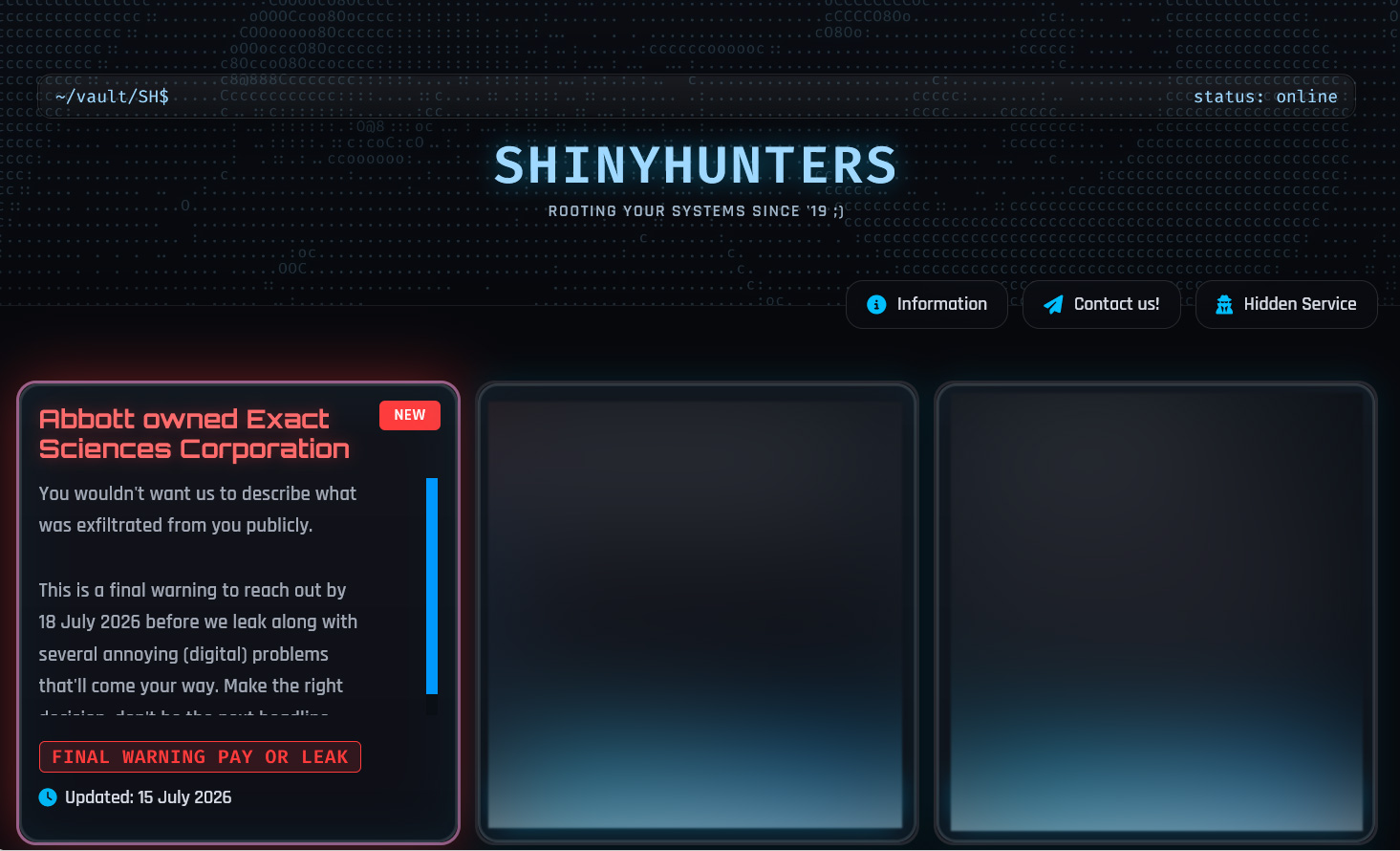
The first incident centers on unauthorized access to legacy systems previously associated with the Exact Sciences business unit, now under the Abbott corporate umbrella. The breach gained international attention when the notorious threat actor group known as "ShinyHunters" listed Abbott on their digital extortion portal. The group initially set an ultimatum, threatening to leak sensitive exfiltrated data if their demands were not met by July 18, a deadline they later extended to July 21.
Abbott has officially confirmed the intrusion but has been quick to manage the narrative regarding the scope of the damage. According to a formal statement released by the company, the breach was confined to a restricted segment of its Cancer Diagnostics internal infrastructure. The company emphasized that this incident did not disrupt manufacturing, lab operations, product availability, or the essential care provided to patients. Abbott maintains that these legacy systems are siloed from its broader corporate network, effectively quarantining the threat.
However, the threat actors’ account of the intrusion suggests a more methodical approach. ShinyHunters claims to have gained initial access via a "vishing" (voice phishing) campaign conducted in mid-June. By manipulating employees into divulging credentials, the attackers allegedly compromised a Microsoft Entra single sign-on (SSO) account. This, they assert, provided the necessary "keys to the kingdom" to pivot into internal systems.

The Persistent Threat of SSO and SaaS Exploitation
The tactic described by ShinyHunters—exploiting SSO accounts—is a growing trend in the cyber-extortion landscape. By compromising a single point of authentication, threat actors can bypass traditional perimeter defenses and gain broad access to interconnected SaaS (Software as a Service) ecosystems. Once inside environments like Microsoft 365, Salesforce, or ServiceNow, attackers can conduct silent data exfiltration for extended periods.
ShinyHunters, in particular, has become a significant headache for the medical technology industry. The group has been linked to a series of high-profile breaches involving companies like Medtronic, OneMedical, and iRhythm. Their methodology often involves shifting from pure data theft to extortion, where the psychological pressure of public exposure is used to coerce payments. While the group claims to have obtained over 30 million rows of customer personally identifiable information (PII)—including Social Security numbers, medical orders, and doctor-patient communications—these claims remain unverified, serving as a reminder that threat actors often inflate the severity of their hauls to increase leverage during negotiations.
The LabCentral Portal Incident
While the company is managing the fallout from the ShinyHunters affair, a second, arguably more technically focused incident has emerged. A separate threat actor, operating under the alias "ShadowByt3$," claims to have breached the company’s "LabCentral" customer portal. This portal serves as a critical interface for the Core Laboratory diagnostics business, facilitating communication and information exchange with medical professionals and lab operators.
ShadowByt3$ claims that the breach occurred on July 4, 2026, and was facilitated by the exploitation of compromised customer credentials. According to the group, they identified a structural weakness in the environment that allowed for the gradual exfiltration of files via API endpoints. Unlike the ShinyHunters case, which focused on massive data dumps, this breach appears to have targeted proprietary intellectual property and technical documentation, including manufacturing certificates, regulatory filings, and complex assay files.
Abbott’s response to the LabCentral claims has been dismissive regarding the sensitivity of the data involved. The company maintains that the portal acts primarily as a repository for public-facing technical reference materials, such as manuals and troubleshooting checklists, and does not house proprietary business secrets or private patient records. This divergence in perspective—where the attacker claims a significant theft of IP and the company classifies the data as public-facing—is a common feature in modern corporate cyber-disputes, designed to minimize the perceived impact on stock value and regulatory standing.
Industry Implications and the Regulatory Landscape
The targeting of Abbott by two different groups within such a short timeframe underscores the heightened threat level facing the healthcare sector. Medical technology firms hold a unique position in the digital economy: they possess a wealth of sensitive patient data, essential intellectual property regarding life-saving treatments, and complex, often fragmented IT infrastructures. The transition from physical medical records to interconnected digital health systems has outpaced the security maturation of many legacy diagnostic platforms.
From an industry perspective, these incidents highlight a critical "legacy debt" problem. Large corporations frequently acquire smaller entities or utilize older software platforms to maintain continuity. These legacy systems, often lacking the advanced multi-factor authentication (MFA) and monitoring capabilities of modern cloud environments, become low-hanging fruit for attackers. When an attacker gains a foothold in an older, less-monitored system, they often find pathways to more secure, modern infrastructure.
Furthermore, the involvement of two different threat groups suggests that Abbott, like many large-scale global enterprises, is subject to near-constant reconnaissance. Whether the two incidents are coincidental or part of a coordinated effort remains to be seen, but the optics for the company are challenging. Security researchers note that in the era of "ransomware-as-a-service," the barrier to entry for these types of attacks has lowered significantly, allowing smaller, less organized groups to execute high-impact campaigns.

The Future of Corporate Incident Response
As the dust settles on these dual incidents, the industry will be watching to see how Abbott handles the forensic disclosure. There is a growing trend of "transparency-first" incident response, where companies provide granular detail regarding exactly what was taken and what was not. However, this is a delicate balance. Providing too much information can invite further extortion, while providing too little can erode customer trust and trigger regulatory scrutiny under frameworks like the GDPR or HIPAA.
The "vishing" element of the ShinyHunters attack also serves as a stark reminder that even the most robust technical defenses can be rendered useless by human error. Organizations are increasingly shifting their security budgets away from purely technical "hardened" perimeters toward advanced identity and access management (IAM) and continuous security awareness training for employees. The ability to detect an abnormal login attempt—even one using a valid SSO token—is now the primary defense against this new breed of extortionist.
Ultimately, these incidents at Abbott underscore a broader reality: in the current threat environment, the goal for a large corporation is no longer to be "unhackable," but to be "resilient." The company’s immediate activation of its incident response protocols, engagement with third-party security experts, and collaboration with law enforcement suggest a well-rehearsed plan. However, the potential for sensitive data to be leaked remains a lingering threat, and the reputational and financial ramifications of such breaches often extend far beyond the initial cleanup period.
As the digital transformation of healthcare continues to accelerate, the intersection of patient safety and cybersecurity will remain the most critical frontier. For Abbott, and for the industry at large, the lesson of July 2026 is clear: legacy systems require the same level of rigorous oversight and modern defense-in-depth strategies as the most cutting-edge, cloud-native platforms. Failure to recognize this parity leaves the door wide open for those who wish to monetize the vulnerability of the world’s most critical medical infrastructure.
