

The trajectory of artificial intelligence integration within consumer electronics continues its rapid ascent, and Google is making a significant strategic move by accelerating the deployment of advanced Gemini capabilities within its Google TV ecosystem. Following initial previews showcased earlier this year at the Consumer Electronics Show (CES), key feature sets—originally promised for the coming months—are now commencing their phased rollout, transforming the television interface from a simple content aggregator into a proactive, context-aware entertainment concierge. This evolution underscores a critical shift in how users interact with streaming platforms, moving beyond mere recommendations toward instantaneous, synthesized information retrieval directly on the primary viewing screen.
The core of this update centers on three specific functional enhancements designed to provide users with immediate, relevant supplementary content pertaining to whatever they are watching or searching for. These features, which began their deployment in the United States market immediately, aim to bridge the information gap that often exists between passive viewing and active curiosity. For instance, when a user is engrossed in a documentary about historical figures or a fast-paced sports match, the desire to instantly know more, check statistics, or understand context is a persistent friction point. Gemini is being deployed to eliminate this need to reach for a secondary device.
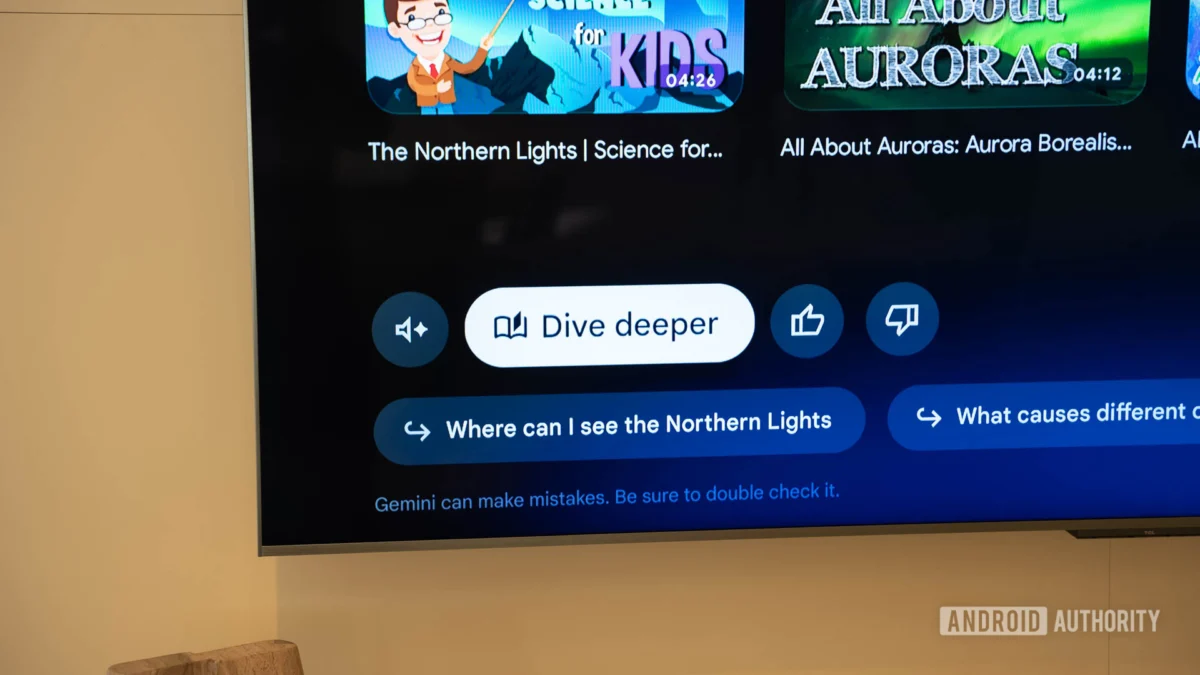
One of the most compelling additions is the introduction of "Deep Dives." This function is engineered to provide comprehensive, layered background information about the content currently on screen. If a viewer is watching a film featuring a specific architectural style, Gemini can instantly generate a summary or visual guide explaining that style. If the content references a complex political event, the Deep Dive feature can offer a curated, easily digestible explainer, drawing from Google’s vast knowledge graph. This moves beyond simple ‘trivia pop-ups’ often seen in older smart TV interfaces; it signifies generative AI synthesizing and presenting nuanced narrative context tailored to the real-time viewing experience.
Complementing this contextual depth is the rollout of "Sports Briefs." In an era where sports consumption is increasingly fragmented across live games, highlights, and historical analysis, Gemini is designed to serve up immediate, relevant sports data. If a user pauses a broadcast featuring a particular team or player, they can query the system for recent performance statistics, league standings, or even curated highlight reels aggregated from various sources. This feature is particularly powerful because it acknowledges the immediate, event-driven nature of sports fandom, offering utility right when the user is most engaged.
The third significant feature being activated focuses on "Richer Visual Help." While the specifics remain somewhat broad, this suggests an enhancement to how Gemini interacts with visual elements on screen, likely incorporating advanced image recognition and object identification. For example, a user might be able to ask, "What is the name of that actor in the background?" or "Where was this scene filmed?" and receive an immediate, visually supported answer overlayed onto the viewing experience. This level of interactivity begins to blur the lines between traditional television programming and interactive digital media, echoing concepts previously explored in experimental digital formats.
The immediate availability of these features in the US sets a high benchmark for the feature parity of the Google TV platform globally. For Canadian users, the rollout timeline is slightly staggered; while they gain access to the richer visual help immediately, the full suite of Deep Dives and Sports Briefs is scheduled to arrive later this spring. This minor delay suggests infrastructural or localized data integration dependencies that need final tuning before a full launch north of the border.
Beyond these specific feature rollouts, Google has confirmed a broader, strategic expansion for the Gemini voice assistant on Google TV. This indicates a commitment to making the conversational AI central to the operating system’s functionality, not just a bolted-on feature. The expansion is scheduled to commence this spring, targeting key English-speaking markets initially: Australia, New Zealand, and Great Britain. This phased international deployment is crucial, as it requires not only language adaptation but also the integration of locally relevant streaming services, sports leagues, and regional knowledge bases—a significant undertaking for any large-scale AI deployment.
Industry Implications: The Battle for the Living Room Operating System
The continuous enhancement of Gemini on Google TV is not merely an iterative software update; it represents a pivotal engagement in the ongoing technological competition for control of the living room operating system. For years, the battle has been waged between proprietary systems (like those from Apple and Amazon) and the more open, albeit fragmented, Android TV/Google TV ecosystem. By infusing Gemini’s advanced LLM capabilities directly into the platform, Google is attempting to create a significant moat against competitors like Roku and even the evolving interface layers on newer smart TVs from Samsung and LG.
The implication is clear: the value proposition of a TV platform is shifting from simply being a conduit for streaming apps to becoming an intelligent layer that enhances, organizes, and contextualizes the viewing experience. Competitors who rely on more basic search functions or static recommendation engines risk appearing archaic in comparison to an AI that can dynamically generate bespoke content summaries mid-stream. This move forces rivals to accelerate their own AI integrations, potentially leading to a rapid technological leap across the entire smart TV industry, akin to the shift seen when 4K became standard.
Furthermore, this positions Google TV uniquely against the Amazon Fire TV platform, which is also heavily investing in its own Alexa-powered AI. While Alexa excels in smart home control, Gemini’s strength lies in its deep integration with Google Search and its known proficiency in synthesizing complex, verifiable information—a key differentiator when dealing with educational or detailed sports content. If Gemini can prove more reliable and contextually aware than competing voice assistants in the living room setting, it could significantly boost Google TV’s market share, especially among users prioritizing information density alongside entertainment.
Expert Analysis: Moving Beyond Metadata
From a technological perspective, these updates signal Google’s success in overcoming a significant hurdle in TV AI: latency and integration fidelity. Traditional metadata retrieval is fast but limited. Conversely, running a large language model (LLM) locally or managing cloud queries quickly enough to prevent viewing interruption requires immense optimization. The success of Deep Dives and Sports Briefs hinges on achieving near-instantaneous response times. If the latency spikes, users will revert to picking up their smartphones, negating the entire purpose of the integration.
The "Richer Visual Help" feature points toward advancements in multimodal AI application within a controlled environment. This suggests the system is using real-time frame analysis—perhaps leveraging advanced codecs or dedicated on-device processing units in newer hardware—to identify visual cues that trigger specific knowledge queries. This capability, if robust, transforms the passive television screen into an active informational surface. It suggests a future where every frame of content, whether live or recorded, is potentially annotatable or queryable by the user’s AI assistant.
The challenge for Google in expanding internationally, particularly into markets like Australia and the UK, will be managing the cultural and linguistic nuances that go beyond simple translation. Sports vernacular, local celebrity recognition, and regional historical context require bespoke training or fine-tuning of the base Gemini model. A "Sports Brief" about the English Premier League must draw upon UK-centric data sources and phrasing, just as a guide about Australian cricket needs localized terminology. This regional specialization will be the true test of the scalability of this ambitious rollout.
Future Impact and Trends: The Ambient Entertainment Layer
The long-term impact of this Gemini integration points toward the creation of an "ambient entertainment layer." This concept suggests that the operating system fades into the background, serving as an intelligent, ever-present assistant that anticipates needs rather than just responding to explicit commands.
Imagine a scenario several years down the line: a user is watching a nature documentary narrated by David Attenborough. The user doesn’t even need to ask a question; the system recognizes the species on screen, cross-references it with the user’s past viewing history (noting a past interest in marine biology), and subtly displays a small, dismissible notification offering a short, synthesized overview of the animal’s migratory patterns, without interrupting the primary audio track.
This evolution suggests several future trends:
-
Personalized Content Curation based on Interaction: Gemini won’t just recommend content; it will learn how the user interacts with supplementary information. If a user consistently requests Deep Dives on World War II history while watching films set in that era, the system will begin pre-fetching or prioritizing similar content and proactively offer contextual summaries upon launch.
-
Deeper Integration with IoT and Home Automation: As Gemini becomes the hub for the living room experience, queries will naturally extend outward. "Gemini, pause the movie and dim the lights to 30%, but keep the accent lighting around the bookshelf on, because I want to read about that author mentioned in the film." This seamless control over the ambient environment elevates the AI from a content helper to a genuine environmental manager.
-
The Rise of Contextual Advertising: While perhaps less desirable for the user, this rich contextual awareness presents an unparalleled opportunity for advertisers. Being able to ascertain precise viewer interest during a specific scene allows for hyper-targeted, non-intrusive advertising placement or sponsored content integration directly related to the on-screen topic, moving far beyond current demographic targeting. Google will need to navigate user privacy concerns carefully as it monetizes this deep contextual understanding.
In conclusion, the current wave of Gemini updates for Google TV is far more than a simple feature addition. It represents Google asserting its dominance in the smart TV space by leveraging its core strength—information synthesis—directly into the entertainment consumption workflow. By offering immediate, deep context through Deep Dives and specialized briefs, Google is setting a new standard for what users should expect from their television interfaces, pushing the entire industry toward a more interactive, intelligent, and ambient media experience. The success of the international rollout will confirm whether this technological leap can translate effectively across diverse global viewing habits.
