

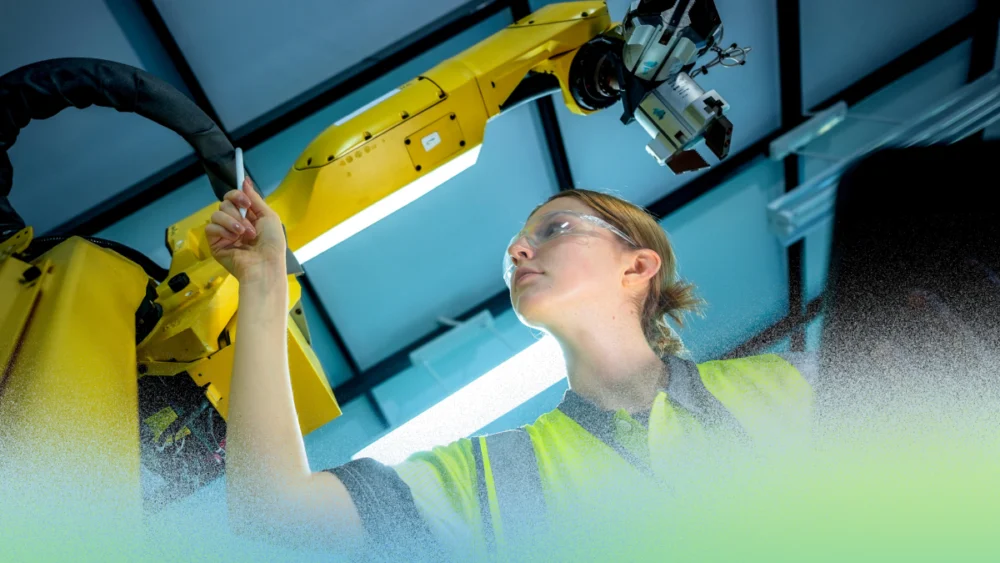
For nearly a century, the narrative of industrial progress was written in the language of mechanical repetition. From the first moving assembly lines of the early 20th century to the programmable logic controllers (PLCs) that defined the late 1900s, the goal was singular: eliminate variability. Automation was a game of "if-this, then-that," where machines thrived in highly controlled, static environments. However, the modern industrial landscape has outgrown the confines of rigid programming. Today’s manufacturers are grappling with a volatile cocktail of global labor shortages, fractured supply chains, and an urgent need for hyper-customization. In this high-stakes environment, traditional automation is no longer the finish line; it is merely the baseline.
The next epoch of industrial evolution is being defined by "Physical AI"—a sophisticated convergence of large-scale generative models, high-fidelity simulation, and robotics. Unlike the "digital-only" AI that populates chatbots and recommendation engines, Physical AI possesses the capacity to perceive, reason, and interact with the material world. It represents a shift from machines that follow instructions to systems that understand intent. As this technology matures, the partnership between computing giants like NVIDIA and cloud leaders like Microsoft is providing the architectural scaffolding necessary to move these systems from experimental laboratories to the high-pressure floors of global manufacturing.
The Limits of Legacy Automation
To understand the necessity of Physical AI, one must first recognize the ceiling of traditional robotics. For decades, industrial robots were essentially "blind" actors. They were bolted to factory floors, fenced off for human safety, and programmed to move to precise coordinates in space. This worked perfectly for welding a car chassis or palletizing uniform boxes. But the moment a part was slightly out of alignment, or a human entered the workspace, the system failed.
Current market pressures have exposed these vulnerabilities. Manufacturers today face "high-mix, low-volume" production cycles where the product being made might change weekly or even daily. Re-programming traditional robots for these shifts is prohibitively expensive and time-consuming. Furthermore, the global labor gap is reaching a crisis point; the Deloitte and The Manufacturing Institute study suggests that the U.S. alone could face a shortfall of 2.1 million skilled jobs by 2030.
The industry is at an inflection point. It needs systems that can handle "unstructured" environments—warehouses where items are cluttered, assembly lines where components vary, and logistics hubs where humans and machines must coexist. This is the "industrial frontier," a space where intelligence must be as tactile as it is digital.
Defining Physical AI: Sensing, Reasoning, and Acting
Physical AI is the realization of the "closed-loop" system at an enterprise scale. It functions through a continuous cycle of three core capabilities. First is sensing: using advanced computer vision, LiDAR, and tactile sensors to create a high-fidelity digital understanding of the physical environment. Second is reasoning: using neural networks—often trained in massive simulations—to determine the best course of action when faced with an anomaly. Third is acting: translating that reasoning into precise, safe motor commands for robotic arms, autonomous mobile robots (AMRs), or automated guided vehicles (AGVs).
This "reasoning" component is the true disruptor. In the past, if a robotic gripper missed a part, the system would simply error out. A Physical AI-enabled system, however, can "see" that it missed, "reason" that it needs to adjust its approach angle, and "act" to try again—all without human intervention. This adaptability transforms the robot from a tool into an agent.
The Microsoft and NVIDIA Synergy: Building the Toolchain
The complexity of Physical AI is too vast for any single company to solve in a vacuum. It requires a massive "toolchain" that spans from the silicon level to the cloud. The collaboration between NVIDIA and Microsoft is specifically designed to address this.
NVIDIA provides the "engine" of Physical AI. Through its accelerated computing architecture and platforms like NVIDIA Isaac and Omniverse, the company allows manufacturers to create "Digital Twins"—virtual replicas of factories that are governed by the laws of physics. In these virtual worlds, AI agents can undergo millions of hours of training in a fraction of the time, learning how to navigate obstacles and handle delicate materials without the risk of damaging expensive real-world hardware.
Microsoft complements this with the "connective tissue" and "brain" of the enterprise. Through Azure, Microsoft provides the massive data lakes and cloud-to-edge infrastructure required to manage these AI models. Perhaps more importantly, Microsoft integrates these physical systems into the broader business workflow. When a Physical AI agent on the factory floor identifies a recurring mechanical issue, it doesn’t just fix the immediate problem; it can communicate via Microsoft’s "agentic" frameworks to update maintenance logs, order replacement parts through the ERP system, and alert human supervisors via natural language interfaces.
From "Human Replacement" to "Human-Agent Teams"
One of the most persistent myths of the AI era is the total displacement of the human worker. In the industrial frontier, the reality is far more collaborative. Physical AI is giving rise to "Human-Agent Teams," where the AI handles the "3Ds"—tasks that are Dull, Dirty, or Dangerous—while humans move into roles of "intent setters" and "orchestrators."
In this new model, a factory worker might manage a fleet of five or ten AI-driven robots. Instead of coding their movements, the worker provides high-level instructions: "Reorganize Section A to prioritize the new turbine components." The Physical AI then calculates the most efficient way to move racks, adjust assembly stations, and clear pathways, executing the labor-intensive work while the human ensures quality control and safety compliance.
This shift also addresses the "skills gap." By using natural language processing (NLP) and intuitive interfaces, manufacturers can empower workers who may not have a background in robotics programming to operate highly sophisticated autonomous systems. The AI becomes a force multiplier for human expertise.
The Imperative of Trust and Governance
As machines gain the ability to make autonomous decisions in physical spaces, the stakes for safety and security skyrocket. A hallucination in a text-based AI is a nuisance; a "hallucination" in a five-ton industrial robot is a catastrophe. This is why "Trust" has become the primary metric for Physical AI adoption.
Scaling these systems requires rigorous governance frameworks. Manufacturers must ensure that AI models are "grounded" in real-world operational data and that there are clear "guardrails" preventing the system from acting outside of safety protocols. This involves "Observability"—the ability for human operators to see exactly why an AI made a specific decision at a specific microsecond.
Microsoft and NVIDIA are addressing this by building security and compliance directly into the platform. By using "simulation-grounded" AI, every move a robot makes in the real world has already been "vetted" in a virtual environment. Furthermore, the use of enterprise-grade cloud environments ensures that the proprietary data used to train these factory-specific models remains secure, preventing the "data leakage" that haunts many consumer-facing AI applications.
The Road Ahead: The Democratized Factory
Looking toward 2026 and beyond, the convergence of Physical AI and edge computing will lead to what many are calling the "Democratized Factory." Currently, advanced automation is often the province of massive corporations with deep pockets. However, as Microsoft and NVIDIA standardize the toolchains for Physical AI, these capabilities will become increasingly accessible to small and medium-sized enterprises (SMEs).
We are moving toward a future where the "Software-Defined Factory" is the norm. In this world, a manufacturing facility’s most valuable asset won’t just be its physical machinery, but the proprietary AI models that run that machinery. These models will continuously learn from every shift, becoming more efficient, safer, and more adaptable over time.
The transition to the industrial frontier is not merely a technical upgrade; it is a strategic necessity. In an era of radical uncertainty, the "advantage" goes to those who can bridge the gap between digital intelligence and physical execution. The collaboration between technology leaders is providing the map, but it is the manufacturers who must choose to cross the frontier. Those who embrace Physical AI today are not just optimizing their current operations—they are building the resilient, autonomous foundations of the next industrial century.
