

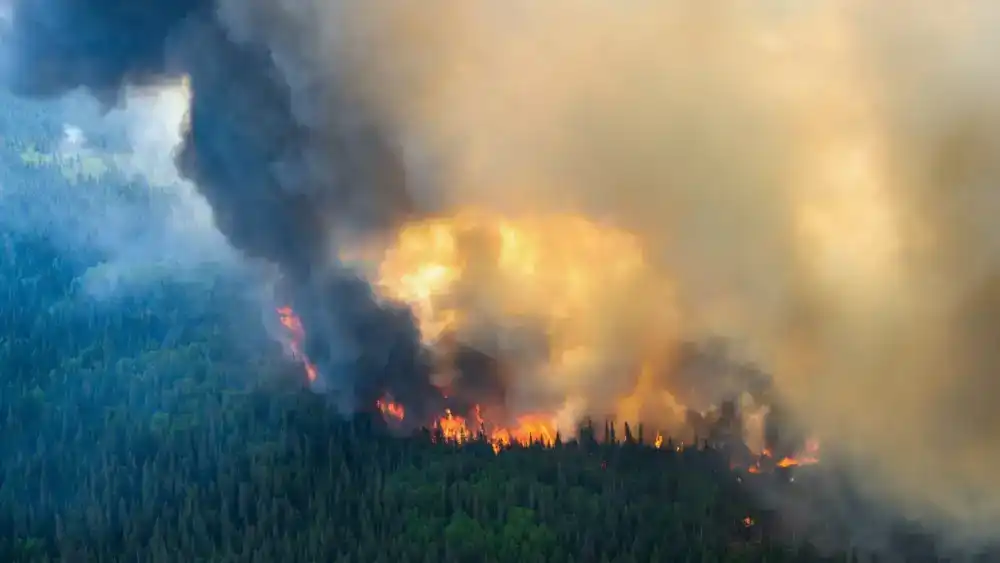
On June 1, 2023, the atmosphere over Quebec transformed into a volatile electrical engine. As a relentless heat wave gripped the province, the sky erupted in a barrage of thousands of lightning strikes. By the time the storm cells dissipated, they had ignited more than 120 individual wildfires. These were not isolated incidents; they were the opening salvos of a season that would become the most destructive in Canadian history. By the end of the year, nearly 7,000 fires had consumed tens of millions of acres, displaced hundreds of thousands of residents, and pumped an estimated 500 million tons of carbon emissions into the atmosphere—four times the amount produced by Canada’s entire fossil fuel sector in the same period.
While human activity often garners the headlines in fire prevention campaigns, the data tells a more nuanced story of natural volatility. In 2023, lightning was responsible for approximately 60% of Canada’s wildfires, yet those specific blazes accounted for a staggering 93% of the total area burned. This discrepancy arises because lightning-ignited fires often occur in remote, inaccessible regions where they can grow unchecked for days before discovery.
Now, a Vancouver-based startup named Skyward Wildfire is proposing a radical shift in how the world manages these disasters. Rather than waiting for smoke to appear on the horizon, the company aims to intervene in the atmosphere itself, neutralizing the electrical potential of storm clouds before they can ever strike the ground. Having recently secured millions in seed funding, the company is moving from theoretical modeling to aggressive field operations, reigniting a decades-old scientific debate over the ethics and efficacy of weather modification.
The Science of Atmospheric Neutralization
To understand Skyward’s mission, one must first understand the mechanics of the "Rorschach tests" of the sky. Clouds are essentially vast, churning mixtures of water vapor, ice crystals, and tiny pellets known as graupel. As updrafts force these particles to collide, they exchange electrons through a process known as the triboelectric effect. This creates a massive separation of charges: lighter ice crystals carry positive charges to the top of the cloud, while heavier graupel carries negative charges toward the base.
When the electrical potential between the cloud and the ground becomes too great to be resisted by the air, the result is a massive electrostatic discharge—lightning. Skyward’s solution involves "seeding" these high-risk storm cells with a material known as metallic chaff. Chaff consists of microscopic fiberglass strands coated in aluminum, a material long used by the military to confuse enemy radar systems.
When dispersed into a developing storm, these conductive fibers act as thousands of tiny "lightning rods" in the sky. By providing a medium for ions to move and neutralize, the chaff theoretically bleeds off the electrical charge in small, harmless increments rather than allowing it to build up into a catastrophic bolt. According to documents released through the World Bank, Skyward utilizes sophisticated artificial intelligence to predict which storm cells pose the greatest risk, optimizing flight paths for planes and drones to deliver the material exactly where it is needed most.
A Legacy of Cold War Weather Control
The concept of lightning suppression is far from new. It represents a modern revival of a mid-century scientific obsession. Following World War II, a wave of "techno-optimism" led U.S. research agencies to believe that humanity could—and should—tame the weather. In the 1950s and 60s, the U.S. Forest Service launched "Project Skyfire," an ambitious multi-agency effort to test whether cloud seeding with silver iodide could reduce lightning in the tinder-dry forests of Montana and Idaho.
The stakes were raised in 1969 when the Apollo 12 mission was struck twice by lightning shortly after launch, nearly ending the mission in disaster. This close call prompted NASA and NOAA to initiate "Project Thunderbolt," which shifted the focus toward the use of metallic chaff. While early results were described as "promising," the programs eventually withered. The complexity of measuring a "non-event"—proving that lightning didn’t strike because of human intervention—made statistical significance difficult to achieve. Furthermore, the military grew concerned that widespread use of chaff could interfere with civilian and defense radar systems, leading to the abandonment of the research in the mid-1970s.
Skyward Wildfire is now picking up these abandoned threads, betting that modern AI and high-resolution sensors can overcome the hurdles that stymied scientists fifty years ago. The company claims that its recent trials in Alberta and British Columbia have demonstrated a 60% to 100% reduction in lightning strikes within targeted cells compared to untreated control groups.
The Controversy of "100% Prevention"
Despite the company’s optimism, its marketing has already faced scrutiny. Until recently, Skyward’s website claimed its technology could prevent "up to 100%" of lightning strikes. Such a definitive figure is a rarity in atmospheric science, where variables are infinite and systems are chaotic. Following inquiries from researchers and journalists, the company softened its language, acknowledging that "consistent 100% outcomes are not realistic" in complex atmospheric systems.

The skepticism from the scientific community is rooted in recent data. A study presented at the American Geophysical Union by researchers from MIT and New Mexico Tech analyzed storms in Florida where military chaff was present. They found that while the storms were often shorter-lived, the total number of electrical flashes—including those occurring within and between clouds—was actually higher in the presence of chaff.
This suggests a "capture problem": ions released by the chaff may be absorbed by cloud droplets before they can neutralize the larger charged regions of the storm. If the material is spread too thin by turbulent winds, it may become ineffective, or worse, potentially alter the storm’s behavior in unpredictable ways.
Environmental Stewardship and the Geoengineering Dilemma
Beyond the physics of lightning, there are mounting concerns regarding the environmental footprint of cloud seeding. While the U.S. military has historically classified chaff as "generally nontoxic," the prospect of scaling its use to cover vast swathes of the Canadian boreal forest raises new questions.
Aluminum-coated fiberglass eventually falls to earth. Critics and environmental advocacy groups, such as Environmental Defence Canada, are calling for greater transparency regarding the long-term impact on watersheds and wildlife. There is a "remote but potential" risk of aluminum accumulating in reservoirs, which could affect aquatic ecosystems and the species that depend on them.
Furthermore, the "unintended consequences" of weather modification remain a significant ethical hurdle. If humans intervene to stop lightning, do they inadvertently change the precipitation patterns of a region? In a world already reeling from climate change, the prospect of "messing with the weather" is viewed by some as a dangerous form of local geoengineering. Skyward maintains that its interventions are highly targeted, occurring only on the 0.1% of days when the wildfire risk is at its absolute peak, but the lack of public disclosure regarding trial locations and material volumes has left some observers uneasy.
The Economic Imperative: Prevention vs. Suppression
The financial argument for Skyward’s technology is, however, difficult to ignore. Wildfire management is currently a reactive, billion-dollar industry. In 2023 alone, the costs of fighting fires, repairing infrastructure, and managing health crises related to smoke reached astronomical levels.
Preventing a fire is exponentially cheaper than extinguishing one. If a startup can prove that a few thousand dollars’ worth of aerial seeding can prevent a fire that would otherwise cost $50 million to fight, the return on investment is clear. This economic reality is what has attracted venture capital firms like Climate Innovation Capital and Active Impact Investments. For these investors, Skyward isn’t just a weather company; it is a "climate resilience" platform.
The urgency is bolstered by climate modeling. As the planet warms, the atmosphere holds more moisture and convective energy, which scientists predict will lead to a significant increase in lightning frequency, particularly in northern latitudes. The Arctic boreal region is already seeing a sevenfold increase in extreme wildfires. In this context, proponents argue that we no longer have the luxury of purely natural systems; we must use every technological tool available to protect the remaining carbon sinks of the North.
A New Frontier in Wildfire Management
As Skyward Wildfire prepares for its 2025 field season, the company stands at the intersection of innovative climate tech and controversial geoengineering. The success or failure of their upcoming trials in British Columbia and Alberta will likely dictate the future of atmospheric fire prevention.
If Skyward can provide rigorous, peer-reviewed data that proves their method works without harming the environment, they may fundamentally change the playbook for wildfire agencies globally. The shift from "reactive suppression" to "proactive prevention" could save lives, preserve biodiversity, and significantly reduce the global carbon footprint.
However, the path forward requires a delicate balance of innovation and transparency. The scientific community and the public will likely demand more than proprietary claims; they will want to see the methodology behind the "disarmed" clouds. As we enter an era of increasingly volatile weather, the question is no longer whether we can influence the elements, but whether we can do so wisely, ethically, and with a full understanding of the ripples we create in the sky. For now, the world looks toward the clouds of the 2025 season, waiting to see if the next great spark will be extinguished before it ever touches the earth.
