

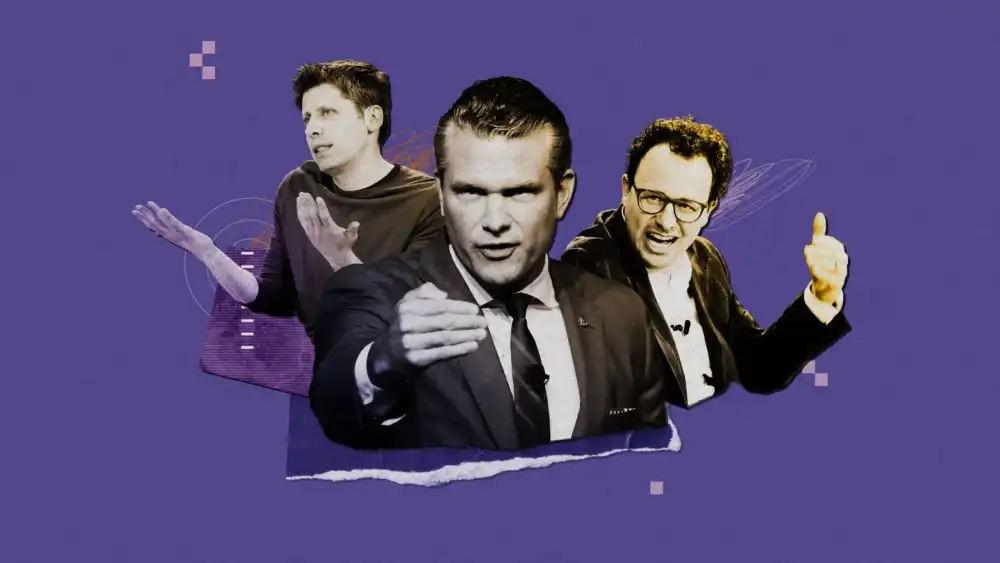
The long-standing, often fractious relationship between the titans of Silicon Valley and the United States Department of Defense reached a historic, if controversial, milestone on February 28. OpenAI, the organization that ignited the current generative AI boom, officially announced a landmark agreement to integrate its cutting-edge technologies into the classified echelons of the U.S. military. This move, characterized by CEO Sam Altman as "definitely rushed," marks a profound shift in the geopolitical landscape of artificial intelligence. It also serves as the culmination of a high-stakes drama that saw OpenAI’s primary rival, Anthropic, cast out of the Pentagon’s good graces for attempting to impose moral boundaries that the government deemed unacceptable.
The deal did not emerge in a vacuum. It was forged in the heat of a public and scorched-earth reprimand of Anthropic by the Department of War—a rhetorical shift in nomenclature that signals a more aggressive posture in American defense strategy. OpenAI’s entry into the fold is being framed by the company not as a surrender of its founding principles, but as a pragmatic compromise. In a series of public statements and a detailed blog post, OpenAI sought to reassure both its employees and the public that it has not granted the military carte blanche. The agreement specifically prohibits the use of OpenAI’s models for autonomous weaponry or mass domestic surveillance. However, beneath the surface of these assurances lies a complex legal and ethical architecture that suggests OpenAI has traded Anthropic’s rigid moral "red lines" for a more flexible, law-based framework that gives the Pentagon significantly more breathing room.
To understand the gravity of this "compromise," one must look at the divergent paths taken by the industry’s two most prominent players. Anthropic, founded by former OpenAI executives with a heavy emphasis on AI safety and "constitutional" frameworks, attempted to bake specific prohibitions into its government contracts. They sought a free-standing right to veto uses of their technology—such as the Claude model—that they deemed ethically precarious, even if those uses were technically legal. This stance was met with a visceral reaction from the defense establishment. Defense Secretary Pete Hegseth, in a scathing public rebuke, labeled Anthropic’s position a "master class in arrogance and betrayal."
OpenAI, watching the bridge burn behind Anthropic, chose a different route. Rather than fighting for the right to define what is "moral," OpenAI deferred to what is "legal." Sam Altman noted that the company’s comfort level stemmed from citing applicable laws and existing Pentagon directives rather than inventing new contractual prohibitions. This distinction is the crux of the matter. By tethering its safety standards to existing law—such as a 2023 Pentagon directive on autonomous weapons and the Fourth Amendment’s protections against unreasonable search and seizure—OpenAI has essentially signaled that it trusts the government to regulate itself.
Legal experts, however, warn that this is a distinction with a massive difference. Jessica Tillipman, associate dean for government procurement law studies at George Washington University, points out that OpenAI’s contract does not grant the company the same "free-standing right" to prohibit use that Anthropic fought for. Instead, it merely binds the Pentagon to follow the laws as they are currently written and interpreted. For critics of government overreach, this is a hollow victory. The history of American surveillance is littered with programs that were deemed legal by internal oversight and secret courts for decades—most notably those exposed by Edward Snowden—before eventually being ruled unlawful after years of litigation. In the fast-moving theater of AI-enabled warfare, waiting for a court to rule on the legality of a specific algorithm’s application could take years, by which time the damage would be irreversible.
The industry implications of this deal are staggering. For years, the "Project Maven" controversy at Google—where employee protests forced the company to pull out of a military drone program—acted as a cautionary tale for tech giants. It suggested that a company’s most valuable asset, its talent, would not tolerate the weaponization of their work. OpenAI is now testing that hypothesis in a much more volatile era. The company claims it will maintain control over the safety rules governing its models, promising that it will not provide the military with "stripped-down" versions of its AI that lack ethical guardrails. Boaz Barak, an OpenAI researcher, suggested that the company can "embed" its red lines—such as requiring human involvement in weapon systems—directly into the model’s behavior through fine-tuning and reinforcement learning.
Yet, the technical feasibility of this "embedded morality" remains unproven in a classified, high-stakes combat environment. OpenAI is expected to roll out these protections in just six months—a timeline that most AI safety researchers would describe as dangerously optimistic. Furthermore, the company has not specified how these military-grade safety rules differ from those applied to the average ChatGPT user. In a theater of war, where "mass surveillance" might be rebranded as "theater-wide situational awareness," the semantic and technical boundaries of these guardrails become incredibly porous.
The geopolitical context adds another layer of urgency. The Pentagon is currently operating under a highly politicized AI acceleration strategy, one that is being tested in real-time. As the U.S. escalates strikes in the Middle East and manages covert operations in regions like Venezuela, the demand for AI-driven intelligence and targeting is at an all-time high. Reports indicate that Anthropic’s Claude model was actually used in strikes on Iran just hours after Secretary Hegseth issued the ban on the company, highlighting just how deeply integrated these models already are in the military’s "kill chain."
The transition away from Anthropic is not just a change in vendors; it is an ideological purging. Hegseth’s "scorched-earth" campaign against Anthropic includes a move to classify the company as a "supply chain risk." This designation is typically reserved for foreign adversaries like Huawei or ZTE. By applying it to a domestic startup, the government is sending a chilling message to the entire venture capital and tech ecosystem: if you do not grant the state "unrestricted access" for every "lawful purpose," you will be treated as an enemy of the state. Hegseth has even threatened to prohibit any contractor or partner doing business with the military from conducting commercial activity with Anthropic—a move that, if legally upheld, would be a corporate death sentence.
As OpenAI steps into this vacuum, it finds itself sharing the stage with Elon Musk’s xAI. The Pentagon’s plan to phase in OpenAI and Grok (xAI’s model) over the next six months suggests a new military-industrial complex is forming, one where the underlying infrastructure of national security is built on the proprietary algorithms of a few secretive companies. This raises fundamental questions about sovereignty and accountability. If the "red lines" of AI warfare are determined by the internal alignment teams of private corporations rather than international treaties or transparent legislative debate, where does the ultimate authority lie?
OpenAI’s "compromise" may have secured it a seat at the most powerful table in the world, but it has also placed the company on an ideological seesaw. On one side is the promise to its employees and the public that it remains a force for "good," holding leverage over how its models are used. On the other side is the reality of a massive government contract and a Department of War that has made it clear it will not tolerate being told "no."
The future of this partnership will likely be defined by three critical factors. First is the internal stability of OpenAI itself. The company’s talent pool is its lifeblood, and if the "lawful use" compromise is seen as an unforgivable ethical lapse, we may see a mass exodus of the very researchers who made the Pentagon deal possible. Second is the legal battle looming between Anthropic and the government. If Anthropic successfully sues to block the "supply chain risk" designation, it could re-establish the right of private companies to set ethical boundaries for their products. If they fail, OpenAI’s pragmatic surrender will become the industry standard.
Finally, there is the reality of the battlefield. As OpenAI’s models are integrated into classified operations, the world will watch to see if those "embedded red lines" actually hold. In the chaos of modern conflict, where AI is used to process vast amounts of surveillance data and identify targets in milliseconds, the difference between a "human-in-the-loop" and a "human-as-a-rubber-stamp" is razor-thin. OpenAI has bet its reputation—and perhaps the future of AI governance—on the idea that it can walk this tightrope. But as the Pentagon rushes to deploy these tools amidst escalating global tensions, the rope is getting shorter, and the drop is getting deeper.
The deal reached on February 28 is more than a contract; it is a signal that the era of the "neutral" tech platform is over. In the eyes of the Pentagon, there is no middle ground: you are either an integrated partner in the national security apparatus, or you are a risk to be mitigated. OpenAI chose the former, and in doing so, it has redefined the boundaries of what a technology company is permitted to believe.
