

The human sensory experience is a curated slice of reality, defined more by its limitations than its reach. Our eyes perceive only a narrow band of the electromagnetic spectrum, and our ears are tuned to a specific, mid-range frequency response that ignores the vast majority of the kinetic energy vibrating through the atmosphere. While we are capable of hearing the sharp crack of a nearby lightning strike or the rhythmic churning of internal combustion, we are fundamentally deaf to the most profound oratory of the planet itself. The Earth is constantly speaking in a register of deep, low-frequency vibrations known as infrasound—acoustic waves that fall below the 20-hertz threshold of human audibility. These waves are not merely quiet; they are massive, possessing wavelengths so long they can circumvent the globe, carrying data about distant volcanic eruptions, the slow death of glaciers, and the shifting of tectonic plates.
Until recently, this "secret soundtrack" of the Earth remained the exclusive domain of military surveillance and specialized geophysical research. However, a burgeoning movement at the intersection of technology and the arts is beginning to democratize this hidden data. Musician and artist Brian House has brought this sub-audible world into the light with his recent project, Everyday Infrasound in an Uncertain World. By utilizing high-precision barometric sensors to capture 24 hours of planetary vibrations and compressing them into a 24-minute auditory experience, House has provided a bridge between the clinical world of geophysics and the emotive realm of ambient music. This work does more than just present a novel soundscape; it highlights the sophisticated technology used to monitor our planet and raises critical questions about our relationship with a changing environment.
The Physics of the Inaudible
To understand the significance of infrasound, one must first understand the physics of acoustic propagation. Sound is essentially a pressure wave traveling through a medium—in this case, the air. The frequency of these waves determines the pitch we perceive. While the human ear is optimized for the 20 Hz to 20,000 Hz range, nature operates on a much broader scale. Infrasound occupies the space between 0.001 Hz and 20 Hz. Because these waves have such low frequencies, they have incredibly long wavelengths—sometimes measuring tens of kilometers.
These long wavelengths are the key to infrasound’s "global" reach. High-frequency sounds are easily absorbed or scattered by obstacles like buildings, trees, and even the air itself. In contrast, infrasound waves experience very little attenuation as they travel. They can bounce off the upper layers of the atmosphere and travel thousands of miles with minimal loss of energy. This allows a sensor in Massachusetts to potentially "hear" a storm front brewing over the Atlantic or a massive industrial explosion on another continent. It is a form of planetary-scale communication that has existed since the Earth’s formation, though we have only possessed the tools to record it for a fraction of our history.
The Technology of Capture: From Krakatoa to "Macrophones"
The history of infrasound detection is inextricably linked to the history of barometry. One of the earliest recorded instances of global infrasound detection occurred in 1883, following the cataclysmic eruption of Krakatoa in the South Pacific. The shockwaves from the eruption were so powerful that they circled the Earth multiple times, causing mercury barometers in London and New York to spike and dip in a rhythmic pattern that lasted for days. Scientists at the time realized that the atmosphere was acting as a giant bell, ringing with the energy of the volcanic blast.
Modern infrasound monitoring has evolved significantly from those early mercury tubes. Today, the primary driver for infrasound technology is the International Monitoring System (IMS), managed by the Comprehensive Nuclear-Test-Ban Treaty Organization (CTBTO). This global network of sensors is designed to detect the specific infrasonic "signature" of a nuclear explosion, ensuring that no country can conduct clandestine atmospheric tests.
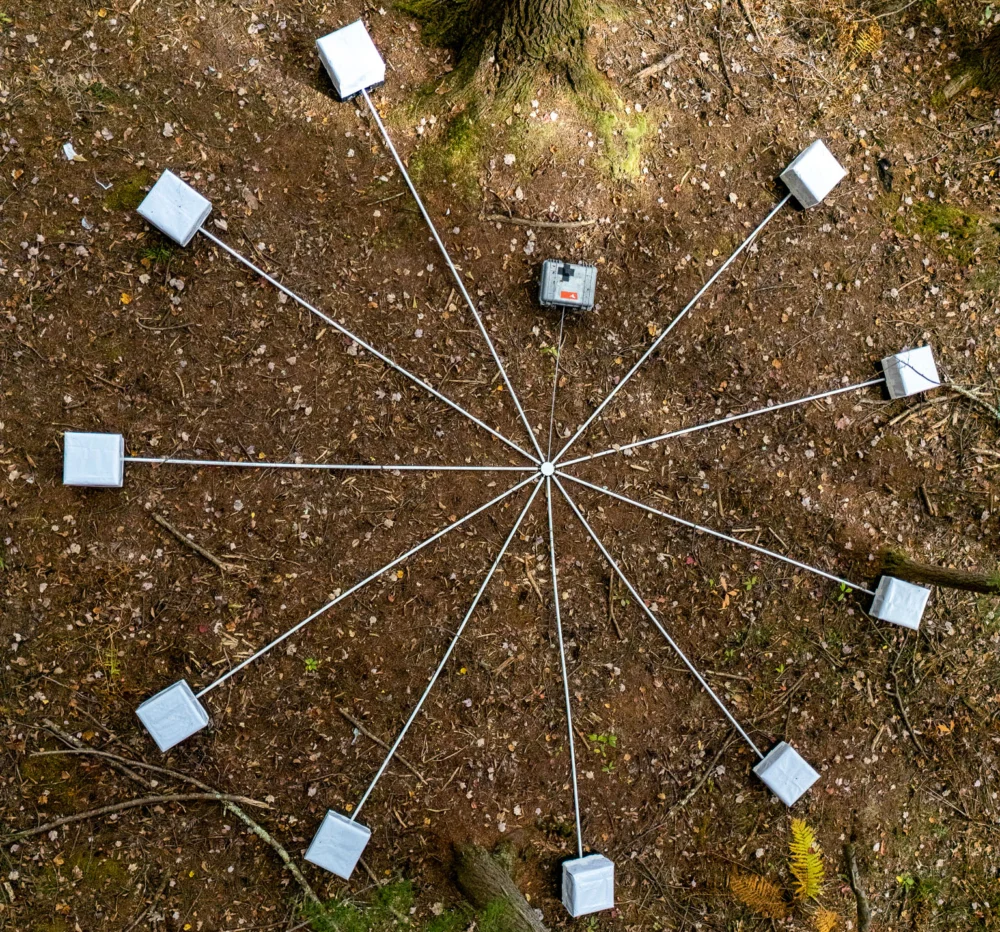
Brian House’s project utilizes a more localized, yet no less sophisticated, version of this technology. To capture the data for Everyday Infrasound in an Uncertain World, House engineered a set of "macrophones." These devices are essentially specialized air-intake systems—long tubes designed to filter out the "noise" of local wind gusts—connected to high-resolution barometers. These sensors are capable of taking 100 pressure readings per second, capturing minute fluctuations in the atmosphere that would be invisible to standard weather station equipment.
The challenge then becomes one of translation. Because the recorded data is, by definition, below the range of human hearing, it must be manipulated to be perceived. House employs a technique of temporal compression, speeding up the 24-hour recording by a factor of 60. This process shifts the frequencies upward into the audible range, turning a day’s worth of planetary rumbling into a 24-minute composition. It is a digital "sonification" process that allows the human brain to process geophysical data as music.
Expert Analysis: The Ambiguity of Global Sound
While the technology to capture infrasound is precise, the interpretation of that data remains a complex puzzle. In the scientific community, infrasound is used to track specific, high-energy events. Leif Karlstrom, a volcanologist at the University of Oregon, uses infrasonic arrays to monitor Mount Kilauea in Hawaii. By analyzing the "low-frequency screams" of a volcano, scientists can predict eruptions or track the movement of magma beneath the surface.
However, when these sensors are placed in a relatively "quiet" environment, such as the woods of western Massachusetts where House conducted his recordings, the resulting audio becomes a tapestry of unidentified phenomena. As Karlstrom notes, while the sensors are highlighting real, physical events, it is often impossible to pinpoint the exact source of every rumble or whistle. A high-pitched tone might be the Doppler-shifted whine of a distant freight train, or it could be a localized atmospheric phenomenon caused by wind interacting with a specific mountain ridge. A deep, rhythmic thrumming might be the "microbaroms" created by ocean waves thousands of miles away, or it could be the signature of a distant thunderstorm.
This ambiguity is where the art takes over from the science. For House, the "mystery" of the sound is the point. In a world where we are constantly tracked by GPS and surrounded by high-definition imagery, there is something profoundly unsettling—and perhaps necessary—about listening to a sound that we know is real, yet cannot fully categorize. It reminds the listener that the Earth is an active, churning entity that operates on a scale far beyond human convenience.
Industry Implications and Future Trends
The democratization of infrasound technology has implications that extend far beyond the arts. As sensor components become cheaper and more accessible, we are likely to see an explosion in "acoustic ecology"—the study of the relationship between living beings and their sonic environment.
- Climate Change Monitoring: Infrasound is an essential tool for tracking the effects of global warming. The "boom" of a calving glacier—when a massive chunk of ice breaks off into the sea—creates a massive infrasonic signature. By monitoring these sounds, researchers can track the rate of ice loss in remote regions of Greenland and Antarctica in real-time, providing more accurate data for sea-level rise models.
- Disaster Early Warning Systems: Beyond volcanology, infrasound is being explored as a way to provide early warnings for tornadoes and tsunamis. Tornadoes emit a specific low-frequency hum long before they touch down, and tsunamis generate infrasonic waves as they displace massive amounts of water. Integrating infrasound sensors into consumer electronics or smart-city infrastructure could save lives by providing minutes of advance warning that current radar systems might miss.
- Biodiversity and Conservation: Many of the world’s largest animals, including elephants, whales, and even some species of birds, communicate using infrasound. This allows them to coordinate movements over vast distances. Conservationists are beginning to use infrasonic arrays to track these populations in the wild, allowing for "non-invasive" monitoring that doesn’t require tagging animals or entering their habitats.
- Industrial Surveillance: In the private sector, infrasound is being used to monitor the structural integrity of large-scale infrastructure. Bridges, wind turbines, and skyscrapers all have "resonant frequencies." If a crack develops or a bolt loosens, that frequency changes. Infrasonic sensors can detect these shifts long before a visual inspection would reveal a problem.
The Aesthetic of the Anthropocene
House’s album arrives at a moment when our relationship with the planet is increasingly characterized by anxiety. The title, Everyday Infrasound in an Uncertain World, reflects this tension. The music itself is described as "otherworldly," alternating between ghostly whispers and intense, low-octave rattles. It does not offer the comfort of traditional ambient music, which often seeks to mask the sounds of the modern world with synthesized "nature" sounds. Instead, it forces the listener to confront the raw, unfiltered vibrations of the Anthropocene.
The "unsettling" nature of the recording is a reflection of our current ecological state. We are living through a period of dramatic geological change, much of which is invisible to us. By shifting these planetary movements into our auditory range, House makes the abstract reality of a "living Earth" visceral. We are no longer just reading about shifting ocean currents or atmospheric pressure changes; we are hearing them rattle our eardrums.
Conclusion: A Deeper Connection
The significance of capturing the Earth’s secret soundtrack lies in the shift of perspective it demands. For most of human history, we have viewed the atmosphere as a void—an empty space through which we move. Infrasound technology reveals that the atmosphere is actually a dense, vibrating medium, a conductor of energy that links a storm in the North Atlantic to a forest in Massachusetts.
Projects like Brian House’s Everyday Infrasound in an Uncertain World serve as a reminder that our "human-scale" perception is only a tiny fraction of the story. By utilizing the tools of geophysics to create art, we can begin to foster a deeper, more profound connection to the planet. It is a connection rooted not in the mastery of nature, but in the humble act of listening—paying attention to the low-frequency pulses that have been echoing around us, unheard, for eons. As we move into an increasingly uncertain future, learning to listen to the Earth’s deeper rhythms may be the first step toward understanding our place within them.
