

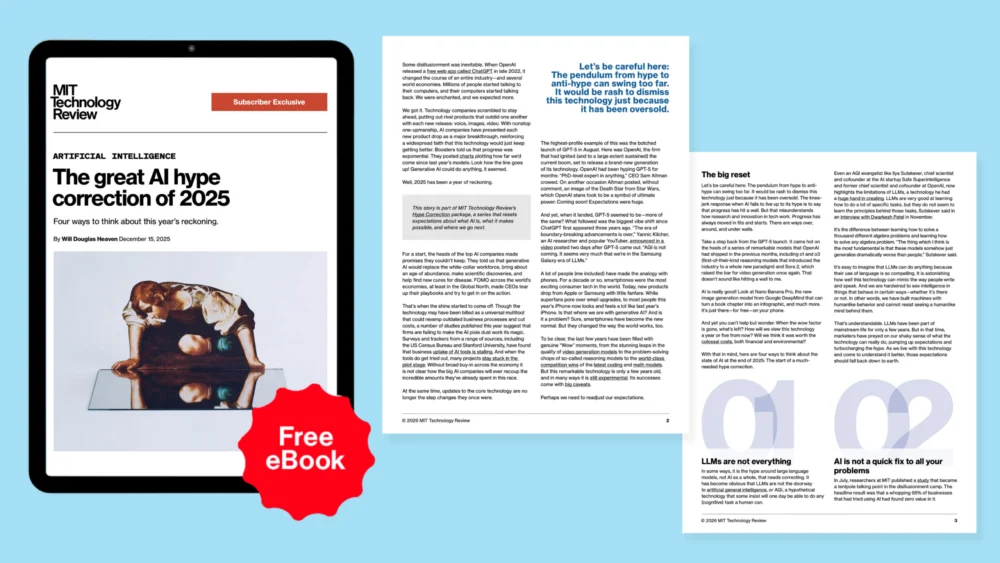
The year 2025 is increasingly viewed by economists, technologists, and venture capitalists as a pivotal moment of reckoning for the artificial intelligence industry. After more than two years of unbridled enthusiasm triggered by the public release of large language models, the narrative is shifting from speculative potential to measurable utility. This transition, often characterized as a "hype correction," represents a necessary phase in the maturation of any foundational technology. Much like the dot-com era of the late 1990s or the early days of mobile computing, the initial phase of AI adoption was defined by a "gold rush" mentality. However, as the dust settles, the industry is entering a more sober, analytical period where the primary metric for success is no longer the complexity of an algorithm, but the tangible value it delivers to the bottom line.
The historical context of such technological cycles provides a roadmap for what to expect. Since the late 19th century, the evolution of emerging technologies—from the electrical grid to the internal combustion engine—has followed a predictable pattern: a breakthrough discovery, a surge of speculative investment, a period of over-saturation, and a subsequent market rationalization. Artificial intelligence is currently navigating the peak of this curve. The "Correction of 2025" is not merely a financial adjustment; it is a fundamental re-evaluation of the technical, ethical, and logistical frameworks that underpin the digital economy.
One of the primary drivers of this correction is the "ROI Reckoning." Throughout 2023 and 2024, Fortune 500 companies allocated billions of dollars to AI pilot programs and experimental labs. While these initiatives produced impressive demos and internal buzz, the conversion of these pilots into scalable, revenue-generating products has been slower than many anticipated. In 2025, shareholders are expected to move beyond the novelty of chatbots and demand specific evidence of productivity gains, cost reductions, and new revenue streams. This pressure is forcing a pivot from "General AI" to "Applied AI." Companies are shifting their focus away from massive, all-purpose models toward smaller, specialized models trained on proprietary data. These leaner models are not only more cost-effective to run but are also more accurate in specific domains like medical diagnostics, legal discovery, and predictive maintenance.
The technical landscape is also facing its own set of constraints, often referred to as the "Infrastructure Wall." For years, the prevailing philosophy was that more data and more compute power would inevitably lead to more intelligent systems—a concept known as scaling laws. However, as we approach 2025, the industry is encountering diminishing returns. The supply of high-quality, human-generated text on the open internet is finite, and the energy requirements to train and maintain increasingly larger models are reaching the limits of current power grids. This has sparked a renewed interest in "algorithmic efficiency" rather than sheer brute force. The correction is driving a wave of innovation in hardware, with a shift toward specialized AI chips (ASICs) that prioritize energy efficiency over raw performance, and a move toward "synthetic data" to supplement the training of future models.
Furthermore, the industry is witnessing a significant shift in the competitive landscape. The "Big Tech" hegemony, led by giants that controlled the clouds and the chips, is being challenged by a new generation of vertically integrated startups. These newcomers are not trying to build the next "everything engine." Instead, they are building deeply integrated solutions for specific industries. In this environment, the value is migrating from the "model layer" to the "application and data layers." The correction of 2025 will likely see a consolidation of the market, where companies that lack a clear moat—either through proprietary data or deep integration into a user’s workflow—will struggle to survive. This is a classic Darwinian moment for Silicon Valley, where the "wrapper" companies that merely provide a user interface for someone else’s API will be replaced by platforms that offer deep, structural value.
Beyond the boardroom and the data center, the social and political implications of the AI correction are becoming more pronounced. The initial fear of mass unemployment is being replaced by a more nuanced understanding of "task augmentation." In 2025, the focus is shifting toward how AI can assist humans in high-stakes environments. This requires a new level of transparency and "explainability." The "black box" nature of early deep learning models is no longer acceptable in sectors like finance or healthcare, where a decision must be auditable. Consequently, the correction is ushering in the era of "Regulated AI." Governments around the world are moving from broad statements of intent to specific, enforceable frameworks. These regulations are not just about safety; they are about establishing the standards for intellectual property, data privacy, and algorithmic bias. The companies that thrive in the post-2025 era will be those that view compliance not as a burden, but as a foundational element of trust.
Expert analysis suggests that the 2025 correction will also be characterized by a move toward "Agentic AI." While generative AI was about creating content, agentic AI is about taking action. We are moving toward systems that can plan, reason, and execute multi-step tasks autonomously. This shift requires a departure from simple probabilistic text generation toward "system 2 thinking"—a cognitive science term for slower, more deliberate reasoning. The transition to agentic systems will be the primary theme of the late 2020s, but it requires the foundational correction of 2025 to clear away the "noise" of less capable systems.
The impact on the workforce is also entering a second phase. We are seeing the emergence of the "AI-Native Professional"—individuals who do not just use AI tools but who understand how to orchestrate them. Education and corporate training programs are being redesigned to focus on "prompt engineering," "data literacy," and "ethical oversight." The correction is highlighting a critical skill gap: while the technology has advanced at light speed, the human capacity to manage and integrate it has lagged behind. 2025 will be the year of "Human-Centric Realignment," where the focus returns to how these tools can enhance human creativity and strategic thinking rather than simply replacing human labor.
As we look toward the future, the trends emerging from the 2025 correction suggest a more sustainable and integrated technological ecosystem. We are likely to see the rise of "Edge AI," where intelligence is processed locally on devices rather than in the cloud, addressing both privacy concerns and latency issues. We will also see a deeper convergence between AI and other frontier technologies, such as quantum computing and synthetic biology. The "Great Correction" is essentially the end of the beginning. It marks the moment when AI stops being a "special" or "emerging" category and becomes as ubiquitous and invisible as the internet itself.
In conclusion, the AI hype correction of 2025 should not be viewed with cynicism or fear. It is a sign of a healthy, maturing industry. By stripping away the unrealistic expectations and speculative excess, the market is making room for the real work of digital transformation. The companies, investors, and policymakers who navigate this period successfully will be those who prioritize long-term utility over short-term hype. The legacy of this era will not be the chatbots that entertained us, but the structural improvements in efficiency, scientific discovery, and global problem-solving that a more rational, mature AI ecosystem can provide. As we move past the peak of inflated expectations, the "slope of enlightenment" awaits, promising a future where technology serves as a reliable, transparent, and indispensable partner in human progress. This shift represents the latest iteration of a long legacy of technological evolution, one that continues to reshape the commercial, social, and political fabric of our world. The correction is not an end, but a refined beginning, setting the stage for the next decade of genuine innovation.
