

The global narrative surrounding electric vehicles (EVs) has long been dominated by the high-tech corridors of Silicon Valley, the industrial heartlands of Germany, and the sprawling gigafactories of China. For years, the consensus among market analysts was that Africa would be the final frontier for electrification—a region destined to remain dependent on the world’s internal combustion engine (ICE) hand-me-downs due to infrastructure deficits and limited purchasing power. However, that conventional wisdom is being dismantled by a series of aggressive policy shifts, strategic industrial investments, and a fundamental recalculation of energy economics. Across the continent, the transition to electric mobility is no longer viewed merely as a luxury of the climate-conscious, but as a pragmatic necessity for economic survival and energy independence.
While the adoption of EVs in Western markets is often framed through the lens of environmental stewardship and carbon credits, the African context is increasingly defined by fiscal urgency. Many African nations are currently trapped in a cycle of importing refined petroleum, which drains foreign exchange reserves and leaves domestic economies vulnerable to the volatility of global oil prices. By pivoting toward electric transport, these countries are seeking to decouple their mobility sectors from the dollar-denominated oil market and tether them instead to domestic energy production.
The Ethiopian Paradigm: Policy as a Catalyst
The most striking example of this shift is found in Ethiopia. In 2024, the Ethiopian government made global headlines by becoming the first nation to implement a total ban on the importation of non-electric private vehicles. To seasoned observers of the automotive industry, this move was nothing short of revolutionary. Even the most progressive European nations have set target dates for the mid-2030s to phase out ICE sales; Ethiopia simply flipped the switch.
The rationale behind this radical "nudge" is purely economic. Ethiopia possesses immense renewable energy potential but lacks domestic oil reserves. In September 2025, the country commissioned the final stages of the Grand Ethiopian Renaissance Dam (GERD), a $5 billion project that stands as Africa’s largest hydropower installation. With a capacity of five gigawatts, the dam has effectively doubled the country’s peak power availability. For the Ethiopian government, it makes little sense to spend billions of dollars in precious foreign currency to import gasoline when the country can produce cheap, abundant clean electricity at home.
However, the transition is not without friction. Ethiopia’s vehicle market has historically been dominated by used ICE vehicles, often imported from Europe or the Middle East. Transitioning this ecosystem to electric requires more than just a ban; it requires a complete overhaul of the maintenance and resale market. Yet, by forcing the market’s hand, Ethiopia is creating a vacuum that is rapidly being filled by Chinese EV manufacturers and local entrepreneurs who see the writing on the wall.
Micro-Mobility: The Real Engine of Change
While high-end electric sedans garner the most media attention, the real "electric revolution" in Africa is happening on two and three wheels. In cities like Kigali, Nairobi, and Lagos, the "boda boda" or motorcycle taxi is the lifeblood of urban transport. These vehicles are numerous, highly polluting, and expensive to operate due to rising fuel costs.
Rwanda has taken a lead in this sector by banning new registrations for commercial gas-powered motorbikes in its capital, Kigali. This policy is designed to accelerate the adoption of electric motorcycles, which already account for a significant portion of the city’s fleet. The logic is simple: for a commercial driver, the Total Cost of Ownership (TCO) is the only metric that matters. Electric bikes offer significantly lower operational costs, as electricity is cheaper than petrol and electric motors require far less maintenance than their internal combustion counterparts.
A recent study published in Nature Energy underscores this trend, suggesting that across the continent, EVs—ranging from scooters to the ubiquitous minibuses—could be cheaper to own and operate than gas vehicles by 2040. In many cases, for high-mileage commercial users, that "tipping point" has already arrived.
The private sector is responding to this opportunity with unprecedented capital. Spiro, an electric motorbike company based in Dubai, recently secured $100 million in funding specifically to scale its operations across Africa. With assembly plants already active in Uganda, Kenya, Nigeria, and Rwanda, Spiro is tackling the infrastructure challenge head-on through "battery swapping" stations. By allowing drivers to swap a depleted battery for a charged one in under two minutes, the company bypasses the need for long charging times and alleviates the "range anxiety" that often plagues the EV transition in regions with unreliable power grids.
Building an Industrial Base: From Assembly to Gigafactories
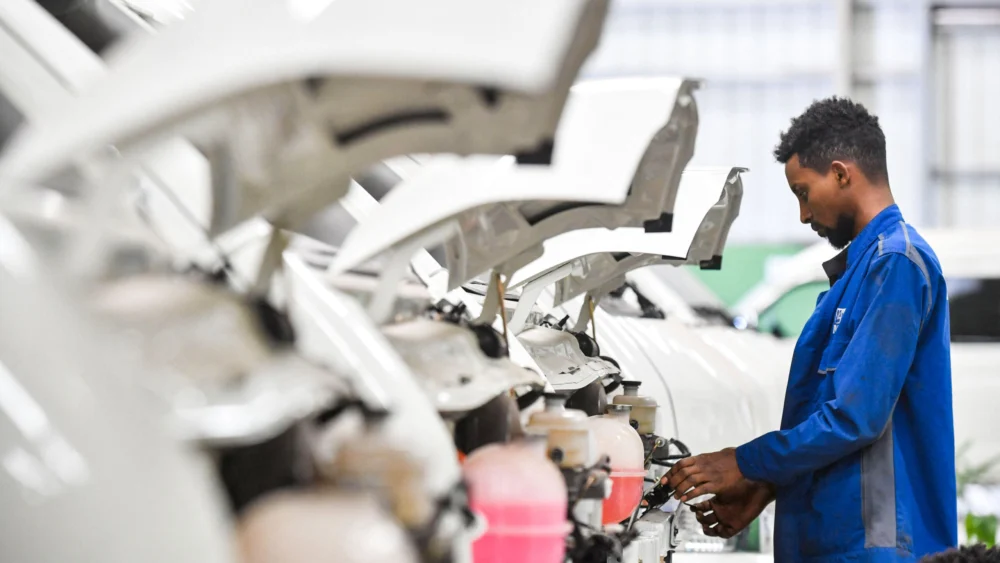
One of the most significant shifts in the African EV landscape is the move from being a consumer of technology to a producer. For decades, the African automotive sector was largely limited to the assembly of "knock-down kits" designed elsewhere. Now, there is a concerted effort to build a localized supply chain for the electric era.
Morocco is emerging as a central hub in this new industrial strategy. The Chinese battery giant Gotion High-Tech is currently constructing Africa’s first battery gigafactory in the kingdom. This $5.6 billion project is a cornerstone of Morocco’s ambition to become a global automotive leader. Once operational in 2026, the facility is expected to produce 20 gigawatt-hours of batteries annually—enough to power hundreds of thousands of vehicles.
Morocco’s advantage lies in its strategic geography and its free trade agreements with both the United States and the European Union. By manufacturing batteries on African soil, Gotion is not only targeting the burgeoning local market but also positioning Morocco as a vital link in the global EV supply chain, providing a "near-shoring" solution for European automakers looking to diversify away from a purely China-centric production model.
The China-Africa Synergy
The role of China in Africa’s EV transition cannot be overstated. As the Chinese domestic market becomes increasingly oversaturated, its automotive giants are looking toward the "Global South" for growth. BYD, the world’s largest EV manufacturer, is currently executing an aggressive expansion strategy in South Africa, with plans to establish 70 dealerships by the end of 2026.
Chinese manufacturers have a distinct advantage in the African market: they specialize in the production of high-quality, affordable EVs that benefit from massive economies of scale. While Western automakers have largely focused on the luxury and premium segments, Chinese brands like BYD, Wuling, and Chery are offering vehicles that are price-competitive with traditional ICE cars.
Kelly Carlin, a manager at the Rocky Mountain Institute, notes that this influx of affordable technology is a "game changer." By providing vehicles that fit the economic reality of African consumers, Chinese firms are lowering the barrier to entry and accelerating a transition that many thought was decades away.
Infrastructure: The Final Hurdle
Despite the optimism, the road to full electrification remains fraught with challenges. The most significant of these is the electricity grid itself. While some nations like Ethiopia and Morocco have made strides in energy production, many other African countries struggle with intermittent supply and limited grid reach.
Charging an EV requires a stable and robust power source. In regions where blackouts are common, owning an EV can be a liability. To solve this, a new wave of "off-grid" charging solutions is emerging. Startups are experimenting with solar-powered charging hubs that operate independently of the national grid, utilizing Africa’s most abundant resource—sunlight—to power its transport.
Furthermore, the "leapfrog" effect that saw Africa skip landline telephones in favor of mobile technology is likely to repeat in the energy sector. Instead of waiting for massive, centralized grid expansions, many regions may move toward decentralized microgrids and home solar systems that include EV charging as a core component.
The Path to 2040
The evolution of EVs in Africa is not a monolith; each of the 54 countries on the continent faces a unique set of circumstances. However, the underlying trend is clear: the economic case for electrification is becoming undeniable. As local manufacturing expands, as battery costs continue to fall, and as governments implement more "pro-EV" policies to protect their foreign reserves, the momentum will only grow.
By 2040, the streets of African cities will likely look and sound very different. The roar of small-displacement engines and the haze of exhaust fumes are being replaced by the quiet hum of electric motors. This is more than just a technological upgrade; it is a fundamental shift in how the continent moves, works, and powers its future. In the race toward a decarbonized world, Africa is no longer just a spectator—it is becoming a central player in the global electric revolution.
