

Across the steep inclines and historic architecture of San Francisco, local sidewalks have long served as an open-air proving ground for autonomous transit. While autonomous vehicles have gradually shifted from curious tech novelties to ambient background infrastructure, an entirely different technological frontier is quietly crossing residential thresholds. Rather than navigating street intersections and highway merges, a new breed of bipedal machines is attempting to master the vastly more unpredictable terrain of living rooms, kitchens, and private bathrooms.
At the forefront of this emerging wave is Tau Robotics, a nimble robotics startup based in the Bay Area that is dispatching humanoid machines directly into residential properties. The core promise—a future where tedious domestic chores are permanently offloaded to mechanical assistants—evokes vintage mid-century science fiction. Yet beneath the veneer of futuristic domesticity lies an intricate, labor-intensive bridge between pure human intervention and embodied artificial intelligence: human teleoperation.
Rather than autonomous artificial general intelligence executing seamless household maintenance, early residential deployments rely on human operators operating behind the curtain. These remote pilots guide the machines through wrist- and head-mounted optical cameras, translating digital commands into physical motions. As these four-and-a-half-foot-tall automatons scrub bathroom porcelain, fold garments, and navigate throw rugs, they generate the missing currency of the robotics sector: granular, high-fidelity real-world kinematic data.
The domestic service, which the company initially offered at subsidized rates around $30 an hour before transitioning to tiered pricing models, functions less like an off-the-shelf appliance and more like an immersive field trial. For consumers, having a humanoid machine cross the threshold represents an extraordinary glimpse into the trajectory of consumer hardware. For engineers, it represents a calculated gamble that real homes are the only classrooms capable of advancing machine learning beyond sterile lab demonstrations.
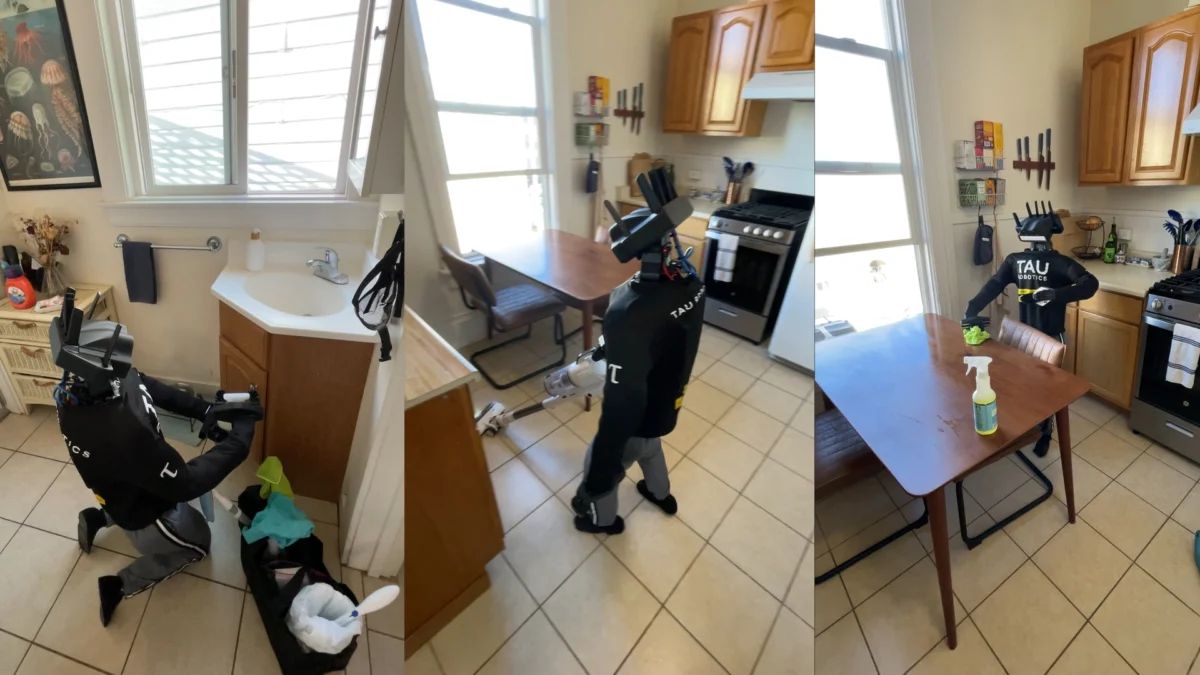
The physical architecture of the Tau robot illustrates the stark gap between polished venture-capital marketing renderings and the gritty realities of domestic maintenance. Standing roughly the height of a middle-schooler, the machine eschews the delicate, multi-articulated hands favored by research institutions in favor of rugged, 3D-printed claw end-effectors. While human-like hands possess fine motor capabilities, their intricate gear trains and complex tendon networks break down rapidly under the repetitive mechanical shocks of cleaning. The dual-pronged claws, while aesthetically utilitarian, prove capable of executing gross motor manipulation: grasping spray bottles, securing sponge wands, and manipulating textiles.
Adorned in branded casual attire and wearing rubberized non-slip socks designed to protect hardwood floor finishes, the robot embodies an odd blend of industrial prototyping and suburban domesticity. Two communication antennae protrude from its printed chassis, maintaining the low-latency cellular and local network uplinks that link its onboard actuators directly to remote command centers across town.
That communication link, however, exposes the precarious physics of remote mechanical operation. In a recent trial across a classic multi-story San Francisco residential building, the machine encountered its first major physical obstacle before ever crossing the front door: an eight-step exterior staircase. The robot navigated the concrete steps with an uneven, halting gait reminiscent of a person battling extreme inner-ear disequilibrium. Each forward ascent was counterbalanced by defensive backward adjustments, an erratic dance dictated by the milliseconds of latency separating the remote pilot’s control input from the physical robot’s sensor response.
Inside the residence, the challenges multiplied. Dense carpeted steps introduced an excessive degree of mechanical friction, ultimately requiring on-site human staff to assist the bipedal chassis over the final risers. Later, as the robot commenced surface maintenance in the kitchen, operations ground to an unexpected standstill. An unseasonal spike in ambient indoor temperature had overwhelmed the control hardware stationed at the pilot’s remote monitoring terminal, causing the video feeds to stutter and drop. Because the system lacks full native autonomy, the sudden severance of teleoperation rendered the machine entirely inert, terminating the session early.
Subsequent trials conducted under stabilized network and thermal conditions, however, revealed the sheer dexterity these systems can achieve under seasoned remote supervision. Inside a compact apartment kitchen, the machine systematically cleared debris from countertops, moving with slow, calculated deliberation. Its most notable feat occurred in the bathroom, tackling the unglamorous chore of scrubbing the toilet bowl. When the disposable cleaning pad detached from its wand—an error that occurred three consecutive times—the machine did not require human intervention. Guided by the remote pilot, the robot leveraged spatial feedback, repeatedly angling the shaft until it successfully engaged the locking mechanism and resumed scrubbing.
Despite these flashes of mechanical competence, the operational friction of early-stage hardware remains omnipresent. The robot inadvertently tipped over a bottle of olive oil, knocked an air purifier onto its side without the kinematic dexterity to right it, and left water faucets trickling after use. The cadence of cleaning is deliberate to the point of sluggishness; for many early adopters, watching the machine navigate around chair legs and door jambs takes considerably more time than performing the cleaning manually.
Yet viewing these missteps through the lens of pure consumer utility misses the economic logic driving the venture. What users are witnessing is not a finished appliance, but the costly process of data collection required to overcome Moravec’s paradox. First articulated by artificial intelligence researchers in the 1980s, the principle observes that tasks requiring advanced reasoning—such as playing grandmaster-level chess or passing bar examinations—demand surprisingly little computational overhead, whereas basic sensorimotor skills like walking across an uneven rug, grasping an egg without cracking it, or identifying the hem of a sheet remain monumental challenges for robotic systems.
Large language models expanded exponentially because they were fed decades of digitized text harvested from the public internet. Embodied AI enjoys no such repository. There is no historical internet archive detailing the exact force curves required to scrape dried food from a ceramic plate or the visual-tactile feedback needed to flatten a crumpled fitted sheet. By deploying teleoperated machines into private spaces, startups are manually compiling the foundational datasets necessary to train end-to-end neural networks.
Tau co-founder Cornelia Weinzierl notes that the machines are already transitioning toward localized autonomy for low-complexity, structured behaviors. Baseline duties such as floor vacuuming and mopping can operate without direct kinematic piloting, functioning along pathways mapped by onboard spatial sensors. The transition toward handling unstructured edge cases—such as untangling charging cords, navigating scattered toys, or laundering fragile fabrics—will require thousands of recorded teleoperation hours before autonomous vision-language-action (VLA) models can reliably take over.
This operational methodology introduces profound considerations regarding privacy and residential security. Inviting a network-connected machine equipped with omnidirectional, high-resolution cameras and microphone arrays into intimate residential environments represents an unprecedented data concession. Remote pilots inevitably gaze into bedrooms, bathrooms, and private workspaces. While early adopters in technology hubs may trade personal privacy for access to frontier technology, widespread consumer adoption will require air-gapped processing, localized edge-computing architectures, and ironclad regulatory frameworks governing domestic data custody.
Simultaneously, the maturation of domestic robotics will eventually force a reckoning within the service economy. Residential and commercial cleaning employs millions of individuals globally, often representing accessible entry points for migrant and working-class labor. Startup leaders argue that robotic labor addresses chronic shortages in a high-turnover, injury-prone industry characterized by repetitive strain injuries and chemical exposure. Tau points toward future applications in high-risk environments, including toxic mold remediation, industrial biohazard cleanup, and assisted-living facilities facing acute caregiving deficits. Nevertheless, the macro-scale automation of manual services risks outstripping the social safety nets currently available to displaced workers.
The road from teleoperated prototype to autonomous domestic fixture remains long, fraught with engineering bottlenecks spanning battery energy density, actuator reliability, and network latency tolerances. With only a few hundred cleanings completed, Tau Robotics and its competitors are navigating an arduous evolutionary path.
Yet, as the small, t-shirt-clad machine works methodically through a San Francisco residence, clutching a toilet wand with 3D-printed claws, the trajectory of domestic labor shifts from theoretical speculation to physical reality. The automated home of tomorrow will not arrive instantaneously as an immaculate, perfectly coordinated marvel. It will enter clumsily, one teleoperated step at a time, stumbling occasionally on the stairs while gathering the data it needs to stand entirely on its own.
