


Modern internet browsers serve as the central operating system for the digital age, hosting our communications, financial transactions, and professional workflows. Because users place immense trust in these applications, malicious actors continuously search for architectural vulnerabilities to exploit. A recent, highly organized threat campaign has weaponized popular browser add-ons across major platforms like Google Chrome and Microsoft Edge. By deploying a modular framework designed to steal cryptocurrency, capture sensitive credentials, and inject deceptive lures, the operators behind this campaign have demonstrated how easily the foundational trust of web extensions can be subverted into an expansive attack vector.
Discovered by application security researchers, the multi-layered campaign relies on a suite of malicious modules that are as versatile as they are dangerous. Investigators tracking the operation believe it has been quietly active since early 2024, gradually refining its methodologies, expanding its targeting criteria, and scaling its distribution network. The underlying architecture of the malware is distinguished by its high degree of modularity. Rather than packing all malicious functions into a single monolithic script, the threat actors utilized 19 distinct modules, each engineered for a specialized task. This modular approach allows the attackers to tailor their payload dynamically based on the target environment, making detection significantly more difficult for automated security scanners and heuristic engines.

The lifecycle of these malicious add-ons often begins innocently. Security experts emphasize that many of the tools involved in this campaign originally entered the Chrome Web Store as legitimate utilities. They provided genuine, advertised services to their user bases, allowing them to accumulate favorable reviews, build organic trust, and clear the initial automated screening processes implemented by platform operators. Once a stable user base was established, the threat actors executed a classic supply-chain takeover maneuver. In several documented instances, the developers behind these extensions sold their digital assets to anonymous buyers, or accounts were compromised outright.
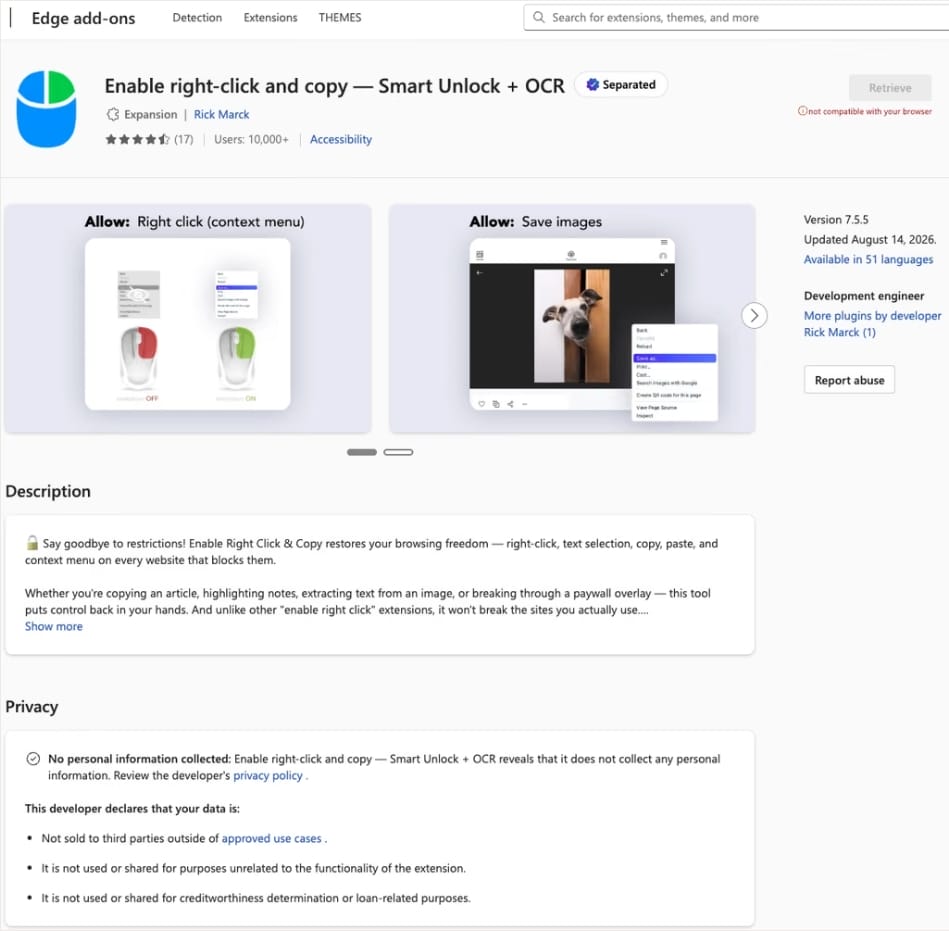
With administrative control transferred, the new operators weaponized the tools by pushing automatic updates to thousands of unsuspecting users. A prime illustration of this strategy is the utility tool marketed as "Enable Right Click & Copy — Smart Unlock + OCR." Prior to its malicious transformation, the extension enjoyed a healthy following of at least 70,000 Chrome users, alongside an additional 10,000 installations on the Microsoft Edge add-on marketplace. When the malicious update rolled out, it seamlessly converted a productivity aid into a covert data-harvesting machine. Although Google’s automated threat-hunting systems flagged and purged the offending utility from the Chrome Web Store relatively quickly, the Edge variant persisted for a significantly longer window, highlighting discrepancies in multi-platform threat response times.
The technical mechanics of the framework are both intricate and invasive. Upon successful installation of an affected extension, the malware immediately initializes communication with external command-and-control (C2) infrastructure. It establishes an encrypted WebSocket connection, ensuring that data exfiltration and command polling remain obscured from basic local monitoring tools. Through this channel, the framework downloads additional JavaScript payloads on demand. To facilitate deep interaction with the user’s browsing sessions, the malicious scripts systematically strip out Content Security Policy (CSP) headers from every website the victim visits. Dismantling these security headers effectively neutralizes browser-level mitigations designed to prevent cross-site scripting and unauthorized resource loading, paving the way for further exploitation.
Once the environment is compromised, the malware deploys specialized modules via hidden HTML elements injected directly into DOM structures. Among the most lucrative components observed by researchers are advanced crypto-drainer interfaces and seed-phrase harvesting pages. These modules are custom-built to intercept user interactions with decentralized finance platforms, cryptocurrency wallets, and authentication portals. When an individual attempts to manage digital assets or interact with a Web3 application, the injected scripts can manipulate interface elements, display fraudulent verification prompts, or directly capture sensitive mnemonic phrases. Beyond cryptocurrency theft, the framework actively logs browser histories, sifts through local storage for authentication tokens, and deploys "ClickFix" social engineering lures designed to trick users into executing further administrative commands or downloading secondary payloads.
Security analysts warn that the observed toolset is merely a snapshot of a living, evolving ecosystem. Because the framework is inherently extensible, the threat actors retain the capability to deploy entirely new payloads, alter exfiltration routes, or pivot toward different types of monetization strategies as defensive postures adapt. While rigorous remediation efforts eventually cleared the compromised software from major storefronts, the historical distribution footprint remains extensive. The security community has published comprehensive telemetry data, including a full roster of affected extension identifiers and the associated domain names tied to the adversary’s C2 infrastructure.
The catalog of compromised utilities spans a diverse range of categories, proving that the threat actors deliberately targeted tools with broad demographic appeal. The affected software inventory includes productivity enhancements, PDF utilities, SEO and website traffic analyzers, custom crypto news readers, portfolio trackers, multi-chain explorers, and social media ad library search tools. Prominent examples cataloged by researchers include RapidLens – Google Lens for Screen Search & Images, Password Protect PDF, Allow Copy – Select & Enable Right Click, PixelCheck, Creative Library – Ad Spy Tool, Website Traffic Checker: MirrorSphere SEO Stats, Site Signal – Website Traffic & SEO Checker, SEO Pulse Pro – Website Traffic & SEO Analyzer, Private Crypto News Reader, Blockfolio: Address Monitor, Crypto Rates & Fiat Converter, Crypto Alerter: Price Alarms & Volatility Warnings, DeFi Pulse Tracker, Crypto Price Badge: Quick Glance, Multi-Chain Explorer, LedgerLook: Wallet Checker, and Meta & Facebook Ad Library Spy.
The implications of this campaign extend far beyond immediate financial losses, shedding light on systemic vulnerabilities within centralized software distribution models. The ease with which legitimate developer accounts can be acquired or hijacked points to a critical blind spot in how platform operators vet ongoing software maintenance. Automated scanning tools excel at evaluating initial submissions, but they historically struggle to monitor the behavioral evolution of software post-installation, especially when updates are pushed incrementally. This creates an environment where browser extensions—privilege-heavy applications capable of inspecting and modifying web traffic—can transform into internal threats overnight.
For individuals who discover they have operated any of the listed extensions, the remediation protocol must be swift and comprehensive. Because the malware is engineered to harvest authentication tokens, session cookies, and login credentials, victims should immediately operate under the assumption that all personal and professional accounts accessed via the browser have been compromised. Essential steps include revoking active sessions, rotating account passwords across critical services, and enforcing multi-factor authentication everywhere possible.
Cryptocurrency holders who interacted with Web3 platforms while these extensions were active face a severe risk of asset loss. Security experts strongly advise moving remaining digital assets to a newly generated, uncontaminated wallet address immediately, as traditional password changes will not secure funds if private keys or seed phrases were previously exfiltrated. Ultimately, this incident serves as a stark reminder of the digital supply chain’s fragility, urging both everyday users and enterprise administrators to maintain rigorous scrutiny over the browser extensions they invite into their digital workflows.
