


Digital security infrastructures faced yet another high-profile test following a targeted cyberattack on pCloud Pass, the dedicated password management solution provided by cloud storage provider pCloud. The incident, which quickly sparked widespread anxiety across international user communities, underscored the persistent risks facing centralized credential repositories. As threat actors continually refine their tactics to exploit enterprise networks and consumer-facing applications alike, the compromise of a password manager serves as an alarming reminder that even zero-knowledge architectures and rigorous encryption protocols are not entirely immune to operational disruption and targeted perimeter probes.
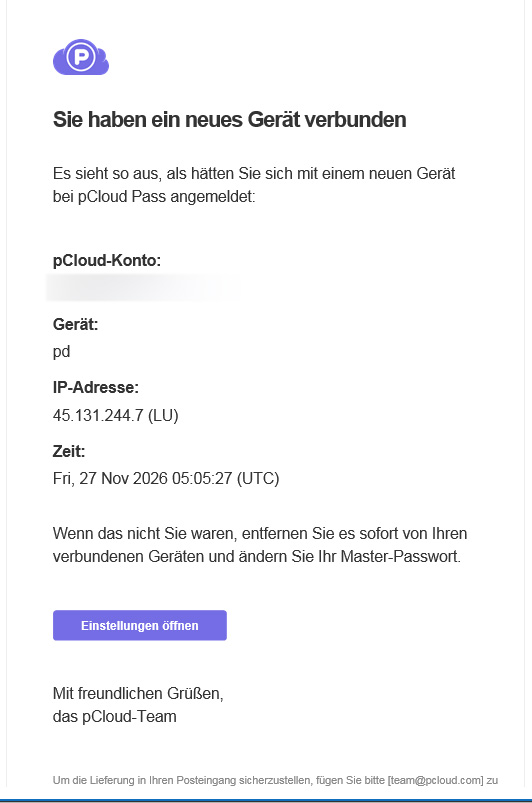
The breach first came to light through a flurry of organic user complaints across digital forums such as Reddit, where international customers expressed mounting confusion after receiving unsolicited automated security warnings. These notifications explicitly cautioned account holders that an unfamiliar client device, labeled mysteriously as "pd," had established an active connection to their pCloud Pass environments. Deepening the intrigue and immediate suspicion among technical users, the originating IP address associated with these inbound connections—45.131.244.7—was rapidly traced back to infrastructure physically and logically located in Luxembourg, aligning directly with internal network blocks historically utilized by pCloud itself.
Complicating the narrative further, a significant subset of affected individuals reported receiving these automated alerts despite having robust, time-based two-factor authentication (2FA) mechanisms natively enabled on their profiles. Yet, upon logging into their dashboards to audit active sessions and revoke rogue tokens, many users discovered absolute vacancies in their connected device logs, pointing toward an internal telemetry glitch or an automated brute-force wave that bypassed standard session persistence metrics. Stranger still, the alert vector swept beyond active users of the password manager; multiple complaints surfaced from individuals who had long abandoned the ecosystem. One notable account holder noted receiving the warning message at a designated email alias linked to a cloud storage tier they had formally requested to purge nearly a year prior, highlighting potential deficiencies in database lifecycle management and user record retention.

Faced with mounting public inquiry and digital forensics speculation, pCloud management formally acknowledged the security event, asserting that the malicious activity was isolated strictly to the pCloud Pass framework and promptly contained by its internal engineering units. In an official communication released to the community, company representatives detailed that an unauthorized actor initiated a targeted campaign directed at the password management subsidiary. According to this narrative, a minor portion of registered user email addresses faced exposure, facilitating a sequence of automated login maneuvers that consequently triggered the platform’s native notification dispatchers.
Crucially, pCloud maintained that its primary cloud storage architecture remained entirely insulated from the breach. The organization heavily emphasized the foundational security tenets of its password manager, reiterating that core user assets—including stored credentials, confidential notes, and sensitive text snippets—retained their cryptographic integrity. Because pCloud Pass operates on client-side encryption paradigms, stored items are scrambled locally on user endpoints before ever hitting corporate servers, meaning decryption theoretically requires the user’s unique master password.
Despite these reassuring architectural guarantees, critical transparency gaps quickly drew the critical eye of cybersecurity researchers and privacy advocates. Notably, pCloud omitted explicit confirmation regarding whether encrypted user vaults—the encrypted blobs containing the underlying credential databases—were successfully accessed, copied, or exfiltrated during the intrusion window. In the landscape of modern threat intelligence, this omission carries immense weight.
Security analysts frequently emphasize that the acquisition of an encrypted password vault by a sophisticated adversary represents a severe structural danger, regardless of client-side encryption. Once threat actors secure a copy of an encrypted vault file, they can extract it from the target environment and subject it to offline cracking techniques. This completely circumvents cloud-side login rate limits, account lockouts, and multi-factor authentication defenses. Attackers can leverage powerful GPU clusters to execute relentless brute-force and dictionary attacks against the master password hash at scale.

The catastrophic potential of this threat model was famously proven during the multi-stage 2022 LastPass security incident. In that scenario, attackers exfiltrated corporate backups containing encrypted password vaults, which were subsequently weaponized in targeted cryptocurrency theft campaigns. Investigators later tied the stolen vaults to devastating digital asset losses, concluding that threat actors successfully cracked weak, recycled, or poorly constructed master passwords to unlock stored wallet private keys and mnemonic seed phrases. Consequently, pCloud’s silence regarding the potential theft of encrypted vaults leaves a lingering cloud of uncertainty for privacy-conscious users.
Further compounding the operational confusion surrounding the incident, attentive readers and security researchers who dissected the notification emails flagged a peculiar anomaly. The hyperlinks labeled "Open settings" within the automated warning messages redirected traffic to passqa1.pcloud.com. Rather than routing users to the secure, public-facing production website, this subdomain clearly pointed toward a quality assurance (QA) and testing environment. Independent verification by technical publications confirmed that this staging URL was indeed embedded uniformly across the alert transmissions, suggesting either an internal configuration oversight during the incident response phase or evidence of an environment mix-up originating deep within the platform’s automated notification pipeline.
Amid these revelations, pCloud briefly touched upon the macro-level threat landscape, noting that contemporary advancements in artificial intelligence are drastically accelerating the discovery of software bugs and the execution of vulnerability research. However, the firm stopped short of classifying the pCloud Pass breach explicitly as an AI-driven offensive operation. Alongside its technical debriefing, the company issued standard defensive advisories, urging clients to remain hyper-vigilant against opportunistic phishing campaigns that typically tailspin out of publicized data breaches. pCloud reiterated a golden rule of digital hygiene: corporate representatives will never solicit a user’s master password or account recovery seed phrase via electronic mail, telephony, or instant chat interfaces.
The timing of the pCloud Pass incident positions it uncomfortably within a broader, deeply unsettling wave of cybersecurity crises impacting the password management sector as a whole. The digital security community has watched a relentless succession of high-profile platform compromises unfold within a remarkably tight window. Earlier in the month, mSeven Software issued an urgent advisory urging mSecure customers to immediately modify stored credentials, cycle their two-factor authentication configurations, and strip away passkeys after a malicious actor successfully purloined an encrypted customer database.
Just days prior to the pCloud disclosures, identity management heavyweight 1Password suffered its own structural scare, disclosing a notable data breach stemming from a compromised employee GitHub account. In that attack, threat actors successfully deployed malicious code injections into backend services with the explicit intent of harvesting customer metrics. While 1Password moved quickly to reassure the public that user vaults and underlying cryptographic keys remained untouched, the sheer frequency of these assaults highlights an undeniable reality: password managers remain the crown jewels of the modern internet, making them primary targets for nation-state actors, financially motivated cybercrime syndicates, and persistent advanced persistent threat (APT) groups.
Looking forward, the cumulative effect of these sequential breaches is likely to accelerate a structural shift in how users authenticate and how developers construct digital security tools. As consumer trust faces continuous erosion, the industry is witnessing an accelerated migration toward alternative authentication paradigms, such as passkeys rooted in public-key cryptography, hardware security keys, and decentralized identity verification models. These technologies aim to eliminate the single point of failure represented by master passwords and centralized credential vaults.
For centralized password management providers, the message is stark and uncompromising. Maintaining zero-knowledge architecture is no longer sufficient; platform operators must enforce rigorous internal access controls, rigorous supply-chain hygiene, rapid incident transparency, and airtight environment segregation to prevent staging servers and QA domains from bleeding into production telemetry. As threat actors increasingly weaponize automation and artificial intelligence to probe enterprise perimeters, the margin for error in digital security has evaporated entirely. Consumers, meanwhile, are left with little choice but to adopt maximum-defense postures—utilizing exceptionally complex, unique master passwords, enforcing hardware-backed multi-factor authentication, and maintaining constant vigilance against the rising tide of sophisticated cyber threats.
