


The sprawling ecosystem of open-source content management architectures has once again been cast into the spotlight of cyber risk following the identification of a high-severity security defect within a widely deployed utility. Tracked systematically under the designation CVE-2026-19949, this architectural flaw resides inside the All-in-One WP Migration and Backup utility, an indispensable administrative asset utilized heavily across the global web hosting landscape. Security researchers who analyzed the code identified a complex second-order SQL injection vector that, if deliberately chained with auxiliary exploitation techniques, opens an avenue for unauthenticated malicious actors to execute arbitrary remote code. This capability effectively grants nefarious external agents total operational control over millions of vulnerable web properties worldwide, highlighting the fragile nature of third-party dependencies in modern enterprise and consumer web deployments.
To fully understand the gravity of this technological exposure, one must examine the operational footprint of the affected utility. The module in question is fundamentally engineered to simplify the complex lifecycle of website administration. It allows developers, system operators, and casual bloggers alike to back up, export, import, and migrate entire web properties—encompassing intricate relational databases, rich media assets, custom themes, and complex software extensions—seamlessly across distinct servers or domain boundaries. Because of its robust functionality and user-friendly interface, the package has achieved massive market penetration, boasting an active installation base exceeding five million live websites. This high-density adoption transforms what would otherwise be an isolated coding error into a systemic crisis capable of sending shockwaves through a significant fraction of the internet economy.
The discovery of CVE-2026-19949 is credited to independent security investigator Jack Taylor, who formally surfaced the anomaly in mid-August through the coordinated vulnerability disclosure channels managed by the cybersecurity firm Wordfence. Subsequent technical analysis conducted by specialized threat research teams unveiled that the core vulnerability stems from how the software processes data strings during specific operational phases. Specifically, the defect manifests as a second-order SQL injection flaw impacting all software releases up to and including version 7.109. The root cause is traced back to improper sanitization and incorrect parsing behaviors when the program handles escaped backslashes and quotation marks while rewriting internal database contents during archive restoration routines.

Unlike direct-injection vulnerabilities where an incoming request immediately executes malicious queries, second-order injections require a multi-stage attack pattern. In this particular scenario, an unauthenticated, remote adversary can inject maliciously crafted payloads into a target website by exploiting routine communication channels, such as standard WordPress trackbacks. These injected strings remain entirely dormant within the database tables, posing no immediate threat to the confidentiality, integrity, or availability of the system. However, the operational danger escalates dramatically when a privileged administrator performs routine site maintenance. Because migration and backup utilities are designed precisely for moving data, administrators frequently export and import site archives as part of standard operational workflows. When the administrative user initiates a restoration or import sequence, the application processes the stored string boundaries improperly, forcing the dormant malicious payload to execute as legitimate SQL commands.
The mechanics of the exploit leverage this administrative trigger to achieve privilege escalation. Once the injected SQL code successfully executes during the archive import phase, it forces the exposure of the utility’s highly guarded administrative secret import key, formally designated as ai1wm_secret_key. This sensitive credential is inadvertently leaked through a publicly accessible comment section or equivalent output vector, allowing the external attacker to harvest the key without authorization. Armed with this valid secret import key, the malicious actor can bypass structural security gates and upload a specially crafted, malicious archive file—commonly utilizing the proprietary .wpress extension format—containing executable webshells or custom backend code. Because the application processes these files under high-level administrative privileges, the resulting remote code execution grants the attacker absolute dominion over the underlying server environment, enabling unauthorized data exfiltration, defacement, or the quiet conversion of the host into a node for larger botnet infrastructure.
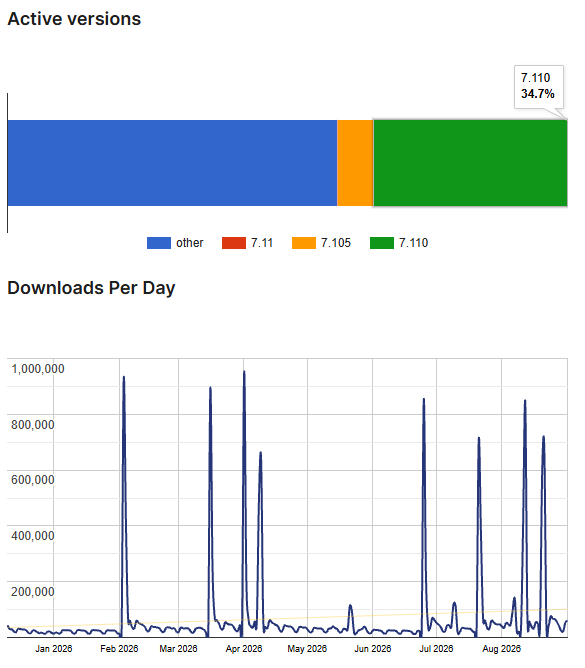
Despite the rapid response and remediation efforts orchestrated by the developer, ServMask, the aftermath of this disclosure paints a concerning picture of patching velocity across the broader digital landscape. ServMask moved swiftly to neutralize the threat, releasing version 7.110 of the plugin which officially remediates CVE-2026-19949. Yet, telemetry data gathered across the ecosystem reveals a severe lag in patch adoption among site owners. Statistics indicate that approximately 35 percent of the active user base has successfully updated to the secure iteration. Consequently, an alarming 3.25 million active web properties continue to operate on vulnerable releases, leaving them exposed to potential exploitation if malicious actors decide to weaponize the disclosed flaw at scale.
This slow remediation cadence underscores a persistent, systemic vulnerability within the open-source software supply chain: patch fatigue and administrative negligence. Millions of website owners treat software updates as optional chores rather than critical defensive operations, often failing to monitor advisory boards or maintain automated update pipelines. Furthermore, security analysts note that while the requirement for an administrative trigger—specifically the restoration of a backup archive—introduces a minor friction point that somewhat limits instant, automated drive-by exploitation, the fundamental nature of the software virtually guarantees that administrators will execute these routines eventually. Because backing up and restoring data is the primary raison d’être of the migration utility, routine maintenance actions are inevitable, transforming the administrator’s own workflow into the unwitting catalyst for system compromise.
Security researchers have also clarified nuance regarding deactivated states. While leaving a vulnerable version of the plugin in a dormant, deactivated status naturally reduces the immediate attack surface because the application logic is not actively evaluating incoming web traffic, the risk is not entirely eliminated. If a compromised site undergoes temporary activation of the plugin for an emergency maintenance check, the underlying second-order SQL injection vector instantly becomes viable for exploitation. This reality emphasizes that mere deactivation is an insufficient security posture, and complete removal or strict updating is the only definitive remedy.
The broader industry implications of the CVE-2026-19949 incident extend far beyond a single utility or content management platform. As the global digital economy becomes increasingly reliant on modular software architectures and third-party code libraries, the attack surface expands exponentially. Developers of utility plugins carry an immense responsibility, as a single parsing error in a database manipulation routine can jeopardize millions of corporate identities, e-commerce storefronts, and informational portals. Cybersecurity analysts point out that enterprise risk management frameworks must evolve to incorporate rigorous third-party component monitoring, automated vulnerability scanning, and continuous compliance checks to catch such second-order anomalies before they reach production environments.
Looking toward future trends in web application security, the proliferation of sophisticated injection vectors highlights the limitations of traditional perimeter defenses. Web Application Firewalls (WAFs) and basic input filters often struggle to detect second-order SQL injections because the malicious payload is initially stored benignly and only executed later during internal application processing routines. This behavioral complexity necessitates advanced runtime application self-protection (RASP) solutions and stricter code auditing standards that emphasize secure string parsing, robust context-aware escaping, and rigorous boundary validation. As threat actors increasingly target the software supply chain to achieve maximum leverage with minimal effort, the cybersecurity community must prioritize proactive threat hunting and frictionless patching mechanisms. Ultimately, the All-in-One WP Migration and Backup incident serves as a stark reminder that in the interconnected architecture of the modern web, an organization’s security posture is only as robust as its most neglected plugin.
