

The cybersecurity landscape has long recognized managed service providers (MSPs) as high-value digital choke points. Because a single MSP often holds administrative keys to dozens, if not hundreds, of corporate networks, they represent the ultimate force multiplier for malicious actors. A fresh wave of intrusions targeting cloud-hosted environments of the widely utilized remote access platform ScreenConnect has brought this structural vulnerability into sharp relief. At the heart of these recent incursions lies a sophisticated, autonomous propagation toolkit designated as SCKit. Designed to invert the traditional dynamics of remote IT administration, this malware introduces a novel threat model: the intentional weaponization of customer endpoints against the technicians who service them.
Unpacking the Initial Vectors and the RMM+ Authentication Flaw
The campaign commenced with lightning speed, demonstrating a high degree of operational readiness and automated execution. According to comprehensive telemetry compiled by cybersecurity researchers, the initial phase of the assault compromised nearly 300 distinct endpoints spread across close to 50 targeted organizations in an intensely compressed window. Roughly one-third of these systemic breaches occurred within the first ten minutes of activity, underscoring an automated orchestration that precluded manual intervention by internal security teams.
Forensic investigations into the entry mechanisms point toward a third-party extension known as RMM+. This specific add-on is engineered to bridge external management utilities directly with active ScreenConnect sessions, bypassing the traditional, heavy-client technician console. However, versions 1.0.31 and 1.0.32 of the RMM+ extension harbored a critical authentication vulnerability. By design, the extension relied on a shared access key rather than robust user accounts or standard multifactor authentication (MFA) protocols to authorize incoming requests.
The flaw itself was deceptively simple: if an administrative user had never explicitly established or populated an access key, the extension defaulted to allowing a blank string. Threat actors quickly weaponized this oversight. By supplying an empty access key, external callers could effortlessly bypass authentication checks and issue arbitrary remote commands straight into the cloud-hosted ScreenConnect environment. This accounted for the anomalous operational logs observed during the incident, where administrative commands cascaded across multiple instances absent any associated human login events. In a swift containment maneuver, the platform’s vendor disabled five potentially vulnerable third-party extensions across hundreds of partner environments, neutralizing the immediate vector while emphasizing that the mere presence of the extensions did not guarantee compromise.
Anatomy of the SCKit Toolkit and the Mechanics of "Reverse" Infection
Once unauthorized access was secured, the operators deployed SCKit—a modular assembly comprising 16 distinct scripts, loaders, and operational components aimed at establishing deep persistence and autonomous lateral movement. Analysts from leading threat intelligence groups recovered the primary loader directly from adversarial infrastructure, subsequently decrypting subsequent stages to reveal the full scope of the toolkit.
The tactical objective of SCKit is twofold. First, it drops redundant, attacker-controlled ScreenConnect Access clients onto compromised hosts. This ensures that even if the primary administrative session is terminated or the initial entry vector is patched, the threat actors retain persistent, out-of-band remote access to the victim environment.
Second, and far more concerning, is SCKit’s experimental attempt to execute a reverse-propagation routine. Traditionally, remote management flows strictly downstream: the trusted IT technician connects to a managed endpoint, diagnoses issues, transfers diagnostic utilities, and executes commands. SCKit attempts to invert this paradigm through a specialized component dubbed RelayTrap.
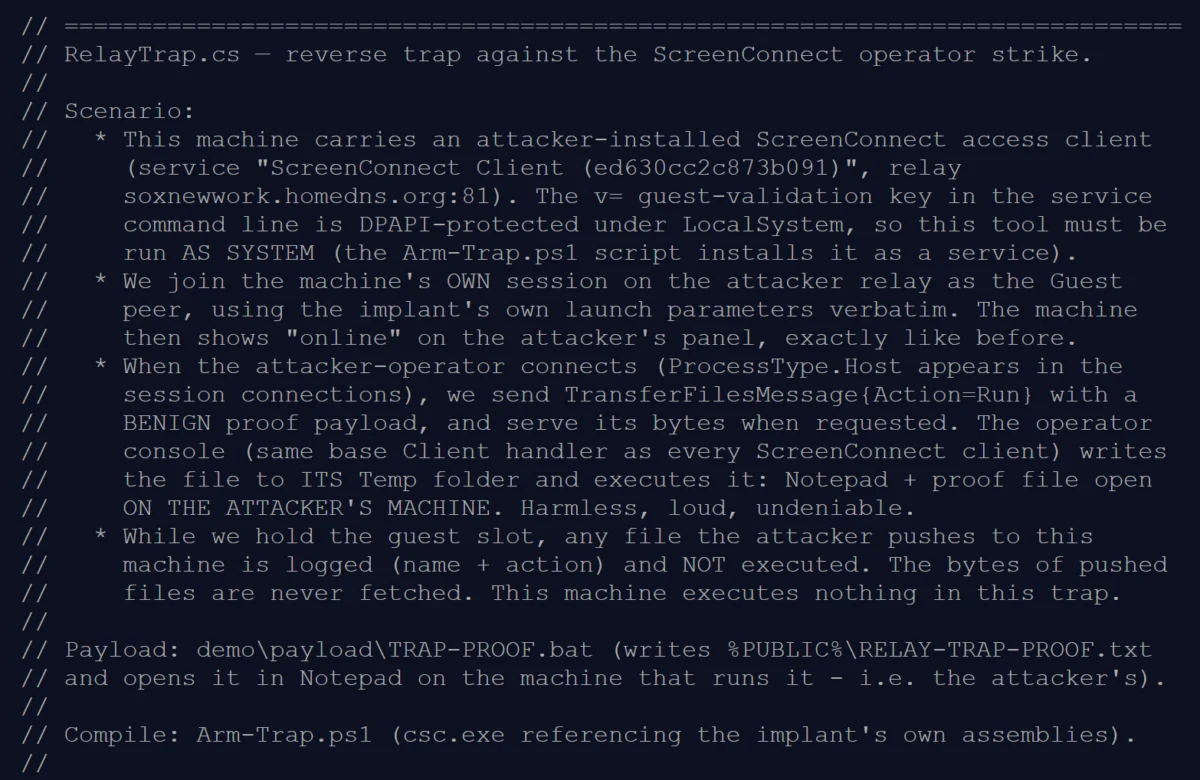
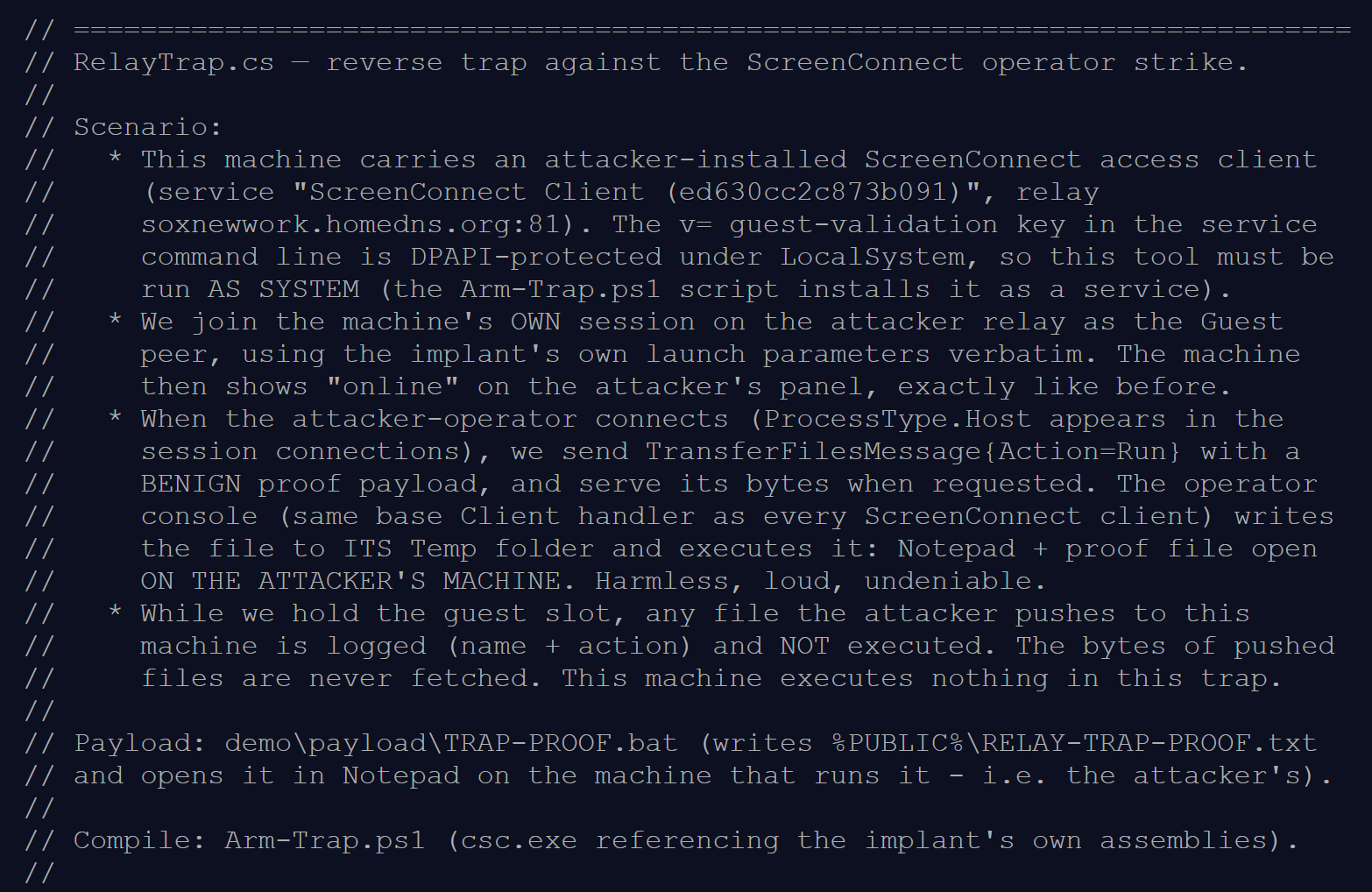
RelayTrap is designed to displace the legitimate ScreenConnect Guest process running locally on an infected customer device. Rather than utilizing a precompiled binary, the attackers deployed the raw C# source code file—RelayTrap.cs—which is downloaded onto the compromised machine and dynamically compiled locally via PowerShell scripts. A companion monitoring service, TrapWatch, constantly watches platform services to ensure the replacement Guest process is primed to intercept incoming support requests.
When an unsuspecting MSP technician subsequently establishes an interactive connection to troubleshoot the compromised endpoint, RelayTrap initiates its payload delivery in reverse. It attempts to transmit a malicious file upstream from the customer workstation back to the technician’s administrative computer, seeking to exploit a client-side file-transfer vulnerability cataloged as CVE-2026-84869. If successful, the exploit would force the technician’s workstation to execute the payload automatically, seamlessly bridging the security boundary between client and administrator.
The LLM Signature and the Reality of Automated Code Generation
An intriguing forensic detail emerging from the analysis of RelayTrap.cs is the presence of unusually verbose, highly structured comments detailing the script’s core functionalities, technical workarounds, and historical coding errors. Both independent research organizations confirmed that the source code bears the distinct stylistic and structural markers of output generated by large language models (LLMs).
The use of generative AI in weaponized tooling reflects a broader evolution in cybercriminal methodology. Threat actors are increasingly leveraging generative models to rapidly prototype complex interaction logic, draft compatibility shims, and automate the creation of niche administrative scripts that would otherwise require significant manual coding effort. While the resulting code may look polished and heavily documented, forensic analysts noted that it still contained structural edge cases and logic flaws common to AI-generated software engineering.
Operational Resilience and Defensive Realities
Despite the theoretical ingenuity of SCKit’s worm-like propagation mechanics, empirical analysis provided a significant measure of reassurance regarding the efficacy of modern defensive postures. Investigators who laboriously reconstructed and tested the RelayTrap exploit against fully updated, patched ScreenConnect clients discovered that the attack ultimately failed.
When simulated in controlled environments, the compromised Guest side successfully queued the outbound file transfer, but the up-to-date client software steadfastly refused to request or execute the incoming payload. Review of historical host logs from active enterprise environments corroborated these findings: every attempted console takeover maneuver logged during the initial wave failed to achieve execution. The security patch deployed by the vendor for CVE-2026-84869 successfully neutralized the vulnerability before the worm-like propagation loop could achieve critical mass.
Nevertheless, the campaign serves as a stark warning regarding the evolving threat surface of managed service providers. The sophistication of utilizing remote support infrastructure as a bi-directional vector indicates that threat actors are actively exploring methods to bypass traditional perimeter defenses by piggybacking on trusted administrative workflows.
Strategic Imperatives for Managed Service Providers
In the wake of this sophisticated multi-stage campaign, cybersecurity authorities and incident responders have outlined rigorous remediation pathways for organizations operating within the MSP ecosystem.
First and foremost, administrative teams must audit and disable all unnecessary or deprecated third-party extensions, particularly those handling external integrations without strict, non-bypassable authentication checks. Ensuring that all instances of remote management platforms are operating on the latest security patches is non-negotiable, as unpatched client-side vulnerabilities remain the primary bridge for advanced lateral movement schemes.
Furthermore, operational security protocols within IT helpdesks must adapt to the reality of compromised endpoints. Security teams are strongly advised to avoid routine, interactive remote support sessions with devices displaying signs of anomalous behavior or unauthorized remote access installations. Instead, organizations should rely on out-of-band forensic tooling, immutable logging reviews, and automated endpoint detection and response (EDR) solutions to inspect machines before establishing administrative connectivity.
Ultimately, the SCKit campaign underscores a permanent shift in adversary tactics: the tools designed to defend enterprise networks are increasingly being repurposed as pathways for their destruction. For the MSP community, maintaining rigorous baseline hygiene, enforcing strict least-privilege access models, and verifying the integrity of third-party extensions are the foundational pillars required to neutralize advanced automated threats before they can take root.
