

The modern threat landscape is increasingly defined by opportunistic yet highly targeted cyber espionage campaigns that bypass traditional perimeter defenses by chaining disparate vulnerabilities across enterprise and edge infrastructure. Recent threat intelligence findings have shed light on a sophisticated, Chinese-speaking adversary orchestrating a sweeping offensive campaign. By leveraging vulnerabilities in widely deployed content management systems, network hardware, and self-hosted development environments, the threat group has successfully compromised thousands of devices and exfiltrated sensitive government records across multiple continents.
This persistent campaign, first detected in early June through advanced global sensor networks, highlights the evolving tactics of state-backed and aligned cyber groups. Connected operationally to clusters resembling the Red Heron threat actor—noted previously for exploiting critical code-injection flaws in self-hosted Git services—the adversary exhibits a broad technological competence. Rather than relying on a single vector, the group dynamically pivots across diverse architectures, targeting enterprise firewalls, virtualization platforms, container orchestration tools, and edge management switches to establish footholds within high-value target networks.
At the core of the campaign’s initial intrusion phase is the exploitation of high-severity flaws within the WordPress core framework, specifically leveraging the "wp2shell" vulnerabilities tracked under CVE-2026-63030 and CVE-2026-60137. Publicly available exploit mechanics for these remote code execution pathways emerged during the summer, and active, weaponized exploitation campaigns materialized shortly thereafter. Threat analysts tracking the activity observed the adversary utilizing these specific WordPress vectors to breach at least 49 distinct organizations spanning 29 countries, predominantly targeting small businesses, enterprises, and public sector administrative bodies.

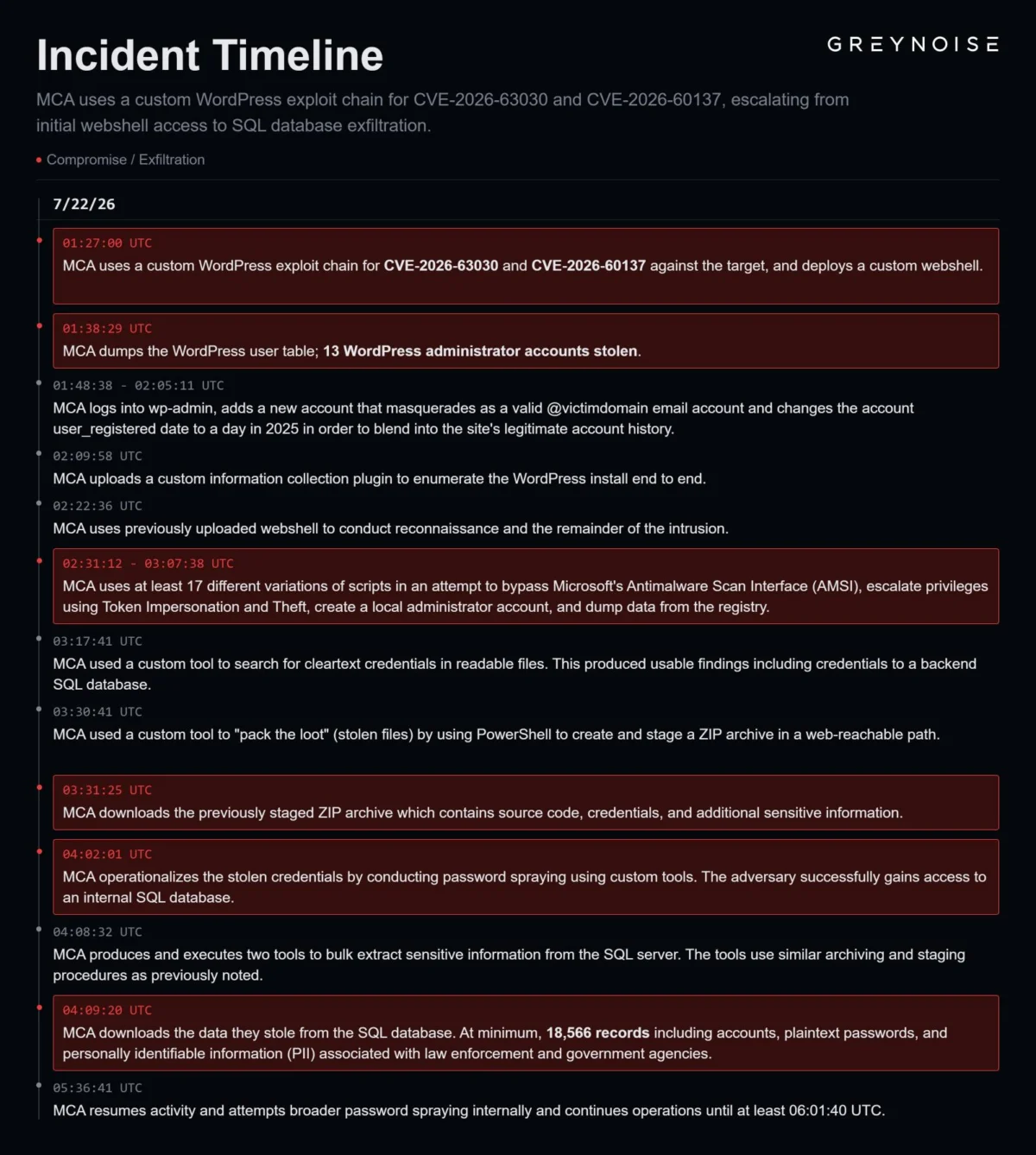
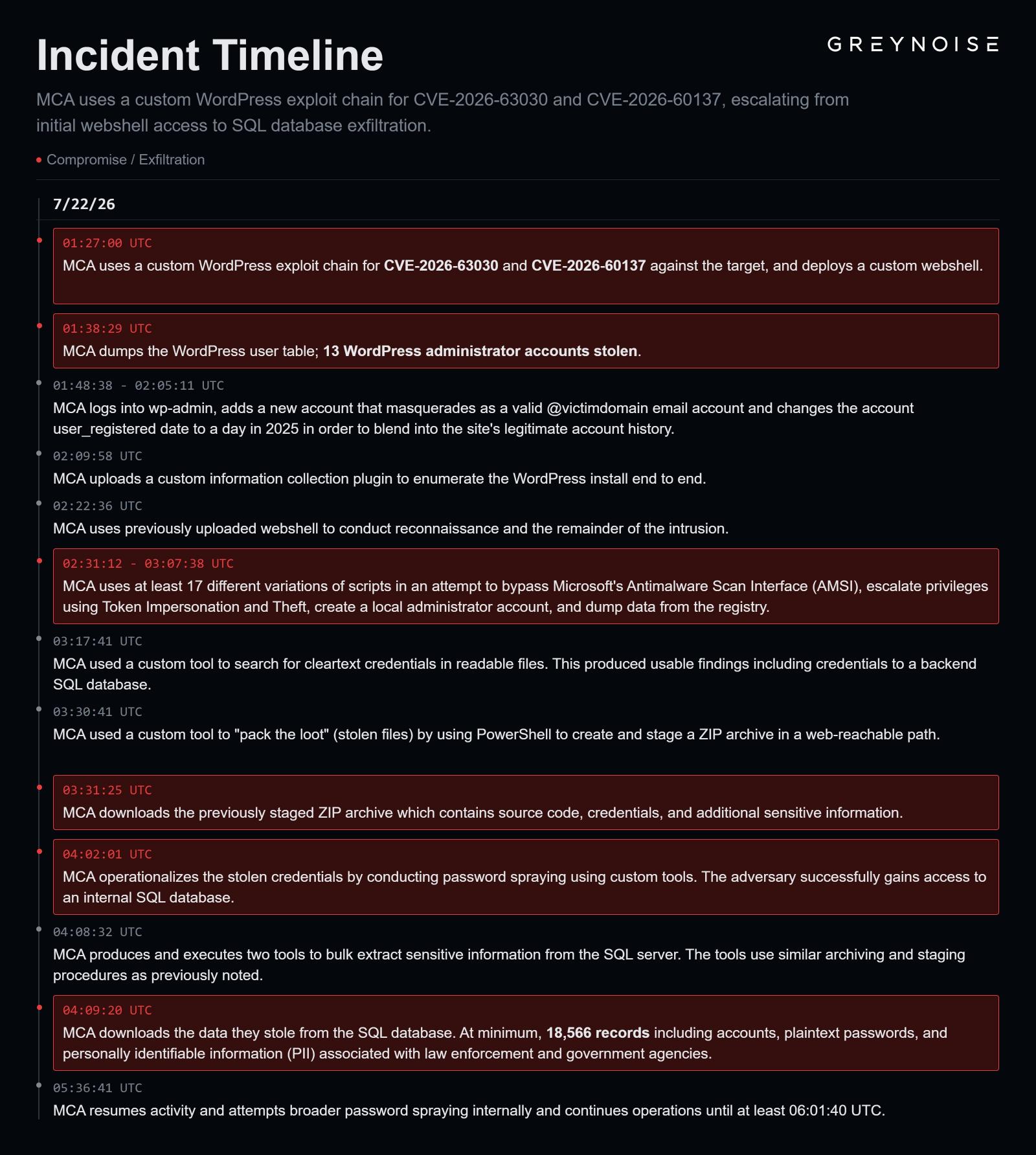
While the sheer volume of breaches underscores the automated nature of modern scanning and exploitation, the qualitative depth of specific attacks reveals a highly methodical, manual post-exploitation playbook. Telemetry from an intrusion targeting an unnamed Western government entity provides a granular look into the attacker’s operational tempo. Following a successful custom wp2shell compromise, the threat actor initiated a rigorous, 36-minute reconnaissance phase designed to map the host environment and neutralize defensive controls.
During this window, the operator systematically evaluated Microsoft Defender configurations, Antimalware Scan Interface (AMSI) hooks, active system services, listening network ports, local user accounts, software restriction policies, and underlying database configurations. In an attempt to blind security monitoring solutions and secure elevated privileges, the adversary executed 17 distinct scripts over the course of the session. These scripts were engineered to bypass AMSI protections, execute token impersonation and theft, provision unauthorized local administrator accounts, and extract sensitive registry hives.
The ultimate objective of this internal reconnaissance was lateral movement and data harvest. After uncovering credentials associated with a backend database structure, the hackers initiated a targeted password-spraying routine that successfully granted them access to an internal SQL server. From this repository, the attackers exfiltrated upwards of 18,566 records containing highly sensitive personally identifiable information (PII), system credentials, and account profiles tied directly to government operations and law-enforcement functions. Intriguingly, the same threat actor’s infrastructure also touched a Russian state-managed organization operating within occupied Ukrainian territory, resulting in a complex "red-on-red" espionage compromise that further complicates the geopolitical attribution puzzle.
Beyond application-layer CMS exploitation, the campaign demonstrates a heavy emphasis on compromising edge and network hardware to secure long-term persistence and intelligence-gathering capabilities. On August 17, the adversary expanded operations to target ZyXEL GS1900 Smart Managed Switches by weaponizing a high-severity flaw cataloged as CVE-2026-7273. This component of the campaign resulted in the compromise of nearly a thousand devices—specifically 996 units distributed across 48 countries—allowing the attackers to harvest system configurations, topology information, and root-level password hashes.
Network-level targeting did not stop at managed switches. The threat group also attempted to chain critical vulnerabilities impacting Ubiquiti UniFi OS environments, specifically CVE-2026-34908, CVE-2026-34909, and CVE-2026-34910, which grant unauthenticated attackers root-level remote code execution capabilities. Given that cybersecurity authorities had previously flagged these specific Ubiquiti bugs as actively weaponized in the wild, their integration into the adversary’s toolkit underscores a deliberate focus on perimeter infrastructure that often evades standard endpoint detection and response (EDR) deployments.
The campaign’s vast technological surface area is further illustrated by confirmed or attempted targeting against an array of additional platforms. Telemetry indicates probes and exploit attempts aimed at PAN-OS GlobalProtect gateways, FlowiseAI instances via CVE-2026-56271, Nuclio serverless event processing components through CVE-2026-79756, Proxmox VE virtualization nodes via CVE-2026-54391, SENAITE LIMS laboratory information management systems, and even classic local privilege escalation vectors such as the Linux kernel’s "Dirty Pipe" flaw (CVE-2022-0847).
Security researchers emphasize a critical disconnect in modern vulnerability management: a significant portion of the security issues leveraged within this specific threat cluster have not yet been incorporated into formal institutional catalogs of known exploited vulnerabilities, such as those maintained by federal cybersecurity agencies. This lag between active, in-the-wild exploitation and official cataloging leaves organizations vulnerable if they rely solely on compliance-driven patch management rather than threat-informed defense strategies.
The implications for the broader cybersecurity industry are profound. As state-sponsored and financially motivated groups alike adopt multi-platform exploitation frameworks, traditional defensive perimeters are proving insufficient. Enterprises can no longer afford to treat content management systems, edge routing equipment, and backend databases as isolated security silos. A vulnerability in an external-facing marketing blog can rapidly translate into a catastrophic breach of internal law enforcement databases if rigorous network segmentation and zero-trust internal controls are absent.
.jpg)
Mitigating threats of this caliber requires a fundamental shift in posture. Defenders must move beyond reactive patching to embrace continuous attack surface management, rapid telemetry correlation, and behavioral monitoring that can detect anomalous post-exploitation activities—such as AMSI tampering and unauthorized registry harvesting—within minutes of initial compromise. As threat actors continue to automate and accelerate their operational lifecycles, organizations must ensure their defensive architectures can respond with equal velocity.
