


The modern software supply chain operates on a fragile foundation of trust, shared components, and open-source infrastructure. That fragility was underscored recently when Alpine Linux—a cornerstone operating system powering millions of Docker containers worldwide—faced a sophisticated cyber onslaught directed squarely at its core development infrastructure. Between October 20 and 21, malicious actors targeted the project’s internal GitLab server in an effort to exploit a maximum-severity remote code execution (RCE) vulnerability. Although forensic examinations ultimately revealed no definitive proof of malicious payload execution or tampering with official package repositories, the inherent ambiguity of missing telemetry forced project maintainers to take the most conservative and secure path possible: completely demolishing and rebuilding their GitLab instance from the ground up while enforcing a mandatory credential reset across the board.
This near-miss incident highlights the immense pressure resting on foundational open-source projects. Alpine Linux is far from an ordinary operating system distribution; due to its exceptionally small footprint, security-oriented design, and minimal attack surface, it has become the de facto base image for cloud-native applications, microservices, and containerized deployments across the global technology sector. When threat actors turn their sights toward such an essential ecosystem anchor, the potential ripple effects threaten not just a single organization, but thousands of downstream enterprises that rely on Alpine-derived container environments. The attempted compromise serves as a stark reminder that open-source maintainers are prime targets for nation-state actors and financially motivated syndicates aiming to inject malicious code at the very inception of the software development lifecycle.
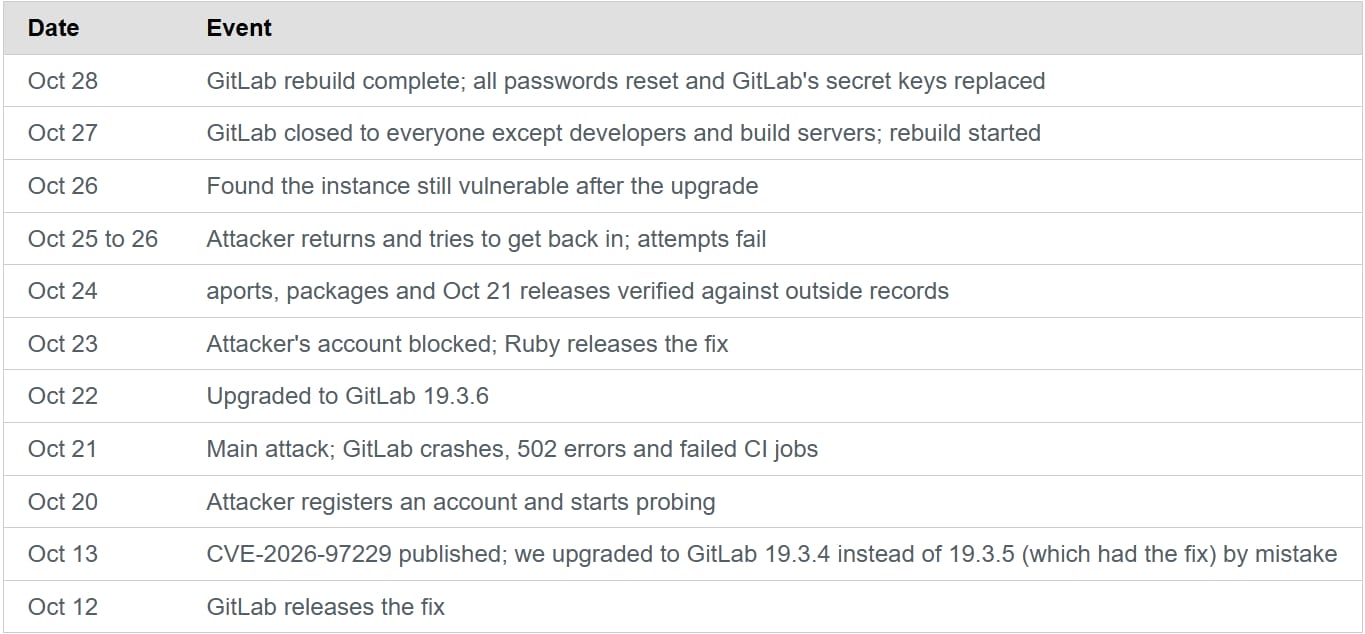
The vector chosen by the attackers was CVE-2026-97229, a critical integer overflow vulnerability residing within Onigmo, the regular expression compiler engine bundled inside Ruby and heavily utilized by GitLab’s continuous integration and continuous deployment (CI/CD) pipeline architecture. Disclosed by GitLab on October 12 alongside urgent patches, the flaw possesses a maximum-severity rating because it allows unauthenticated remote attackers to trigger arbitrary code execution under specific conditions. By submitting specially crafted, malicious regular expression payloads within CI/CD pipeline configurations, threat actors can bypass perimeter defenses and execute arbitrary commands on the underlying host server.

For Alpine Linux, the road to remediation was fraught with technical hurdles and configuration nuances. Initially, the project deployed GitLab version 19.3.4 rather than the patched 19.3.5 iteration. A subsequent upgrade to version 19.3.6 similarly failed to eliminate the vulnerability. This oversight occurred because closing the security gap required a direct patch to the underlying Ruby runtime environment—a component that GitLab typically bundles with its official omnibus packages, but which was omitted from Alpine’s bespoke custom container image deployment. Unbeknownst to the maintainers, this dependency gap left a critical window of exposure open.
During the late-October assault, automated attack scripts leveraged this blind spot, bombarding the platform with malicious CI configuration files designed to trigger the regex compiler flaw. Telemetry logs captured eight distinct worker crashes during the two-day assault. Out of these, four exhibited characteristics of partial success, indicating that the malicious payloads pushed the server to its absolute limits and came dangerously close to achieving full remote code execution. Furthermore, subsequent analysis revealed that the adversaries had downloaded the custom Alpine GitLab container image, strongly implying they were actively conducting reconnaissance and staging the environment for a wider, highly targeted software supply chain attack.
Faced with the terrifying prospect of a compromised build pipeline, the Alpine Linux security team initiated a comprehensive incident response protocol. They thoroughly audited repository commits, software packages, and official releases up to October 27, ultimately confirming that no unauthorized modifications had been introduced to the distribution’s core components. Additionally, relief came in the knowledge that critical cryptographic signing keys—used to authenticate software packages—were stored completely offline and separate from the GitLab server, rendering them safe from exposure.
However, the absence of complete outbound connection records and vital system logs meant that absolute certainty regarding zero code execution remained elusive. Operating under the golden rule of cybersecurity incident response—that uncertainty must be treated as a confirmed compromise—the team opted for a total infrastructure purge. "Because we cannot rule out code execution, and the evidence we would need to confirm it no longer exists, we took the harder route and rebuilt the GitLab instance from scratch," the project team formally stated in a post-incident transparency report.

While direct tampering of production code was averted, a successful exploitation could have granted the attackers access to a trove of sensitive data. Potentially exposed assets included user profile information, encrypted password hashes, multi-factor authentication secrets, sensitive CI/CD pipeline variables, third-party integration credentials, and private project repositories. While no definitive exfiltration of these assets has been confirmed, the project urged all community members and contributors to immediately reset their GitLab credentials as a precautionary measure. Furthermore, administrators rushed to deploy the newly corrected alpinelinux/gitlab:19.3.6 container image, released on October 27, which properly bundles Ruby version 3.3.13 to definitively neutralize CVE-2026-97229.
The broader implications of this near-miss extend far beyond the borders of the Alpine Linux ecosystem, offering vital lessons for the entire software engineering and cybersecurity communities. Supply chain attacks have steadily evolved from theoretical threat models into persistent, highly targeted campaigns. Modern DevOps pipelines—reliant on complex webs of third-party dependencies, containerization engines, and automated CI/CD frameworks—present massive attack surfaces that traditional perimeter defenses often fail to secure adequately. When an adversary targets a foundational upstream provider like Alpine, they are attempting to weaponize trust, turning a developer’s own tools against them to distribute tainted code to downstream consumers automatically.
Expert-level analysis of this incident underscores several critical takeaways for enterprise security architects and open-source maintainers alike. First, vulnerability management in containerized environments requires meticulous attention to underlying runtimes and bundled dependencies. Simply updating an application package manager is insufficient if the container’s underlying language interpreter or compiler libraries remain unpatched. Second, observability and logging infrastructure must be treated as critical security assets. The fact that Alpine Linux was forced to rebuild from scratch largely due to missing logs and incomplete outbound connection records illustrates a glaring vulnerability in incident triage: without comprehensive telemetry, organizations are flying blind and must resort to drastic, business-disrupting measures.
Looking toward the future, the security posture of open-source infrastructure must undergo a paradigm shift. As automated attacks leveraging zero-day and max-severity vulnerabilities become more prevalent, projects will need to adopt zero-trust architectures for their internal development networks. Ephemeral build environments, hardware-backed cryptographic signing, immutable infrastructure logs shipped instantly to secure, off-site storage, and automated patch validation will transition from optional best practices to mandatory standards.
The Alpine Linux GitLab incident should serve as a wake-up call for the cloud-native community. It demonstrates both the resilience of open-source maintainers who choose transparency and caution over sweeping problems under the rug, and the relentless ingenuity of modern threat actors. As software development becomes increasingly automated and interconnected, securing the assembly lines themselves is just as vital as securing the finished product.
