

The global automotive sector is undergoing an unprecedented identity shift. Confronted with bruising price wars, slowing consumer adoption in mature regions, and compressing margins across the electric vehicle (EV) sector, vehicle manufacturers are looking for their next technological and financial frontier. That search has led an expanding cohort of automotive titans straight to humanoid robotics and embodied artificial intelligence.
While the conceptual vision of bipedal machines operating alongside humans has circulated in science fiction and robotics laboratories for decades, the convergence of high-density battery architectures, automotive-grade actuator manufacturing, and multimodal generative AI models has transformed science projects into commercially viable roadmaps. What began as a high-profile endeavor spearheaded by Tesla and pioneering robotics firms is now becoming an industry-wide pivot, with Chinese automotive manufacturers in particular committing billions of dollars to ensure they do not miss the transition from software-defined vehicles to general-purpose autonomous machines.
The Megaround Signaling a New Era
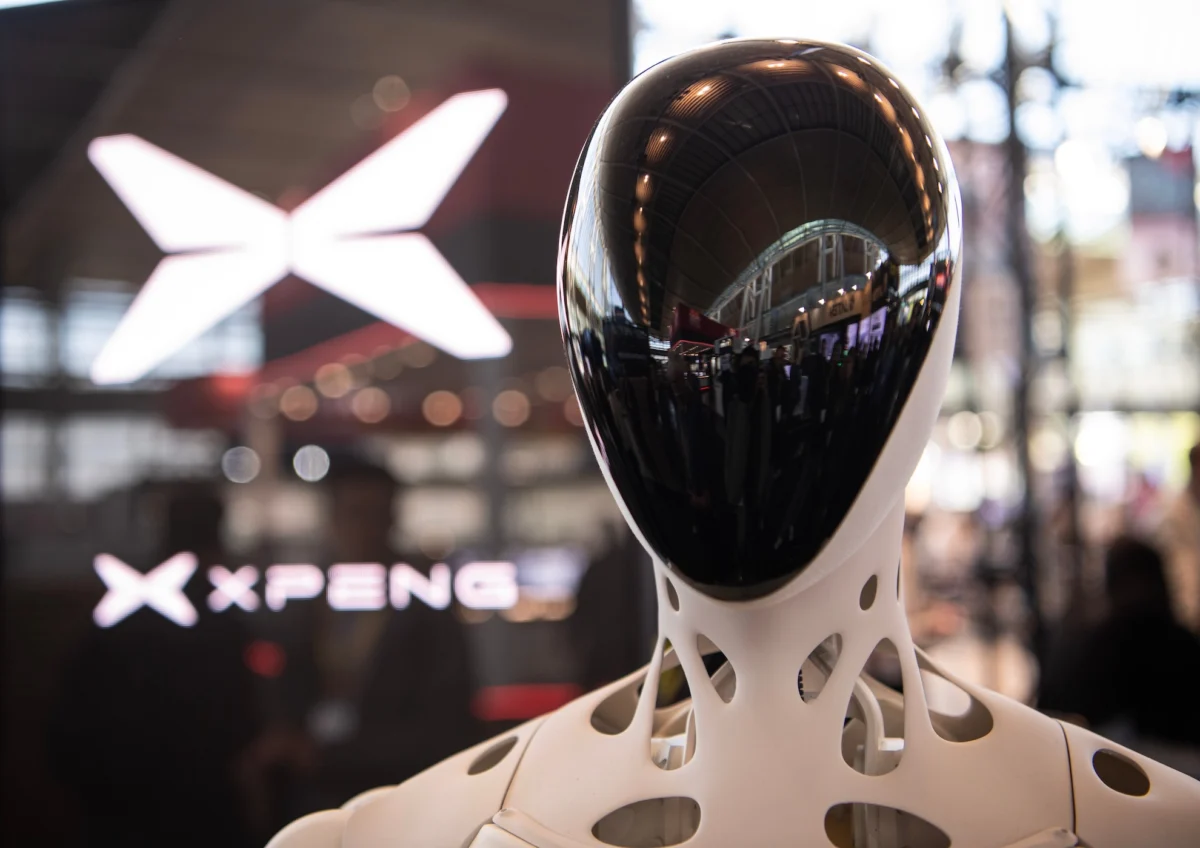
The clearest indicator of this shifting focus materialized when the robotics arm of Chinese electric vehicle manufacturer Xpeng completed a historic funding round, raising over $900 million at a post-money valuation exceeding $6.3 billion. Backed by heavyweight technology and venture firms including IDG Capital, Alibaba, Tencent, and Gaorong Ventures, the transaction marked the largest single private financing round within China’s nascent "embodied AI" sector.
Signaling deep executive conviction, Xpeng founder He Xiaopeng and co-president Brian Gu personally injected approximately $100 million of their own capital into the round. The capital injection is aimed at accelerating the development and industrial deployment of "Iron," Xpeng’s flagship bipedal humanoid robot designed for commercial applications, warehouse logistics, and smart factory floor operations.
The move exemplifies a broader trend among automotive executives who recognize that the core competencies built during the EV boom—battery chemistry, power electronics, sensor fusion, computer vision, and fleet data processing—translate almost directly into the mechanical and cognitive requirements of humanoid robotics. For automotive leadership navigating a hyper-competitive domestic car market where gross vehicle margins can dip into the single digits, high-utility robotics promises a fresh software-and-hardware ecosystem with substantially higher long-term margin potential.
A Rapidly Multiplying Field of Contenders
Xpeng is far from an isolated case. Across the Chinese industrial landscape, major original equipment manufacturers (OEMs) are mobilizing capital and engineering talent toward robotics at a dizzying pace.
AiMOGA, the specialized robotics division incubated by Chery Automobile, has initiated preliminary preparations for an initial public offering, eyeing public capital markets to fuel global expansion. Meanwhile, BYD, the world’s largest manufacturer of plug-in vehicles by volume, recently took the wraps off its own humanoid platform, dubbed "Xiao Di." Other prominent domestic manufacturers, including state-backed stalwarts SAIC Motor, Changan Automobile, and GAC Group, as well as private disruptors like Li Auto and Seres, have established internal embodied AI labs or formed direct joint ventures with robotics research institutes.
This widespread push is not merely reactionary; it is strategically defensive and structurally aligned with national economic policy. In an environment characterized by domestic automotive overcapacity and relentless price cuts, robotics offers an alternative vector for technological differentiation and intellectual property generation. Furthermore, China’s central government has explicitly designated embodied AI and advanced robotics as strategic growth priorities to mitigate the macroeconomic impacts of a rapidly aging domestic manufacturing workforce.
The Technical and Industrial Synergy
The migration of carmakers into robotics is rooted in profound technological overlap. A modern battery-electric vehicle is essentially a massive mobile computer powered by electric motors, sophisticated battery management systems (BMS), high-performance compute chips, and an array of cameras, radar, and LiDAR sensors. Humanoid robots require the exact same foundational supply chain.
- Actuation and Power Density: Humanoid robots require compact, high-torque actuators capable of delicate manipulation and dynamic balance. The precision motor engineering developed for EV drivetrains, active suspension systems, and steer-by-wire mechanics provides automakers with an innate advantage in designing high-efficiency mechanical joints.
- Vision-Based Navigation and Foundation Models: The artificial intelligence pipelines that power Advanced Driver Assistance Systems (ADAS) and full autonomous driving are directly applicable to physical robots. Perception models trained to recognize pedestrians, lane markings, and roadside obstacles can be retrained on spatial geometry, object grasping, and indoor navigation.
- Economies of Scale and Supply Chain Integration: Automotive companies have already spent decades perfecting high-volume, cost-optimized manufacturing techniques. While pure-play robotics startups frequently struggle to transition from low-volume prototypes to mass production, automotive companies already possess the tier-one supplier relationships, stamping facilities, cleanrooms, and quality-control processes required to drive down the bill of materials (BOM) for robotic hardware.
Western and Global Automakers Double Down
The surge in robotics investment is not confined to China. Across the globe, established mobility providers and autonomous technology suppliers are aggressively staking their claims.
Tesla continues to position its Optimus humanoid robot as a cornerstone of the company’s enterprise valuation, with plans to integrate thousands of units across its vehicle assembly lines before offering them to third-party commercial customers. Tesla’s strategy relies heavily on its proprietary Dojo supercomputing infrastructure and end-to-end neural network architecture, leveraging vast video datasets collected from millions of consumer vehicles on public roads.
In South Korea, Hyundai Motor Group has turned its majority acquisition of Boston Dynamics into a core pillar of its long-term industrial roadmap. Hyundai is deploying the next-generation electric Atlas humanoid robot into operational facilities, starting with its state-of-the-art manufacturing hub in Georgia. Supported by a deep research partnership with Google’s DeepMind division to infuse cutting-edge foundation models into robotic control, Hyundai has established dedicated facilities like the Robot Metaplant Application Center to systematize how bipedal machines learn physical manufacturing tasks, such as subassembly transport and precision parts sequencing.
Autonomous vehicle suppliers and startup ecosystems are similarly positioning themselves for the shift. Mobileye, the Intel-backed developer of computer vision driving stacks, completed a $900 million acquisition of Mentee Robotics to merge automotive-grade vision chips with physical manipulation algorithms. Pure-play robotics startups like Figure AI, Apptronik, and Agility Robotics are running pilot programs with major logistics providers and automotive factories, proving out commercial viability in live production environments. Even electric truck maker Rivian has stepped into the arena via its Mind Robotics spinout, exploring alternative non-humanoid autonomous forms optimized specifically for industrial throughput.
The Emerging Battle: Hardware Scale vs. Cognitive AI
As the competitive landscape takes shape, an industry-defining fault line is emerging between hardware execution and foundational intelligence.
Chinese automakers and hardware specialists undeniably command an unmatched lead in physical supply chains, rapid prototyping, and cost-effective mechanical scaling. Their extensive ecosystem of local battery producers, structural casting providers, and precision gear manufacturers allows them to iterate mechanical designs at a fraction of the cost and time required by Western peers.
However, the ultimate success of humanoid robotics will not be determined purely by balance, payload capacity, or manufacturing speed. The decisive bottleneck remains "the brain"—the underlying embodied AI models capable of zero-shot learning, spatial reasoning, and real-time adaptation in unstructured human environments. Translating the cognitive leaps seen in large language models (LLMs) to real-world physical manipulation (often referred to as Large World Models or Vision-Language-Action models) demands immense compute power, advanced simulation environments, and sophisticated algorithmic architectures.
While Chinese OEMs possess the manufacturing muscle to produce hundreds of thousands of robotic bodies, global market dominance will hinge on whether their domestic AI software ecosystems can match the deep-learning capabilities, supercomputing clusters, and algorithmic breakthroughs emerging from premier research institutions in North America and Europe.
The Road to 2030 and Beyond
The transition of humanoid robotics from conceptual novelty to core industrial asset is accelerating rapidly. Over the next three to five years, the primary testing ground will remain inside the factories of the automakers themselves. By deploying humanoid prototypes in their own powertrain plants, paint shops, and logistics centers, automotive manufacturers can iterate their platforms in controlled, data-rich environments without the immediate liability risks associated with consumer-facing deployments.
Once these machines demonstrate consistent uptime, safety, and operational return on investment on factory floors, the technology will inevitably spill over into retail logistics, healthcare support, construction, and domestic assistance.
The automotive industry’s aggressive pivot toward humanoid robotics represents more than a speculative venture; it is a calculated structural adaptation. In an era where building an electric car is increasingly democratized, the defining industrial battleground of the coming decade will be physical intelligence—and automakers are determined to lead the charge.
