


The enterprise software ecosystem is currently navigating a period of significant volatility following the confirmed weaponization of a critical security vulnerability within the ServiceNow AI Platform. Identified as CVE-2026-6875, this flaw represents a severe breach of the platform’s architectural integrity, enabling unauthorized actors to bypass critical sandbox protections. The emergence of active exploitation campaigns, detected shortly after the release of official remediation patches, has forced security operations centers (SOCs) and IT departments at the world’s largest organizations to expedite their patching cycles under immense pressure.
The Technical Anatomy of the Breach
At its core, the vulnerability centers on the platform’s handling of unauthenticated requests. The flaw, initially brought to light by researchers at Searchlight Cyber in early April, facilitates what is known as a pre-authentication sandbox escape. In a standard enterprise environment, the ServiceNow platform relies on rigorous segmentation to ensure that processes running within the system are isolated from the underlying infrastructure and sensitive user data. By circumventing these boundaries, an unauthenticated attacker can effectively achieve remote code execution (RCE).
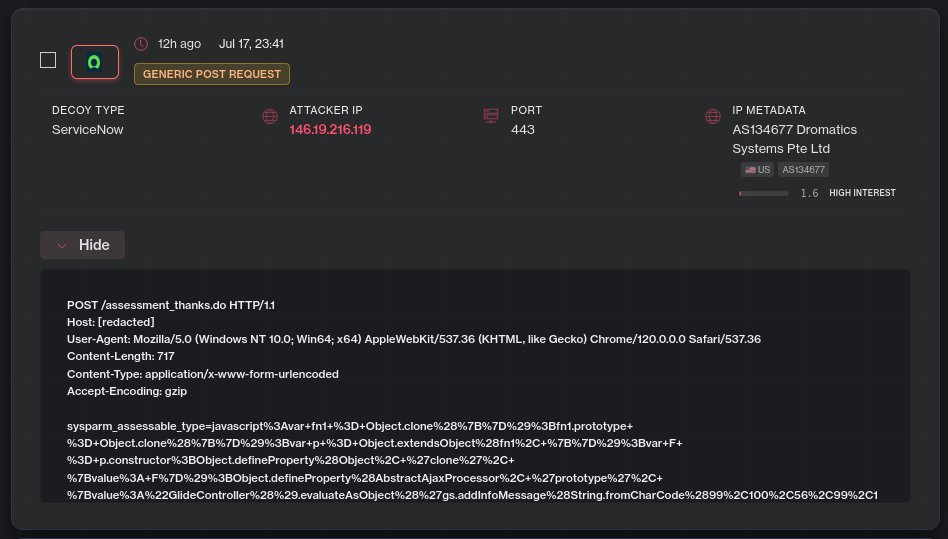
What has alarmed the cybersecurity research community is the agility shown by threat actors in the wake of the patch disclosure. While the initial proof-of-concept (PoC) documented the use of a specific "sink"—the /assessment_thanks.do endpoint—to facilitate the entry, threat intelligence firms have observed that attackers are not merely copying existing exploits. Instead, they have refined their methodologies, identifying alternative paths to reach the same underlying code-execution primitive. This divergence from documented research indicates a sophisticated level of threat actor capability, where adversaries are performing their own internal analysis of the patch to bypass initial security assumptions.

The Scope of the ServiceNow Ecosystem
To understand the gravity of this situation, one must consider the ubiquity of the ServiceNow AI Platform. Formerly branded as the Now Platform, this PaaS (Platform-as-a-Service) environment has become the digital backbone for modern enterprise operations. It manages a staggering volume of activity, orchestrating over 100 billion workflows annually. Its reach is profound, underpinning the internal operations of approximately 85% of the Fortune 500.
When a platform with this level of penetration suffers a critical RCE, the "blast radius" is theoretically limitless. Because ServiceNow often handles sensitive data, including employee identities, IT configuration maps, and proprietary workflow automation, a compromise does not merely affect a single application. It threatens the integrity of the entire business logic layered on top of it. For multinational corporations, a successful exploit could lead to lateral movement within the network, unauthorized data exfiltration, or the deployment of ransomware within the heart of the corporate infrastructure.
Industry Implications and the Patching Gap
The timeline of events—disclosure on April 1st, patches released on July 13th, and exploitation observed on July 17th—highlights the persistent struggle between rapid patch deployment and operational continuity. Even when a vendor provides a fix, the time required to validate, test, and deploy that update across complex, global enterprise environments creates a "window of vulnerability."
In this instance, that window proved to be an open door. While ServiceNow has taken necessary steps to secure its hosted instances, the onus remains on organizations running self-hosted or hybrid deployments to manually apply these updates. The fact that exploitation was observed only days after the official patch release suggests that threat actors are actively monitoring vendor security advisories and utilizing automated scanning tools to identify unpatched, exposed instances. This "weaponization speed" is a growing trend, shifting the burden of defense from weeks to hours.

Expert Analysis: The Shift to "Sandbox-Escape" Tactics
Security analysts have noted that the rise of sandbox-escape vulnerabilities is indicative of a broader shift in how enterprise platforms are being targeted. As vendors improve their surface-level security—implementing better authentication protocols and API rate limiting—attackers have moved deeper into the stack. They are no longer looking for simple credential theft; they are targeting the logical constraints of the platform itself.
By escaping the sandbox, attackers effectively gain the permissions of the service account under which the process is running. In many enterprise configurations, these accounts have elevated privileges to interact with other databases and third-party integrations. This allows the attacker to move beyond the ServiceNow platform and gain a foothold in the broader corporate ecosystem. The use of different routes to reach the RCE primitive, as reported by researchers, suggests that the "attack surface" for this specific vulnerability is wider than initially realized, necessitating a holistic review of all web-facing endpoints on the platform, not just those identified in the initial PoC.
Future Impact and Long-Term Trends
This incident serves as a bellwether for the future of enterprise software security. As companies continue to integrate AI into their core workflows, the complexity of these platforms will only increase, potentially introducing further, unforeseen security gaps. The move toward AI-driven automation means that software platforms are no longer just "utilities"; they are active, autonomous participants in business decisions. Securing them requires a shift toward "zero-trust" architecture, where even internal platform processes are treated as untrusted until validated.
Furthermore, this situation underscores the importance of proactive security posture management. Traditional vulnerability management programs, which often rely on quarterly or monthly scans, are increasingly insufficient. The current threat landscape demands continuous security monitoring and real-time threat intelligence. Organizations must assume that any publicized vulnerability in a major platform will be weaponized with high speed and must prioritize their response accordingly.
Recommendation for Security Teams
For organizations utilizing the ServiceNow AI Platform, the immediate priority remains the verification of patch levels. Security teams should not rely solely on the fact that they have "scheduled" an update; they must confirm that the specific security patches issued on July 13th have been successfully applied and verified.
Beyond patching, organizations should:
- Audit Logs: Review system access logs for any suspicious activity related to the mentioned endpoints, specifically looking for anomalous POST requests or attempts to access administrative functions from unauthorized IPs.
- Endpoint Monitoring: Utilize EDR (Endpoint Detection and Response) tools to monitor for unusual child processes spawning from the ServiceNow service, which could indicate a successful sandbox escape.
- Segmentation: Evaluate if the ServiceNow platform is overly privileged within the network. Implementing stricter network segmentation can limit the impact if a platform is compromised, preventing attackers from pivoting to other sensitive internal systems.
As the industry continues to monitor the activity surrounding CVE-2026-6875, it is clear that the responsibility for security is a shared mandate. While vendors are responsible for the integrity of their code, enterprises must be equally vigilant in their deployment, configuration, and monitoring strategies. The era of the "automated enterprise" is also the era of the "targeted enterprise," and only through constant, rigorous, and rapid defense can organizations hope to stay ahead of an increasingly sophisticated adversary. The warning issued by security researchers is not merely a technical advisory; it is a call for a fundamental reassessment of how enterprise-grade platforms are secured in a high-threat, high-speed digital economy.
