


The modern software development lifecycle has evolved into a hyper-accelerated, distributed ecosystem where cloud platforms, automated build pipelines, and artificial intelligence agents continuously collaborate to deploy production workloads. However, this relentless pursuit of developer velocity has simultaneously expanded the attack surface for sophisticated cyber threat actors. As traditional perimeter-based security models disintegrate under the weight of remote workforces and widespread cloud adoption, identity theft has emerged as the weapon of choice for malicious actors targeting engineering environments.
Recognizing this paradigm shift, cloud deployment powerhouse and Next.js creator Vercel has initiated a deliberate, phased deployment of Device Bound Session Credentials (DBSC) across its developer ecosystem. This advanced cryptographic defense mechanism aims to neutralize one of the most persistent and damaging vectors in contemporary cybercrime: information-stealer malware designed to harvest and reuse browser session tokens. By fundamentally rethinking how user authentication binds to physical hardware, cloud infrastructure providers are attempting to rewrite the rules of session hijacking and unauthorized platform access.
The core vulnerability plaguing traditional web authentication relies on the longevity and portability of standard session cookies. Historically, once a user successfully authenticates through multi-factor authentication or single sign-on mechanisms, the application issues a session cookie. This token is stored locally within the browser’s storage architecture. If an unsuspecting developer falls victim to infostealer malware—often inadvertently downloaded through cracked software, malicious pirated packages, or compromised third-party browser extensions—the malware quietly sifts through browser profiles, extracts these valid session tokens, and exfiltrates them to command-and-control servers operated by cybercriminals.
Armed with a valid, unexpired session cookie, an attacker can bypass multi-factor authentication checks entirely. They simply inject the stolen cookie into their own browser session on a completely different machine halfway across the world, instantly gaining authenticated access to corporate infrastructure, proprietary source code repositories, and sensitive environment variables. Vercel’s implementation of Device Bound Session Credentials permanently breaks this attack chain by making stolen cookies completely useless outside the context of the original hardware device.

According to technical statements released by Vercel Chief Technology Officer Malte Ubl, DBSC operates by anchoring the user’s login session directly to the underlying hardware of their workstation through a cryptographic private key generated and stored inside a Trusted Platform Module (TPM). The TPM—a dedicated secure microcontroller chip built into virtually all modern enterprise laptops, desktops, and mobile devices—is the exact same hardware component responsible for managing local biometric authentication features such as fingerprint readers and facial recognition systems.
When a developer authenticates on Vercel’s platform, the browser coordinates with the local TPM to generate an unexportable cryptographic key pair. The private component of this key never leaves the secure confines of the hardware chip. Ubl emphasized the absolute security guarantees of this architecture, noting that the private key cannot be retrieved by anyone—not by Vercel, not by the user, and certainly not by information-stealer malware running in user space. The browser utilizes this isolated private key to cryptographically sign session requests. Consequently, if an infostealer manages to scrape the session cookie from disk, the stolen asset is mathematically worthless to the attacker, because executing subsequent API calls requires a cryptographic signature generated exclusively by the unique TPM chip present only on the victim’s physical device.
The rollout of DBSC does not occur in a vacuum; it serves as a critical, high-level structural reinforcement to broader industry movements aimed at hardening endpoint browsers. For instance, recent developments such as Google Chrome’s App-Bound Encryption initiative were designed to complicate the extraction processes utilized by infostealer software, adding heavy encryption barriers to local browser cookie storage. While App-Bound Encryption attempts to stop malware from reading the cookies in the first place, DBSC provides an impenetrable fallback mechanism. Even if a remarkably sophisticated malware strain manages to bypass endpoint storage encryption, the stolen token remains untransferable and non-executable on any foreign hardware architecture.
At present, Vercel’s DBSC integration functions natively within Google Chrome instances operating on macOS and Windows environments. The organization is deliberately pacing the rollout to ensure a seamless experience, carefully evaluating and mitigating edge cases involving complex OAuth applications and automated integrations. Furthermore, recognizing that modern developers do not interact with cloud platforms exclusively through graphical web browsers, Vercel is concurrently deploying Demonstration of Proof-of-Possession (DPoP) protocols to secure interactions originating from the Vercel Command Line Interface (CLI). This ensures that programmatic access channels are subjected to the same rigorous hardware-backed validation standards as web-based management consoles.
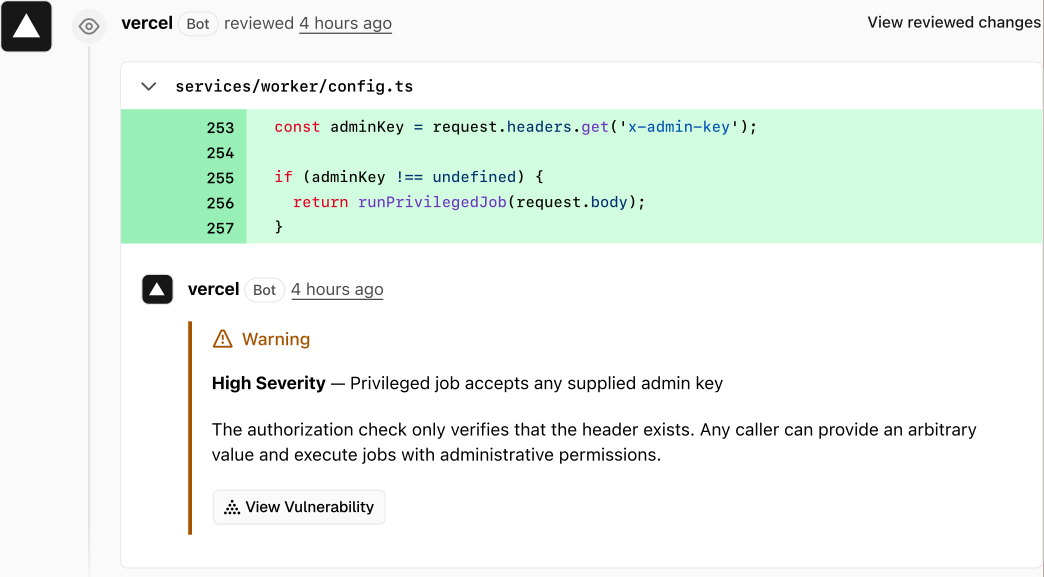
Beyond securing the initial authentication perimeter, Vercel is simultaneously addressing the internal integrity of codebases through advanced automated oversight. Earlier this week, the platform officially launched its "Security Review" feature into public beta for Pro and Enterprise subscribers. This innovative security subsystem integrates directly into the Vercel Agent, automatically executing comprehensive security scans on code alterations every single time a developer pushes updates to connected GitHub repositories.

Rather than relying solely on static analysis tools that hunt for known software vulnerabilities, Security Review evaluates pull requests against custom, team-defined security policies as well as baseline compliance frameworks. The system is engineered to automatically flag critical oversight risks, including missing authorization checks, insecure data handling practices, and accidentally exposed application secrets or API keys.
What separates Vercel’s Security Review from traditional continuous integration security linters is its remediation capability. Provided that appropriate repository permissions have been granted, the Vercel Agent possesses the autonomy to validate, format, and commit security fixes directly into the workflow. Vercel has announced that these comprehensive code scans will remain free of charge through November 10, 2026, while automated, agent-generated remediation actions will be structured under a distinct billing model.
Ubl revealed that Vercel’s internal engineering and security divisions deployed this automated review machinery internally several months prior to the public beta launch. After observing immediate, measurable reductions in accidental security oversights and policy violations during internal operations, the executive leadership team greenlit its broader release to the developer community.
The acceleration of these defensive capabilities underscores a sober reality for cloud-native enterprises: the persistent threat of sophisticated, targeted intrusions. This context is acutely understood by Vercel following a high-profile security incident in April, when unauthorized actors penetrated the organization’s corporate perimeter. In that breach, threat actors compromised an employee’s Google Workspace account managed through a third-party vendor, Context.ai. Leveraging that initial foothold, the unauthorized parties navigated internal systems and gained visibility into application environment variables that had not been strictly segregated or marked as sensitive. Following the incident, cybercriminal entities attempting to impersonate notorious extortion syndicates such as ShinyHunters publicly circulated claims that they were actively auctioning off proprietary source code, internal access keys, and database extracts.
The April breach served as an operational catalyst, prompting enterprise cloud architectures to re-evaluate zero-trust principles, internal access segmentation, and endpoint session security. The implementation of Device Bound Session Credentials and automated repository auditing tools represents a direct institutional response to these lessons, shifting the security burden away from fallible human behaviors and anchoring it deeply into hardware cryptography and continuous automated validation.
Looking forward, the widespread adoption of hardware-rooted session binding represents a watershed moment for the cloud computing industry. For decades, the software development sector has operated under the shadow of credential theft, where a single compromised laptop or infected browser session could compromise an entire corporate technology stack. By transitioning identity persistence from software-defined cookies to TPM-backed cryptographic signatures, platforms like Vercel are effectively neutralizing the business model of commercial infostealer operations.
As browsers, identity providers, and cloud infrastructure hosts increasingly standardize around DBSC and related token-binding frameworks, the window of opportunity for credential-stuffing and session-hijacking threat actors is rapidly closing. While adversaries will undoubtedly iterate on new attack methodologies, the deployment of device-bound authentication sets a robust, highly resilient baseline for enterprise security. For software engineers and DevOps teams managing mission-critical web applications, this technological leap promises a future where the perimeter of trust is defined not by vulnerable secrets stored on a disk, but by the physical hardware anchoring the developer’s workstation.
