


The modern threat landscape is increasingly defined by the weaponization of benign, everyday productivity software. Enterprise defenders have long understood the risks associated with operating systems and traditional network perimeters, but the intersection of utility tools and state-sponsored espionage introduces complex challenges that defy conventional security models. A striking illustration of this paradigm has emerged through recent telemetry analyzed by security researchers at Gen Threat Labs, uncovering a sophisticated campaign orchestrated by the China-aligned threat collective designated UNC3569. This actor has systematically exploited a critical remote code execution vulnerability—cataloged as CVE-2026-51990—within the massively popular Sogou Input Method for Windows, an application developed by Chinese tech giant Tencent that boasts an installed base numbering in the hundreds of millions.
At its core, the vulnerability represents a classic manifestation of input validation failure cascading through a poorly secured multi-component software architecture. The Sogou Input Method is far more than a simple text entry utility; to support its comprehensive feature set, the application integrates custom link handlers, skin management utilities, and an embedded web browser engine. This extensive attack surface provided UNC3569 with the exact leverage needed to bypass traditional endpoint detection mechanisms. By chaining multiple subtle weaknesses within the application’s local IPC (Inter-Process Communication) and command handling routines, the threat actors engineered a seamless, one-click compromise vector capable of deploying the advanced GrayRabbit backdoor directly onto victim machines without triggering immediate administrative alarms.
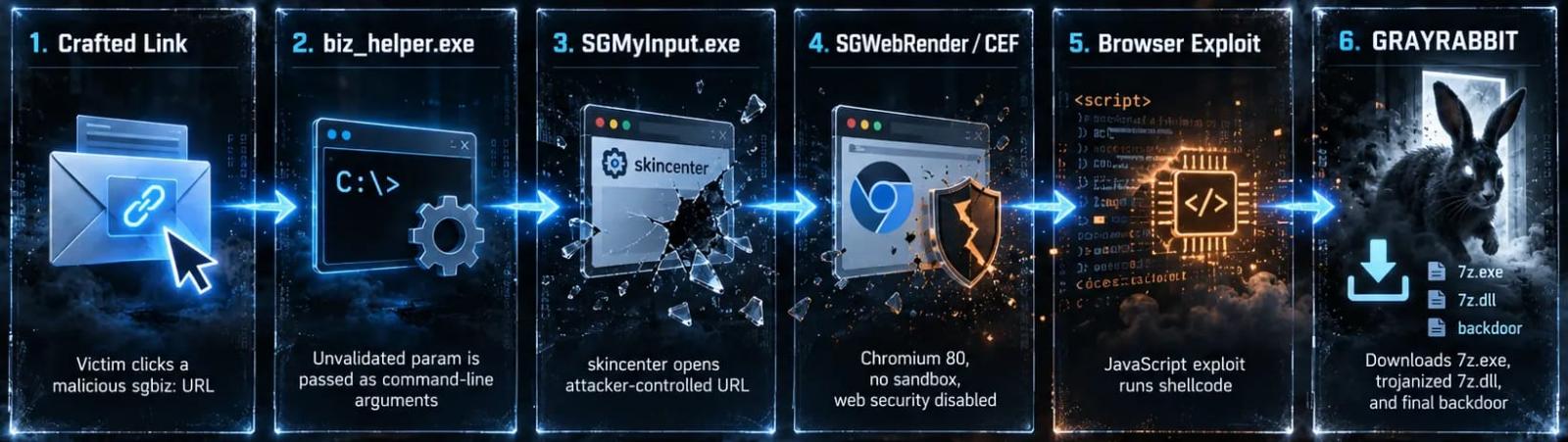
The multi-stage attack chain begins when an unsuspecting target interacts with a maliciously crafted uniform resource identifier utilizing the custom sgbiz: protocol scheme. When Windows processes this hyperlink, it invokes Sogou’s native protocol handler executable, biz_helper.exe. Crucially, this helper component fails to adequately sanitize or validate incoming command-line parameters before passing them down the execution chain to another legitimate application component, SGMyInput.exe. This procedural oversight allows an external entity to inject arbitrary arguments that dictate the operational behavior of subsequent processes.
In the second phase of the exploit, the injected command-line arguments force the application to launch its skin management module, known as the skincenter component. Within this module lies an embedded Chromium webview instance. Because the application implementation lacks stringent controls over navigation parameters, the integrated browser is instructed to load an attacker-controlled external URL. The software fails to restrict the URL scheme or enforce destination whitelisting, giving the malicious remote page unhindered access to the internal application context.

The final and most damaging phase exploits the architectural debt carried by many enterprise and consumer applications: reliance on profoundly outdated software dependencies. The embedded webview utilized by the legacy version of the utility was powered by Chromium 80—an iteration released years prior and lacking numerous modern security mitigations. Compounding this risk, the browser instance operated entirely outside of a protective sandbox environment, with critical web-security guardrails systematically disabled. When the malicious webpage loaded by the threat actors encountered this vulnerable browser environment, it executed arbitrary code effortlessly, dropping and initializing the GrayRabbit backdoor into the host operating system’s memory and disk spaces.
GrayRabbit is not a novel malicious tool, but its evolution highlights the persistent refinement seen in state-sponsored arsenals. Initially documented by Google researchers in 2024, the malware family has been firmly attributed to UNC3569, a group operating within a nebulous intersection of financially motivated cybercrime and state-directed contractor-for-hire espionage operations. The specific sample dissected by Gen Threat Labs revealed a highly mature, 64-bit architectural redesign featuring an expanded operational command set and robust obfuscation mechanisms, including RC4-encoded configuration data for communicating with its command-and-control (C2) infrastructure.
The functional profile of this modern GrayRabbit variant underscores its utility in long-term espionage engagements. Once established on a target endpoint, the backdoor provides operators with extensive administrative control. Capabilities include arbitrary process execution, the spawning of interactive reverse shells for real-time monitoring, comprehensive file upload and downloading utilities, exhaustive system and user reconnaissance harvesting, and the advanced capability to reflectively load modular plugins directly into the host process memory. This in-memory execution strategy minimizes the malware’s physical forensic footprint, complicating post-incident investigations by enterprise incident response teams.
Upon discovering the vulnerability and mapping out the complete exploitation vector, Gen Threat Labs responsibly disclosed their findings to Tencent on April 9. Demonstrating swift response times, the software vendor developed and pushed out a software patch embedded in Sogou Input Method version 16.3.0.3498, which rolled out to consumers on April 21. The remediation efforts focused heavily on securing the protocol handler mechanism: the updated code enforces strict URL argument validation, permits only encrypted HTTPS traffic for internal web components, and restricts navigation capabilities exclusively to approved, verified domains associated with the Sogou and Tencent ecosystems.
However, the cybersecurity community remains cautious regarding the long-term efficacy of such patches when underlying architectural flaws persist. Security analysts have pointed out that while the protocol handler has been successfully locked down, the application continues to rely on an antiquated browser rendering engine that operates without adequate sandboxing. This technical reality highlights a broader structural vulnerability inherent in how major software vendors handle embedded components. When applications bundle legacy browsers or third-party frameworks to maintain backward compatibility or UI styling consistency, they frequently inherit a legacy of unpatched vulnerabilities that cannot be entirely mitigated by superficial input-filtering patches.
The implications of the Sogou Input Method incident extend far beyond a single application or a regional consumer base, providing vital lessons for the broader software development and enterprise security industries. In an era where supply chain compromises and third-party software vulnerabilities represent primary vectors for advanced persistent threats (APTs), the security posture of utility applications—often overlooked by IT administrators focused exclusively on operating systems and enterprise servers—demands rigorous scrutiny.
From an industry perspective, the weaponization of custom URI schemes is a rapidly growing trend among sophisticated threat groups. Custom protocol handlers designed to streamline user experience by bridging web browsers and desktop applications frequently lack the rigorous authentication and sanitization protocols applied to traditional web input fields. When developers treat local IPC channels and protocol handoffs as trusted pathways, they inadvertently construct highways for privilege escalation and remote code execution. Security auditors and application architects must implement comprehensive threat modeling that assumes all external inputs—including those originating from custom URI associations—are fundamentally untrusted.
Furthermore, the incident shines a harsh light on the dangers of embedded browser components, often referred to as "fat client" webviews. Many desktop applications incorporate headless or visible browser engines to render user interfaces, advertisements, or help documentation. When these embedded engines lag behind current Chromium or WebKit release cycles, they accumulate technical debt that exposes users to drive-by exploitation, even when the user is not actively browsing the open internet. Organizations must mandate automated dependency management and continuous vulnerability scanning for all embedded software libraries within proprietary and commercial software alike.
As threat actors continue to professionalize their operations, blurring the lines between cybercrime syndicates and geopolitical espionage units, the defense paradigm must shift toward proactive software component verification. Endpoint detection and response (EDR) vendors will need to develop specialized behavioral monitoring heuristics capable of detecting anomalous process chains where utility tools invoke script interpreters, shell spawns, or unusual outbound network connections triggered by external URL handlers. For enterprise security teams, visibility into consumer-grade software running on corporate endpoints—often introduced via shadow IT or remote work arrangements—remains a critical blind spot that demands aggressive asset discovery and application whitelisting policies.
Ultimately, the resolution of the Sogou Input Method vulnerability highlights both the responsiveness of modern technology vendors to coordinated disclosure and the persistent fragility of complex software ecosystems. As long as software developers prioritize feature richness and seamless user transitions over rigorous sandboxing and secure-by-design architectures, threat actors will continue to exploit the hidden seams of everyday applications to achieve their strategic objectives. Mitigating these risks requires a concerted commitment from developers to modernize legacy dependencies and a vigilant posture from defenders who must continuously monitor the periphery of their digital estates.
