


The landscape of corporate cybersecurity was shaken once again as the notorious cybercriminal collective known as ShinyHunters executed a massive data dump on the dark web, exposing the sensitive personal details of nearly 13 million accounts linked to iconic American apparel manufacturer Carhartt. The disclosure comes in the wake of a failed extortion attempt that saw corporate leadership refuse to bend to the multi-million-dollar financial demands levied by the threat actors. Security researchers and data breach notification platforms have since confirmed the legitimacy of the archive, shedding light on yet another high-profile compromise stemming from vulnerabilities within modern cloud-based data analytics infrastructure.
Established well over a century ago in 1889, Carhartt has long maintained a formidable reputation as a titan in the production of rugged workwear and contemporary streetwear. Operating extensive manufacturing hubs across Kentucky and Tennessee alongside a robust corporate workforce numbering more than 3,000 employees spread throughout the United States and Europe, the brand represents a staple of traditional manufacturing stability. However, this long-standing operational resilience was abruptly tested when digital intruders managed to infiltrate the company’s digital perimeter, extracting a vast reservoir of proprietary information and customer files.
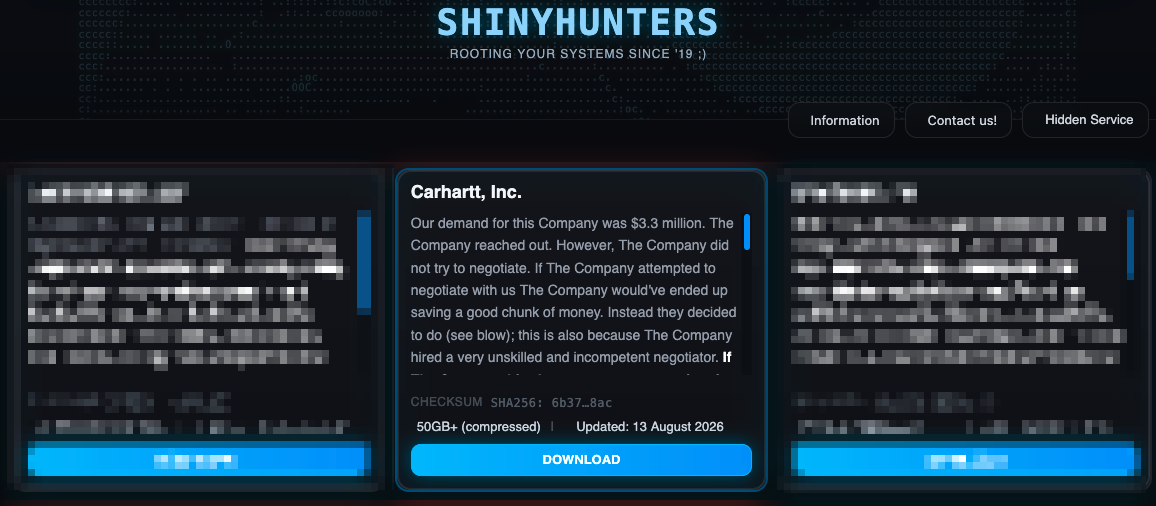
The intrusion first came to public attention when ShinyHunters took to underground forums and messaging channels to claim responsibility for the offensive. According to statements published by the cybercrime syndicate, the operation yielded in excess of 50 gigabytes of compressed documents. This massive haul reportedly encompassed a comprehensive cross-section of corporate assets, ranging from granular customer metadata and loyalty program insights to internal corporate records and deeply personal employee data.

In the weeks following the initial breach, the threat actors initiated direct communication with the apparel enterprise, attempting to leverage the stolen repository as leverage for a $3.3 million ransom payout. However, following exhaustive internal evaluations and consultations involving senior executives and crisis management advisors, Carhartt’s leadership made the strategic determination to stonewall the criminals. Documentation leaked by the extortionists suggests that a corporate representative formally communicated this refusal, informing the gang that leadership had opted against pursuing negotiations or engaging in further dialogue. Denied their financial windfall, the hackers retaliated by publishing the entire stolen archive across their dedicated dark web leak portal, ensuring public visibility for the compromised assets.
Following the public release of the 50GB data archive, digital forensics specialists and threat intelligence analysts immediately set to work dissecting the contents. Troy Hunt, the founder of the prominent breach notification service Have I Been Pwned, conducted an exhaustive technical analysis of the leaked repository. Hunt’s investigation successfully mapped the incident back to a compromise of Carhartt’s cloud analytics environment, specifically targeting a Databricks platform. Databricks serves as an advanced, unified architecture designed to merge standard business intelligence reporting with expansive cloud-based data storage, making it an increasingly attractive target for sophisticated threat groups seeking centralized data repositories.
The fallout from the analytics platform compromise is staggering in scale. According to Have I Been Pwned, the incident directly impacts over 12.9 million individual Carhartt accounts. The exposed data fields within the leak include unique email addresses, full names, direct phone numbers, and physical residential addresses. Interestingly, Hunt’s rigorous verification process also uncovered millions of synthetic test records contained within the analytics database. Because these artificially generated entries did not correspond to real human beings, researchers intentionally filtered them out of the final notification metrics, preventing unnecessary panic among the general public while underscoring the complexities of modern enterprise data hygiene.
Furthermore, the compromised database contained the corporate credentials and contact points of more than 15,000 internal personnel utilizing official enterprise email addresses bearing the @carhartt.com domain. This exposure of internal staff infrastructure raises significant secondary risks, potentially providing malicious actors with the foundational building blocks required to craft highly targeted spear-phishing campaigns, execute business email compromise (BEC) attacks, or attempt lateral movement into adjacent corporate networks. Despite multiple press inquiries directed toward Carhartt’s corporate communications department following the public disclosure, representatives remained unavailable for immediate comment regarding the exact vector of entry or the comprehensive remediation steps being deployed.

The Carhartt incident is far from an isolated event; rather, it represents the latest chapter in an aggressive, sustained campaign waged by ShinyHunters across the global corporate ecosystem. Over the preceding twelve months, the collective has built a formidable and destructive portfolio of high-impact cloud and software-as-a-service (SaaS) breaches. The group has been systematically linked to security failures affecting over a dozen prominent Snowflake customers, as well as widespread compromises originating from third-party integration providers. Their operational footprint expanded dramatically through massive data-theft campaigns targeting Salesforce Aura and Salesloft Drift environments, where the gang claimed the unauthorized extraction of more than 1.5 billion distinct records.
In recent months, the syndicate’s modus operandi has evolved to exploit emerging vulnerabilities in enterprise software suites. Security analysts noted a coordinated wave of attacks leveraging an Oracle PeopleSoft zero-day vulnerability, which allowed ShinyHunters to breach the servers of more than 100 enterprise organizations simultaneously. The sheer breadth of their targeted victims reads like a cross-section of the global digital economy. Over the past year, the group has publicly claimed responsibility for security incidents impacting the European Commission, tech monolith Google, networking giant Cisco, and online dating conglomerate Match Group—which houses platforms like Hinge, Tinder, OkCupid, and Match.com.
The syndicate’s sprawling victimology further extends to major digital brands and industrial enterprises, including streaming and media platforms like Pornhub and Vimeo, gaming titan Rockstar Games, educational technology behemoth McGraw Hill, retail giant 7-Eleven, cruise operator Carnival Corporation, online learning provider Udemy, and medical device manufacturer Medtronic. This staggering roster illustrates a profound shift in modern cybercrime economics: rather than targeting individual end-users directly, modern extortion syndicates systematically hunt for centralized data storage hubs, third-party vendor integrations, and cloud analytics platforms where vast quantities of institutional and consumer data are aggregated into single points of failure.
The broader industrial implications of the Carhartt breach extend far beyond the immediate retail sector, serving as a stark reminder of the inherent vulnerabilities associated with modern cloud data transformation. As organizations increasingly migrate their core business logic, customer relationship management metrics, and operational reporting into unified cloud architectures like Databricks, Snowflake, and Salesforce, they inadvertently create high-value honey pots for cybercriminal organizations. When a threat actor successfully pivots from an initial credential compromise into an enterprise analytics environment, the resulting data loss is exponential compared to legacy on-premise infrastructure breaches.
Security analysts emphasize that traditional perimeter defenses and standard compliance frameworks are increasingly insufficient against credential-based attacks. Modern threat intelligence reports consistently demonstrate that once malicious actors successfully acquire or guess valid user credentials—often through phishing, infostealer malware, or supply chain compromises—preventative security controls struggle to contain lateral movement. Studies tracking millions of corporate simulation environments indicate that a staggering majority of post-compromise actions bypass traditional automated defenses, highlighting an urgent need for organizations to adopt zero-trust architectural models, continuous identity verification, and advanced behavioral monitoring within their cloud pipelines.
For affected consumers, the exposure of core personal identifiable information—such as names, physical addresses, email addresses, and phone numbers—triggers a long-term risk profile. While financial instruments like credit card numbers or social security details were not the primary focus of this specific analytics leak, the gathered data points provide identity thieves and phishing operators with the raw material necessary to construct highly convincing social engineering scams. Cybercriminals frequently leverage such datasets to execute targeted credential-stuffing attacks across unrelated platforms, exploit consumer trust through SMS-based phishing, or orchestrate sophisticated identity theft schemes over extended periods.
As regulatory scrutiny intensifies globally, corporate entities suffering high-profile data exposures face an increasingly complex legal and financial landscape. Regulatory bodies across the United States and the European Union continue to tighten enforcement mechanisms regarding corporate data stewardship, incident response timelines, and transparency standards. Companies that opt against ransom negotiations—while praised by cybersecurity ethicists for refusing to fund criminal enterprises—must simultaneously shoulder the immense reputational fallout, potential class-action litigation, and rigorous regulatory audits that invariably follow a public data dump of this magnitude.
Ultimately, the Carhartt security incident underscores a permanent reality of the digital age: cybersecurity is no longer merely an IT maintenance function, but a fundamental pillar of enterprise risk management. As extortion syndicates like ShinyHunters continue to refine their methodologies, weaponize zero-day flaws, and exploit the blind spots of cloud analytics platforms, organizations across all industry verticals must drastically elevate their defensive posture. Implementing rigorous data minimization strategies, segregating analytical workloads from core operational data lakes, and deploying continuous behavioural anomaly detection will be paramount for enterprises seeking to safeguard their digital assets and maintain the fragile trust of millions of consumers worldwide.
