

The mobile semiconductor landscape is hurtling toward a monumental architectural milestone as the industry prepares for its next cycle of flagship silicon releases. For years, mobile processors have hovered comfortably beneath the 4.5GHz ceiling, prioritizing thermal efficiency, battery longevity, and sustained performance over raw, unbridled clock speeds. However, recent intelligence filtering out of supply chains and benchmarking databases suggests a paradigm shift. Qualcomm and MediaTek are once again gearing up for their annual autumn showdown, but this upcoming generation appears poised to shatter established conventions. At the heart of this transformation is a leaked roadmap indicating that Qualcomm’s upcoming top-tier silicon offering will officially vault past the 5GHz barrier—a feat once thought impossible for passively cooled handheld devices.
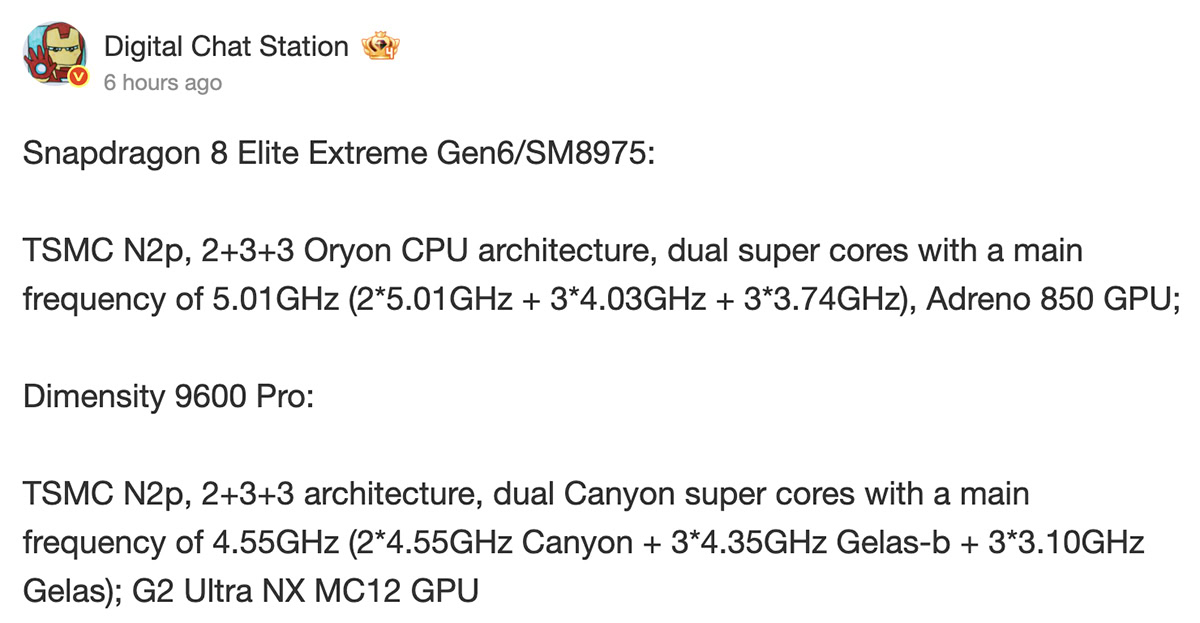
Industry insiders and supply chain watchers have spent months parsing details regarding the forthcoming Snapdragon 8 Elite Gen 6 series and its chief rival, the MediaTek Dimensity 9600 Pro. According to detailed disclosures shared by prominent industry tipster Digital Chat Station (DCS) via social media channels, Qualcomm is preparing a nomenclature shift that matches its ambitious hardware goals. The chip carrying the model number SM8975—initially anticipated to arrive under a standard professional moniker—may officially debut as the Snapdragon 8 Elite Extreme Gen 6. While the nomenclature leans heavily into industry buzzwords, the underlying engineering specifications paint a picture of a silicon behemoth designed to push mobile computing into uncharted territory.
Beneath its elaborate branding, the upcoming flagship processor is projected to be manufactured using TSMC’s cutting-edge 2nm fabrication process. This transition to a denser node is critical, providing the thermal and energetic headroom required to drive clock speeds into frequencies typically reserved for desktop-class processors. The architectural layout outlined in the leaks describes an octa-core configuration structured around two primary ultra-high-performance prime cores, three performance cores, and three efficiency cores. Most striking are the clock speeds: the prime cores are slated to run at an astonishing 5.01GHz, supported by performance cores clocked at 4.03GHz and efficiency cores ticking along at 3.74GHz. Graphics processing is expected to be handled by the formidable Adreno 850 GPU, which previous supply chain murmurs suggest will utilize a six-slice architecture designed to maximize visual fidelity and frame-rate stability.
Simultaneously, MediaTek is not ceding any ground in the high-end silicon race. The Dimensity 9600 Pro is similarly projected to leverage TSMC’s 2nm manufacturing node to deliver its own formidable octa-core package. Leaked specifications indicate that MediaTek’s challenger will feature two Canyon prime cores running at a blistering 4.55GHz, backed by three Gelas-b performance cores at 4.35GHz and three Gelas efficiency cores operating at 3.10GHz. For graphics, the chipset is rumored to integrate the ARM Mali G2 Ultra NX MC12 GPU. This parallel push toward higher frequencies by both major mobile designers highlights a fierce competitive rivalry, with each firm attempting to out-engineer the other in pursuit of absolute performance dominance.
Yet, transitioning to these extreme clock speeds introduces significant engineering hurdles, particularly regarding thermal management and power draw in form factors constrained by passive cooling. This tension was recently highlighted when early benchmark entries for both processors surfaced on Geekbench. The Snapdragon 8 Elite Extreme Gen 6 logged an initial single-core score of 3,434 and a multi-core score of 9,334. Meanwhile, early runs for the Dimensity 9600 Pro yielded a single-core result of 2,653 and a multi-core score of 7,516. To many industry observers, these early figures appeared somewhat underwhelming when benchmarked against previous-generation flagships like the Snapdragon 8 Elite Gen 5 and the Dimensity 9500.
Hardware analysts, however, urge caution when interpreting pre-production benchmark metrics. Early silicon iterations frequently operate on unoptimized firmware, incomplete power profiles, and conservative thermal limits designed to protect engineering samples during initial stress testing. Achieving stability at frequencies hovering around 5GHz requires sophisticated dynamic voltage scaling and advanced thermal interface materials within the chassis of commercial smartphones. Consequently, initial benchmark runs rarely reflect the true potential of mature, market-ready hardware. The primary objective of these early engineering samples is to validate basic circuit integrity and thermal behavior rather than set synthetic performance records.
The broader implications of this performance push extend far beyond benchmark leaderboards. As mobile devices increasingly function as primary computing hubs capable of handling on-device generative artificial intelligence, console-quality ray-traced gaming, and complex multitasking workflows, the demand for raw processing overhead has never been higher. Pushing past the 5GHz threshold signals a maturation of mobile manufacturing nodes, demonstrating that foundry advancements can successfully tame the steep power curves traditionally associated with ultra-high clock speeds. By harnessing advanced gate-all-around (GAA) transistor architectures within 2nm nodes, chip designers can eke out performance gains without causing instantaneous thermal throttling.
Looking ahead, the formal unveiling of these next-generation platforms is rapidly approaching. Qualcomm is widely anticipated to officially showcase the Snapdragon 8 Elite Gen 6 and its Extreme counterpart at the upcoming Snapdragon Summit next month. In parallel, MediaTek is expected to maintain its traditional cadence by revealing the Dimensity 9600 Pro during a similar window, setting the stage for a late-year smartphone release cycle defined by unprecedented processing power. As manufacturers race to integrate these high-frequency silicon platforms into commercial flagships, consumers and developers alike will soon discover whether pushing mobile processors to their literal extreme can deliver a sustainable revolution in everyday user experience.
