

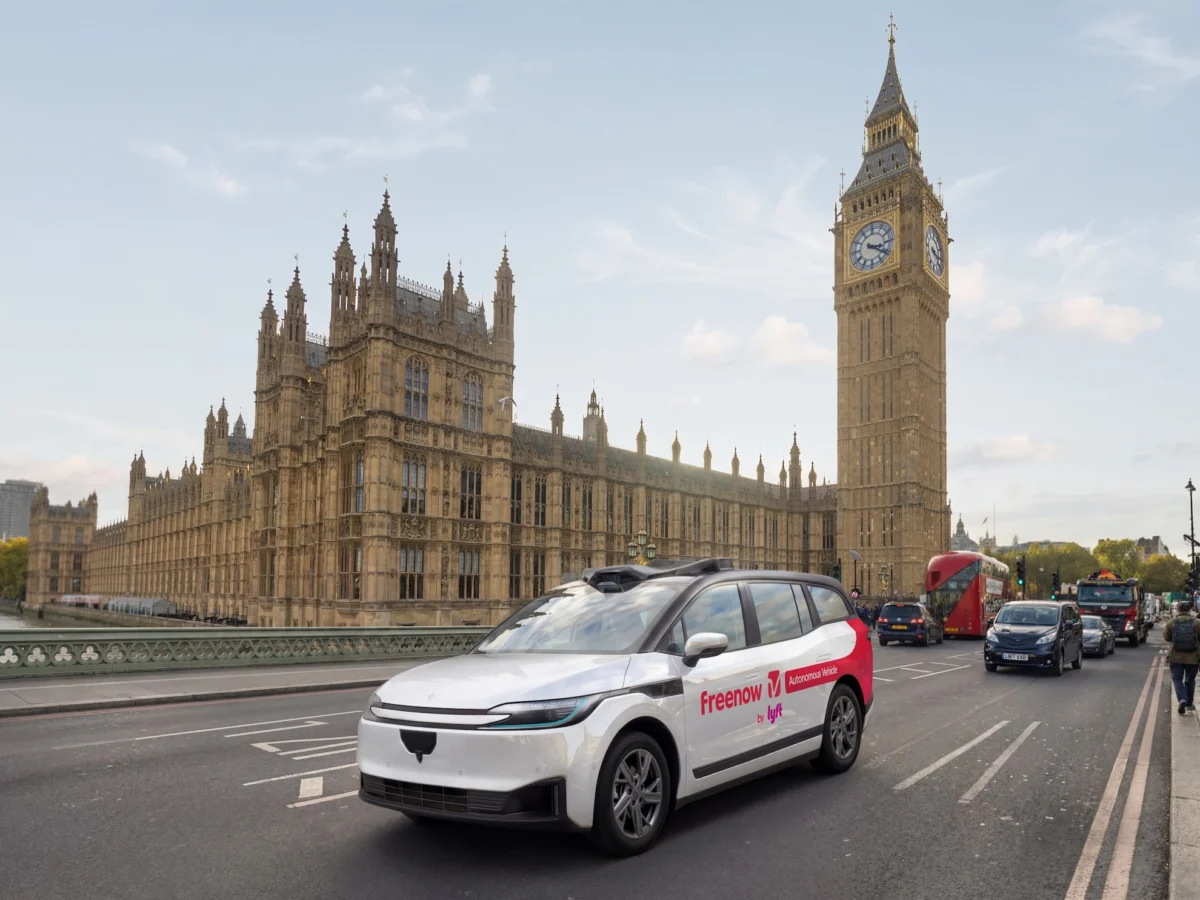
A fleet of self-driving vehicles has officially hit the asphalt in North London, marking the formal European operational debut of a major transatlantic and cross-border autonomous vehicle alliance. Chinese technology powerhouse Baidu, working in tandem with American ride-hailing giant Lyft and its European subsidiary Freenow, has initiated physical vehicle testing across public roads in the United Kingdom. The initiative represents a critical milestone in the race to commercialize driverless taxi services across Europe, establishing London as ground zero for next-generation urban mobility competition.
The trials, which began in the London borough of Brent with licensed human safety drivers behind the wheel, build upon a strategic framework established between Baidu and Lyft. Under the arrangement, Baidu’s purpose-built Apollo Go RT6 autonomous vehicle will be integrated directly into the Freenow mobility network—the European ride-hailing platform acquired by Lyft in 2025 for approximately $197 million. The long-term target envisions a fully commercialized, app-integrated driverless service open to the general public by 2027, contingent upon passing stringent regulatory hurdles established by British transport authorities.
The Hardware Engine: Unpacking the Apollo Go RT6
Central to this trial is Baidu’s sixth-generation autonomous vehicle, the Apollo Go RT6. Unlike earlier iterations of self-driving hardware that relied on retrofitting conventional combustion or electric production cars with roof-mounted sensor suites, the RT6 was engineered from the ground up specifically for commercial robotaxi services.
The vehicle incorporates a modular design architecture with an integrated Level 4 autonomous system powered by Baidu’s proprietary computing platform and a redundant multi-sensor array. This hardware stack features 38 sensors globally distributed across the chassis, combining high-resolution LiDAR, millimeter-wave radar, ultrasonic sensors, and high-definition cameras to deliver 360-degree environmental perception across varying weather conditions.
From a financial standpoint, the RT6 represents a major breakthrough in manufacturing economics. By streamlining the production process and leveraging localized supply chains in China, Baidu claims to have reduced the unit production cost of the vehicle to roughly $35,000—a fraction of the build cost associated with legacy AV testing fleets used by Western competitors. This drastic reduction in capital expenditure per vehicle is widely viewed by automotive analysts as a mandatory prerequisite for achieving positive unit economics in high-density ride-hailing markets.
For the London deployment, test vehicles operating in Brent are configured with human safety operators sitting in the driver’s seat. These operators monitor system behavior, real-time edge-case processing, and local traffic interactions, ready to take manual control if unexpected environmental anomalies or system disengagements occur.
The London Crucible: A Battleground of Rival Paradigms
London’s decision to open its roadways to driverless testing has transformed the city into the primary testing arena for global autonomous technology companies outside North America and Mainland China. Navigating the UK capital presents an exceptionally complex operational challenge, vastly different from the wide, grid-based, sunny thoroughfares of American Sunbelt markets like Phoenix, Miami, or Austin.
London features narrow, medieval street layouts, dense pedestrian foot traffic, aggressive cyclist cohorts, complex multi-lane roundabouts, constant road construction, and notoriously unpredictable precipitation. Achieving reliable Level 4 autonomy in this environment serves as a rigorous validation benchmark for any autonomous software stack.
Consequently, Baidu and Lyft enter a market already crowded with well-capitalized tech and transportation entities:
- Waymo (Alphabet): The American autonomous pioneer launched its own London test fleet with safety operators, translating its extensive mapping experience from San Francisco and Los Angeles to European urban topography.
- Uber and Wayve: Uber partnered with British autonomous startup Wayve to roll out driverless trials in London. Wayve’s technical architecture relies heavily on end-to-end artificial intelligence "foundation models" that learn to drive via generalized vision-language systems, directly contrasting with the detailed HD-map-dependent paradigms traditionally deployed by Baidu and Waymo.
This confluence of diverse technological strategies—map-heavy sensor fusion versus generalized end-to-end neural networks—means London will serve as a real-world crucible determining which technical architecture can scale most efficiently within complex European infrastructure.
Regulatory Horizons and Government Oversight
The commercial launch of driverless fleets in the United Kingdom hinges entirely on the evolving legal structure governed by the UK Department for Transport, Transport for London (TfL), and the Centre for Connected and Autonomous Vehicles (CCAV).
The British government has taken a proactive stance on driverless regulation through the passage of the Automated Vehicles (AV) Act. This legal framework sets the standard for assigning legal liability away from the human occupant and onto the designated "Authorised Self-Driving Entity" (ADSE) once a vehicle is operating in fully autonomous mode. To support this transition, UK authorities opened applications for an official AV pilot program, allowing tech companies to conduct monitored trials while gathering empirical safety data required for commercial licensing.
Lyft and Freenow have emphasized that their operational roadmap will proceed in strict lockstep with CCAV and TfL requirements. The multi-year testing window stretching toward the proposed 2027 commercial launch reflects the extensive validation period required to satisfy British safety standards, build public trust, and secure municipal operating licenses across Greater London’s 32 boroughs.
Platform Orchestration: The Hybrid Network Strategy
Beyond sensor hardware and regulatory compliance, the economic viability of the Baidu-Lyft partnership relies on market deployment strategy. Following its acquisition of Freenow, Lyft secured an established user base, dispatch infrastructure, and driver network across major European markets, including the UK, Germany, Spain, and Ireland.
Rather than attempting to fully replace traditional drivers, Freenow by Lyft intends to run what industry executives refer to as a "hybrid network." Under this model, algorithmic dispatch engines automatically assign incoming passenger requests to either a human driver or an autonomous vehicle based on vehicle proximity, route complexity, local weather conditions, and peak demand spikes.
This hybrid operational model addresses two critical industry challenges:
- Capacity and Utilization Balancing: Autonomous vehicles can cover predictable, high-density routes during peak hours, while human drivers absorb complex custom routes, outer-borough trips, or sudden demand surges that exceed AV fleet capacity.
- Labor Dynamics and Public Relations: Driverless deployments routinely encounter resistance from traditional taxi unions and private-hire driver associations concerned about job displacement.
Addressing these labor dynamics directly, Thomas Zimmermann, Chief Executive Officer of Freenow by Lyft, emphasized that the platform’s core identity remains tied to traditional transport professionals. He noted that as an entity deeply rooted in the taxi ecosystem, the company’s ultimate objective is ensuring that self-driving innovations work in tandem with human drivers rather than disintermediating the workforce that currently sustains London’s transit network.
Macroeconomic Implications and the Global Autonomous Horizon
The deployment of Baidu’s technology on British roads highlights a broader geopolitical shift in the global technology ecosystem. While domestic regulatory restrictions and geopolitical tensions have curtailed Chinese AV expansion within the United States, Europe has emerged as a fertile neutral testing ground for cross-border commercial ventures.
For Baidu, expanding its Apollo Go operations outside China—where it already executes millions of fully driverless rides quarterly across tier-one cities like Wuhan, Beijing, and Shenzhen—is necessary to prove that its autonomous software can adapt dynamically to foreign traffic laws, localized driving norms, and international safety frameworks.
For Lyft, partnering with an established hardware and AV software provider allows the ride-hailing company to counter Uber’s aggressive autonomous partnership strategy without bearing the immense financial burden of in-house robotics research and development.
As the test fleet expands its footprint across Brent and surrounding London boroughs over the coming months, industry observers will closely monitor system performance metrics, safety disengagement rates, and regulatory progress. Should the 2027 commercial timeline hold firm, London could become the world’s most sophisticated multi-platform autonomous transport ecosystem, forever altering the fabric of urban mobility across major European metropolises.
