

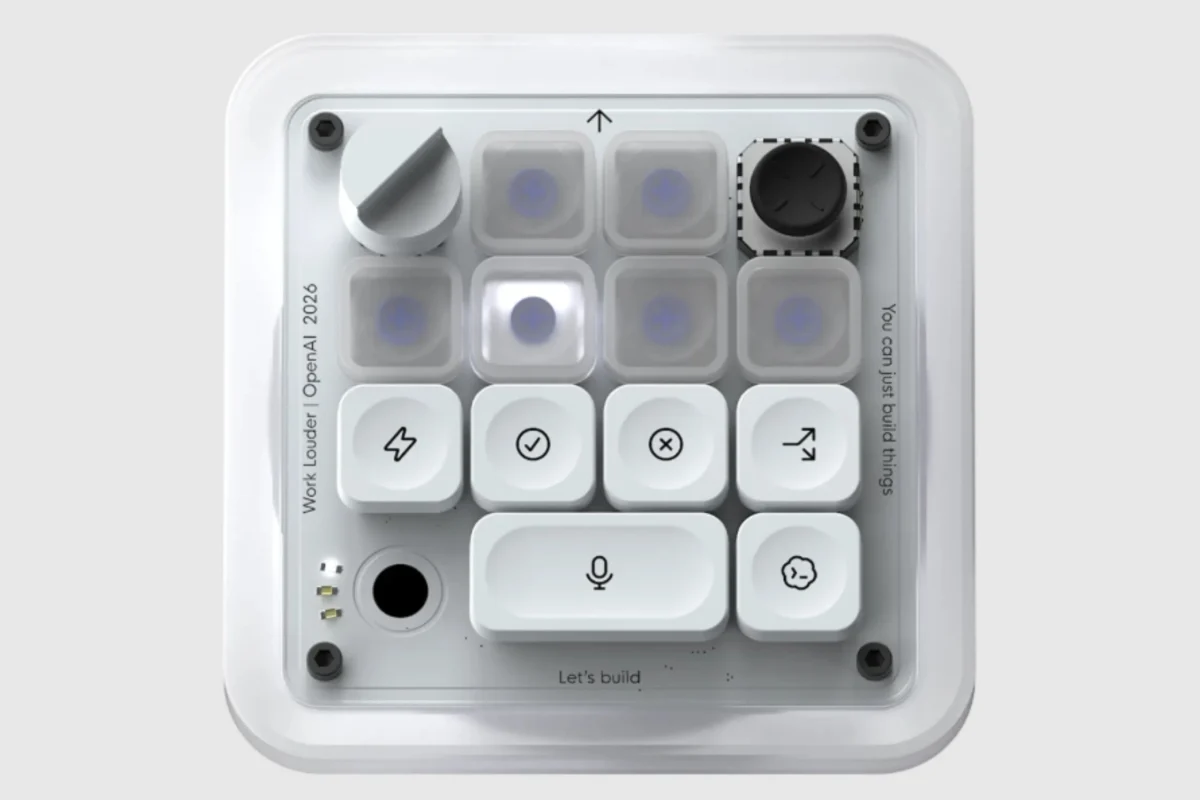
The boundary between artificial intelligence software and physical hardware is undergoing a structural transformation. In a move signaling its long-rumored ambitions to control the full technology stack, OpenAI has released its first physical consumer peripheral: a compact, boutique mechanical keypad named Micro. Developed in partnership with Work Louder, a industrial design studio recognized for specialized input devices aimed at creative professionals, the $230 accessory is designed to serve as a physical tether to ChatGPT and its agentic software-development environment, Codex.
While the device represents a minor financial risk for a company valued in the tens of billions, its release marks a pivotal milestone. Micro is not merely a desk accessory; it is a test balloon for how human operators will physically interact with autonomous software agents. However, its debut arrives during a tumultuous period for the artificial intelligence pioneer, defined by growing skepticism from software engineers, intense price-to-utility scrutiny, and mounting legal warfare with incumbent technology giants over hardware intellectual property.
The Engineering and Ergonomics of Micro
At its core, Micro is a specialized macropad tailored for high-density, repetitive interaction with generative models. Built with a heavy, industrial enclosure that gives it a substantial desk presence, the device eschews conventional keyboard layouts in favor of an asymmetrical, task-focused configuration. Its physical aesthetic mirrors the austere minimalism pioneered by consumer hardware giants, featuring ultra-clean lines and minimalist packaging that immediately draws structural parallels to high-end consumer electronics.
The interface is split into distinct functional zones. The upper tier consists of six frosted, translucent "agent" keys. These buttons are directly programmable through a dedicated interface embedded within the ChatGPT application, enabling users to map specific tasks, system prompts, or active coding threads to dedicated physical toggles. Positioned beneath the agent keys are six command keys used to control application state, manage task queues, and navigate active sessions. The device supports dual-mode connectivity through low-latency Bluetooth or a wired USB-C connection.
A central feature of Micro is its hardware-level push-to-talk dictation mechanism. Rather than relying on software hotkeys or continuous ambient listening, the device features a dedicated voice button paired with an adjacent submission key. Users hold the button to stream audio prompts directly to OpenAI’s whisper-driven voice models, releasing it to finalize input before tapping the send button to dispatch the command. This physical cadence is designed to eliminate the latency and context-switching inherent in toggling between IDE windows and web browsers.
To communicate the internal state of background tasks, Micro utilizes a multi-color LED backlighting system beneath its keycaps:
- White: Indicates that the assigned agent or session is idle and awaiting input.
- Blue: Signals active processing, indicating the model is generating code, analyzing context, or calling external APIs.
- Green: Confirms successful execution of a request or code generation task.
- Red: Alerts the user to a runtime error, system timeout, or failed API call.
By translating the abstract execution states of cloud-hosted language models into persistent, glanceable hardware signals, Micro attempts to solve one of the subtle challenges of working with asynchronous AI agents: knowing when a background process requires human intervention without constantly checking open software windows.
The Developer Paradox: High Price vs. Existing Toolchains
Despite its custom industrial design and seamless integration with OpenAI’s software ecosystem, Micro faces an uphill battle among software engineers—the exact demographic the product purports to target. The developer community’s reaction has ranged from measured skepticism to outright dismissal, exposing a fundamental disconnect between boutique hardware design and practical software engineering workflows.
At $230, Micro enters a competitive market populated by customizable, open-source input devices. Mechanical keyboard enthusiasts and power users have long utilized programmable macropads running open firmware like QMK or VIA. These alternative devices, often available at a fraction of Micro’s price point, allow users to map arbitrary key combinations, scripts, and API triggers across any application or operating system, rather than locking them into a single vendor’s application layer.
For seasoned software developers, physical macro keys often introduce more cognitive friction than they resolve. Integrating a dedicated 12-key pad requires memorizing color-coded state indicators and key assignments across multiple projects—a requirement that runs counter to the muscle memory established by standard keyboard shortcuts within Integrated Development Environments (IDEs) like VS Code or JetBrains. For many programmers, pressing a key combination on a standard keyboard remains faster and less disruptive than lifting a hand to operate a separate physical console.

Furthermore, critics argue that the device’s tight binding to ChatGPT and Codex limits its utility for engineers who routinely cycle between multiple model providers, local open-source models, and diverse development pipelines. For developers who do not center their daily routine entirely around OpenAI’s web interface or proprietary extensions, the device risks becoming an expensive, highly specialized desktop ornament rather than an essential productivity driver.
Hardware Ambitions Under a Legal Cloud
Micro’s launch cannot be evaluated in isolation from OpenAI’s broader corporate trajectory. The small keypad arrives amid a brewing legal conflict that highlights the escalating stakes of hardware development in the artificial intelligence sector.
Apple recently initiated formal legal proceedings against OpenAI, alleging trade secret misappropriation regarding hardware design and ambient computing technologies. The lawsuit underscores the aggressive competition for talent and intellectual property as software companies attempt to build native physical touchpoints for their models. OpenAI’s aggressive recruitment of key hardware engineering personnel from major consumer electronics firms has fueled speculation that the company is preparing a much broader consumer device portfolio.
Reports within the industry indicate that Micro is merely a precursor to more complex, ambient hardware devices currently under development within OpenAI. Rumors point toward screenless audio devices, stationary smart-home endpoints, and context-aware wearables designed to serve as primary interfaces for real-time multimodal interaction. By developing proprietary hardware, OpenAI seeks to bypass the platform dominance of Apple, Google, and Microsoft, reducing its operational reliance on third-party mobile operating systems and app store frameworks.
However, entering the hardware market exposes software-centric AI laboratories to supply chain complexities, hardware margin pressures, and regulatory compliance frameworks that differ vastly from deploying cloud services. The legal friction with established hardware manufacturers illustrates the severe defensive measures incumbents will deploy to protect their device ecosystems from being disintermediated by standalone AI hardware.
Human-Computer Interaction in the Agentic Era
Beyond the immediate product critiques and corporate litigation, Micro represents an early experiment in a fundamental paradigm shift: the transition from Graphical User Interfaces (GUIs) to Agentic Interfaces.
For four decades, personal computing has been defined by the desktop metaphor—windows, icons, menus, and pointers operated via a mouse and QWERTY keyboard. As software transitions from reactive tools that respond to explicit commands to autonomous agents that execute multi-step workflows over extended periods, traditional input paradigms become bottlenecked.
In an agentic workflow, a human operator acts less like a typist and more like an orchestration director, supervising multiple software entities running concurrently in the background. Physical hardware designed for this paradigm must prioritize:
- State Visibility: Providing immediate, low-latency status updates on background operations without occupying primary monitor real estate.
- Asynchronous Input: Enabling rapid dispatch of voice or macro commands to specific agents without breaking context in primary applications.
- Explicit Control: Offering tangible physical cut-offs, confirmation triggers, and safety mechanisms for autonomous software actions.
While Micro attempts to address these requirements through its color-coded feedback and dedicated dictation controls, its form factor highlights the transitional nature of current AI hardware. The high learning curve and specialized utility suggest that dedicated physical keys may not be the definitive answer for general computing users, but rather a transitional bridge for niche power users.
The Outlook for AI Peripherals
As OpenAI iterates on its initial hardware offerings, the ultimate commercial viability of products like Micro will depend on deep integration into broader operating systems and workflow ecosystems. For casual AI users, the device offers little functional advantage over standard web browsers and mobile application inputs. For dedicated ChatGPT power users and specialized software orchestrators who value physical tactility and tactile control, it offers a novel, albeit premium, method for managing continuous model interactions.
The broader significance of Micro lies in what it portends for the technology landscape. Software developers are no longer content remaining trapped inside third-party operating systems and conventional input peripherals. The race to construct dedicated, physical conduits for artificial intelligence has officially begun, and while early attempts may evoke mixed reactions from technical communities, they mark the first steps toward a post-desktop computing era.
