

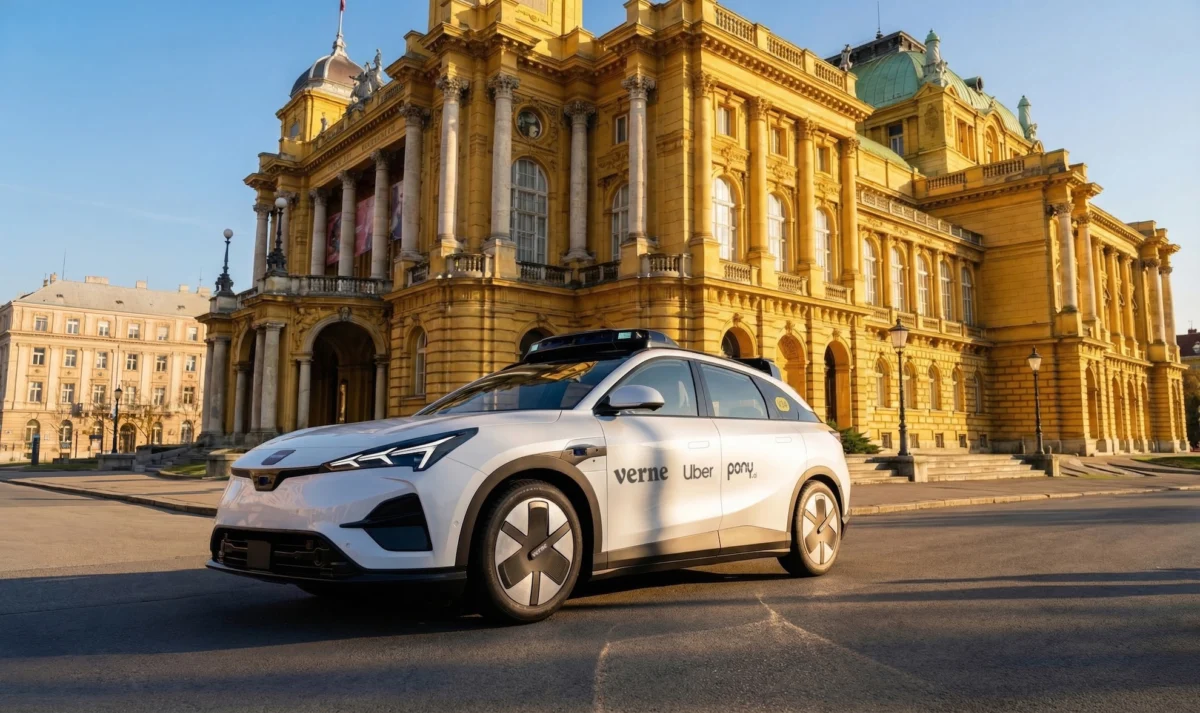
The landscape of urban transportation is undergoing a quiet but profound transformation, anchored not in the traditional automotive hubs of Detroit or Stuttgart, but in the burgeoning tech ecosystem of Zagreb, Croatia. Mate Rimac, the visionary entrepreneur who gained global fame for crafting some of the world’s most advanced electric hypercars, is now pivotally shifting his focus toward the democratization of autonomous mobility. Through his startup, Verne, Rimac has entered into a formidable strategic alliance with global ride-hailing titan Uber and Chinese autonomous driving pioneer Pony.ai. This partnership represents more than just a localized pilot program; it is a blueprint for the commercialization of Level 4 autonomous services across the European continent.
The tripartite agreement, finalized recently, outlines a sophisticated division of labor designed to overcome the traditional bottlenecks of robotaxi deployment. Pony.ai, a company that has already demonstrated significant technical maturity in the competitive Chinese and American markets, will serve as the "brain" of the operation, providing the full-stack autonomous driving system. The initial hardware platform for this venture will be the Arcfox Alpha T5, a vehicle co-developed by Pony.ai and the Chinese automotive giant BAIC. Verne will act as the fleet owner and operator, managing the logistical complexities of urban deployment, while Uber integrates the service into its ubiquitous ride-hailing platform, ensuring an immediate and massive user base.
The Evolution of Verne: From "Project 3" to Market Contender
Verne did not emerge overnight. Its origins trace back to 2019, when it was known internally as Project 3 Mobility (or P3) within the Rimac Group. While the Rimac Group is widely recognized for its high-performance arm—now part of the Bugatti Rimac joint venture—and its technology division that supplies batteries and drivetrains to global OEMs, Verne was conceived as a distinct entity with a radically different mission.
In July 2024, the startup emerged from stealth mode with a significant €100 million Series A funding round, signaling to the market that it had the capital necessary to move from theoretical models to physical infrastructure. Mate Rimac, who maintains a 23% stake in the Rimac Group, has long argued that the future of the automotive industry does not lie in selling more cars to individuals, but in providing mobility as a service. His philosophy is rooted in the belief that autonomous technology will eventually render the high-volume, human-driven passenger car obsolete. This perspective is particularly striking coming from a man whose previous masterpiece, the Rimac Nevera, is a $2.2 million testament to the thrill of human driving.
Rimac’s logic is pragmatic: while there will always be a niche market for "emotional" driving experiences (the hypercars), the functional utility of getting from point A to point B in a congested city is a problem that only automation can solve efficiently. Verne is his answer to that problem.
The Technological and Operational Blueprint
Unlike many competitors who attempt to build every component of the autonomous stack in-house, Verne is adopting an "integrator" model. By leveraging Pony.ai’s existing software, Verne avoids the multi-billion-dollar R&D cycle required to build a self-driving system from scratch. This allows the Croatian startup to focus its resources on what it calls the "customer experience" and "urban infrastructure."
A critical component of this strategy is the development of a purpose-built, two-seater electric vehicle specifically designed for the robotaxi use case. While the initial Zagreb launch will utilize the Arcfox Alpha T5 to gather data and establish the service, Verne’s long-term vision centers on its own proprietary EV. Most urban ride-hailing trips involve only one or two passengers; by optimizing the vehicle for this specific occupancy, Verne can reduce the vehicle’s footprint, increase energy efficiency, and maximize interior comfort for the rider.
Manufacturing of these purpose-built vehicles is slated for a new, state-of-the-art facility in Lučko, Croatia. This factory is expected to begin operations by the end of this year, representing a significant industrial milestone for the region. By controlling the manufacturing process, Verne can ensure that its vehicles are built for durability and ease of maintenance—factors that are often overlooked in traditional passenger cars but are vital for high-utilization fleet operations.
Uber’s Strategic Re-Entry into Autonomy
For Uber, this partnership marks a continued evolution of its autonomous vehicle (AV) strategy. After selling its own internal self-driving division, Advanced Technologies Group (ATG), to Aurora in 2020, Uber has shifted from being a developer of AV tech to being the ultimate marketplace for it. The company’s undisclosed investment in Verne indicates a high level of confidence in the startup’s operational model.
Uber’s involvement provides Verne with a "turnkey" solution for customer acquisition. In the robotaxi industry, the "empty miles"—the time a vehicle spends driving without a passenger—are a major drain on profitability. By tapping into Uber’s massive network, Verne can significantly optimize its fleet utilization rates. Furthermore, the integration allows for a hybrid approach: users can book a Verne robotaxi through the Uber app or Verne’s own dedicated platform, creating multiple touchpoints for the consumer.
Industry Implications: The European Frontier
The robotaxi market has largely been dominated by headlines from the United States (Waymo, Cruise, Tesla) and China (Baidu, Pony.ai). Europe, with its complex regulatory environment, diverse urban layouts, and historical emphasis on public transit, has remained a difficult territory for autonomous startups to penetrate.
Verne’s choice of Zagreb as its launch city is strategic. As the home of the Rimac Group, Zagreb offers a supportive local ecosystem and a regulatory environment that is increasingly open to mobility innovation. Success in Zagreb would serve as a proof-of-concept for other European capitals. CEO Marko Pejkovic has been vocal about the need for Europe to transition from the "testing" phase of autonomous mobility to "real service" deployment.
The expansion plans are ambitious, with the company aiming to scale to thousands of robotaxis across multiple European cities within the next few years. This puts Verne in direct competition with established players, but its lean operational structure and high-profile partnerships may give it an edge in the European market, where local nuances and infrastructure integration are paramount.
The Macroeconomic and Societal Shift
The rise of services like Verne represents a fundamental shift in urban planning and labor economics. If successful, robotaxi fleets could drastically reduce the need for private car ownership in dense urban centers, freeing up space currently dedicated to parking for green spaces or housing.
From an economic perspective, the shift to autonomous fleets also changes the labor dynamic of the gig economy. While the removal of the human driver reduces the cost per mile—making the service more affordable for the end-user—it necessitates a new class of "behind-the-scenes" workers. Verne’s model includes specialized infrastructure for fleet management, which includes automated cleaning, charging, and maintenance hubs. This creates a more industrialized approach to ride-hailing, moving away from the decentralized, individual-contractor model that has defined the last decade of the industry.
Expert Analysis: Challenges and Competitive Moats
Despite the optimistic outlook, Verne faces significant headwinds. The most immediate challenge is the "edge case" problem in autonomous driving—handling unpredictable human behavior, extreme weather, and complex road construction. While Pony.ai has a strong track record, the medieval streets and erratic traffic patterns of some European cities present a different set of challenges compared to the wide boulevards of Phoenix or the structured highways of Shenzhen.
Furthermore, competition is intensifying. Tesla has recently doubled down on its "Cybercab" vision, promising a fleet of autonomous vehicles that could leverage its existing millions of cars on the road. Waymo continues to expand its geofenced operations in the U.S. with a level of reliability that has become the industry benchmark.
However, Verne’s competitive moat lies in its vertical integration of the "operator" role. By building its own factory and focusing on the physical maintenance of the fleet, Verne is addressing the "last mile" of the business model that software-focused companies often ignore. In the robotaxi business, the software gets you the ride, but the hardware and operations keep the business running.
Looking Ahead: The Road to Autonomy
As Verne prepares to launch its commercial service in Zagreb, the automotive world will be watching closely. The partnership with Uber and Pony.ai provides a rare combination of capital, technical expertise, and market access. If Verne can successfully navigate the transition from prototypes to a fleet of thousands, it will validate Mate Rimac’s long-held belief that the age of the human-driven urban car is drawing to a close.
The journey from a "little-known Croatian startup" to a central player in the global robotaxi market is a testament to the shifting geography of innovation. In the coming years, the success of Verne will not just be measured by its stock price or its funding rounds, but by the number of people who choose to leave their car keys at home and trust a two-seater electric vehicle to navigate the streets of Europe’s cities. For Rimac, the hypercar was the beginning; the robotaxi is the destination.
