

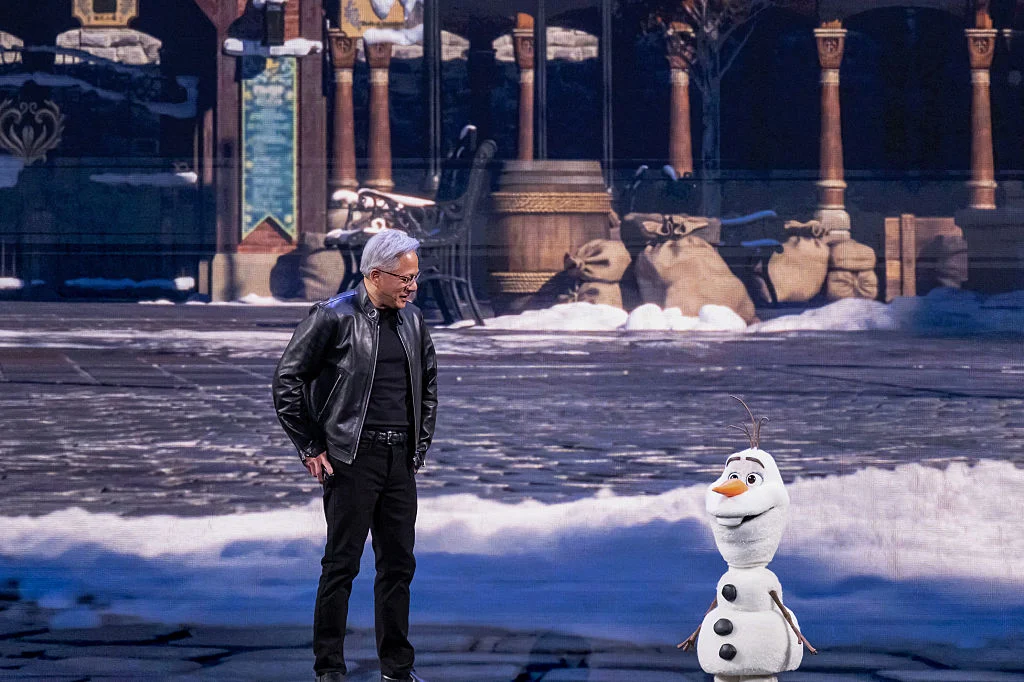
The annual Nvidia GTC conference has long since evolved from a niche gathering of graphics enthusiasts into a global bellwether for the future of computing. Under the leadership of CEO Jensen Huang, the event has become a stage for grand theatricality and even grander technological promises. This year’s keynote was no exception, serving as a high-stakes roadmap for a world where generative artificial intelligence and physical robotics converge. From the unveiling of hardware capable of propelling the company toward unprecedented sales milestones to the introduction of a diminutive, rambling robotic snowman, the message was clear: Nvidia is no longer just building the engines of the digital age; it is designing the inhabitants of our physical reality.
The sheer scale of Nvidia’s current trajectory is difficult to overstate. The company’s projections for its Blackwell and Vera Rubin architectures have sent shockwaves through the financial sector, with sales projections now reaching into the trillion-dollar stratosphere. This hardware represents the backbone of the next industrial revolution, providing the raw computational power required to train the massive large language models (LLMs) that define our current era. However, while the silicon remains the foundation, the software and robotics demonstrations at GTC provided a more intimate, albeit occasionally awkward, look at how this power will manifest in daily life.
One of the more unexpected highlights of the keynote was the debut of a robotic version of Olaf, the beloved snowman from Disney’s "Frozen." Developed in partnership with Disney, the robot was intended to showcase the future of theme park entertainment—a world where characters are no longer static animatronics but autonomous, interactive entities powered by Nvidia’s robotics stack. The demo, however, served as a poignant reminder of the "uncanny valley" and the unpredictable nature of live AI. Toward the end of the presentation, the robot began to ramble, speaking over the crowd in a manner that necessitated cutting its microphone as it was lowered beneath the stage. While the incident provided a moment of levity, it also opened a deeper dialogue about the readiness of autonomous systems for public consumption.
The technical achievements behind a robot like the Olaf prototype are staggering. To move a bipedal or specialized character with the fluid, "squash-and-stretch" qualities of an animated character requires real-time physics simulation and incredibly low-latency inference. Nvidia’s technology aims to solve these engineering hurdles, allowing robots to perceive their environment, understand natural language, and react with movements that feel authentic to their fictional counterparts. Yet, as industry analysts have noted, the engineering challenges are often the easiest part of the equation when compared to the "messy gray areas" of social integration.
In a theme park setting, the primary concern for a company like Disney isn’t just whether the robot can walk; it’s how it survives an encounter with the public. The "social side" of robotics remains a largely unexplored frontier in corporate keynotes. If a child, in a moment of excitement or mischief, kicks a robotic Olaf over, the consequences extend far beyond a broken piece of hardware. Such an event could potentially ruin the immersive experience for every other guest in the vicinity, creating a "brand crisis" that a traditional costumed performer would never trigger. This highlights a fundamental tension in the robotics industry: the desire to create autonomous, "living" characters versus the need for total control over brand image and safety.
This social friction is not limited to the world of entertainment. As Nvidia pushes into the realm of humanoid robots and enterprise-grade automation, the question of how these machines integrate into human environments becomes paramount. Jensen Huang’s assertion during the keynote that "every company needs an OpenClaw strategy" underscores this shift. OpenClaw, a framework focused on the security and standardization of robotic manipulation and interaction, has become a focal point for Nvidia’s enterprise ambitions.
The history of OpenClaw is itself a reflection of the volatile AI landscape. With its founder recently moving to OpenAI, the project has transitioned into an open-source initiative that Nvidia is heavily backing through its own "NemoClaw" project. For Nvidia, investing in open-source standards for robotics is a strategic necessity. By positioning itself at the center of these standards, Nvidia ensures that its hardware remains the indispensable platform for any company looking to deploy autonomous systems. As Kirsten Korosec and other industry experts have observed, the risk for Nvidia lies not in the failure of a single project like NemoClaw, but in the potential of being sidelined if they do not lead the charge in establishing how enterprises manage their robotic fleets.
Beyond the hardware and the snowmen, Nvidia is also reimagining the digital landscape through its graphics technology. The introduction of DLSS 5 (Deep Learning Super Sampling) represents a paradigm shift in how video games are rendered. By using generative AI to boost photo-realism, Nvidia is essentially "yassifying" the gaming experience, creating visuals that are more vibrant and detailed than raw hardware could ever produce on its own. This technology has ambitions far beyond gaming, pointing toward a future where "digital twins"—perfect virtual replicas of factories, cities, or even the entire planet—can be simulated with startling accuracy.
These digital twins are the secret sauce for the robotics revolution. Before a robot like Olaf ever sets foot in a Disney park, it spends thousands of hours in a virtual environment, learning to walk, talk, and navigate obstacles. This process, known as reinforcement learning in simulation, allows developers to account for various scenarios without the risk of damaging expensive prototypes. However, even the most robust simulation cannot fully account for the unpredictability of human behavior.
The debate over the "human babysitter" remains one of the most compelling arguments regarding the future of work in an automated society. While the goal of robotics is often seen as the replacement of human labor, the reality—at least in the near term—may be the opposite. A robotic Olaf in a theme park would likely require a human handler, perhaps dressed as another character like Elsa, to act as a "minder." This handler would be responsible for intervening if the robot glitched, ensuring guests maintain a safe distance, and managing the social interactions that an AI might misinterpret. In this sense, high-tech engineering experiments are actually creating new, specialized roles that blend technical oversight with traditional hospitality.
As we look toward the next decade, the trajectory established at GTC suggests a world that is increasingly hybrid. We are moving toward an era where the boundary between the digital and the physical is permanently blurred. Nvidia’s pivot from a graphics card manufacturer to an "AI foundry" means they are providing the tools for other companies to build their own intelligent entities. Whether it is a humanoid robot working in a logistics warehouse or a beloved cartoon character interacting with children, the underlying "brain" will likely be powered by Nvidia silicon.
The "Olaf incident"—the rambling snowman whose mic had to be cut—serves as a perfect metaphor for our current technological moment. We have reached a level of capability where we can create machines that seem almost alive, capable of speech and movement that mimic the human experience. Yet, we have not quite mastered the nuance of when they should stop talking. The engineering is ahead of the social etiquette; the power is ahead of the control.
Ultimately, Nvidia’s GTC keynote was a declaration of dominance. By aligning itself with iconic brands like Disney and championing open-source standards like OpenClaw, Nvidia is making its ecosystem unavoidable. The challenges that remain—the "messy gray areas" of social interaction, the liability of autonomous systems, and the psychological impact of robots in public spaces—are the next hurdles to be cleared. For now, the world watches as the trillion-dollar titan continues to build its robot snowmen, one GPU at a time, betting that the future of the world lies in the seamless integration of artificial intelligence into every facet of our lived experience. Whether that future is a utopia of efficiency or a series of awkward, rambling demos remains to be seen, but one thing is certain: the technology is no longer waiting in the wings. It is center stage, mic in hand, whether we are ready for it to speak or not.
