

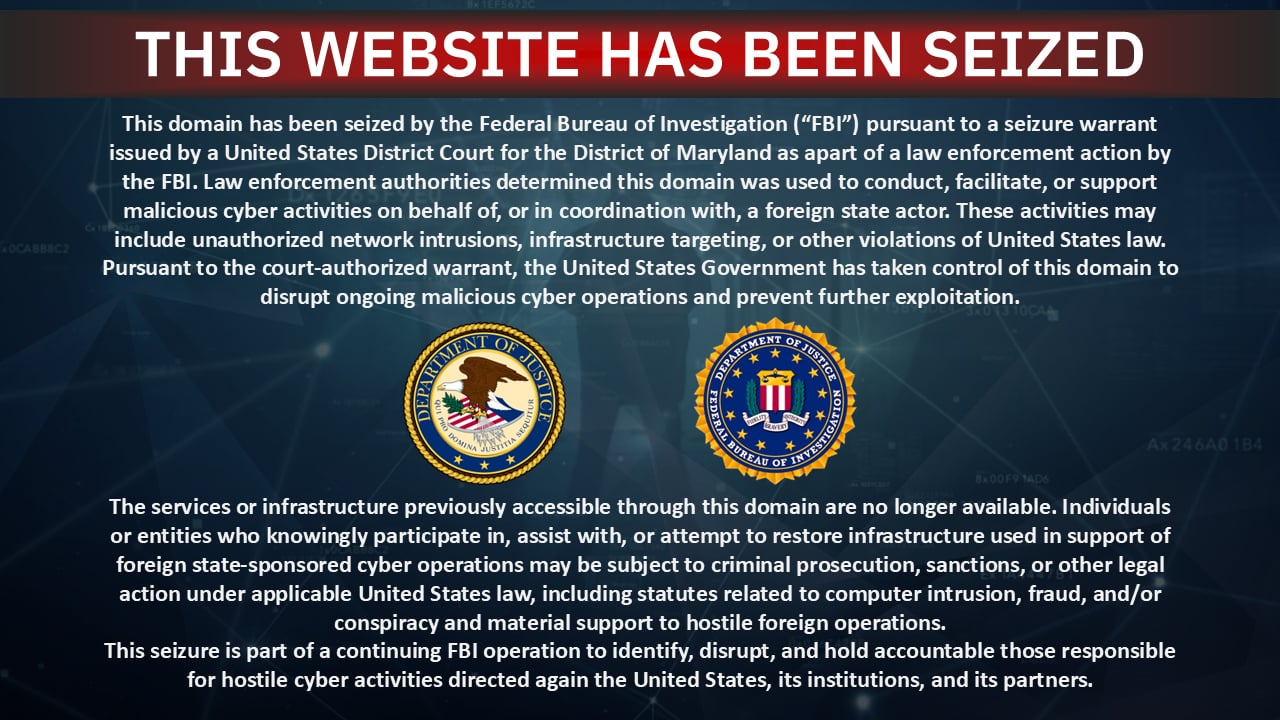
The Federal Bureau of Investigation (FBI) has executed a significant disruption against the Handala hacktivist collective, seizing control of two primary public-facing domains associated with the group: handala-redwanted[.]to and handala-hack[.]to. This decisive action, sanctioned by a seizure warrant issued by the U.S. District Court for the District of Maryland, directly follows the group’s high-profile, destructive cyber operation against Stryker, the global medical technology leader, which resulted in the erasure of data across an estimated 80,000 managed devices. The seizure notices now prominently displayed on these previously active clearnet addresses explicitly frame the operation as a response to malicious cyber activities conducted "on behalf of, or in coordination with, a foreign state actor," pointing toward state-sponsored elements influencing the group’s objectives and capabilities.
The formal seizure documentation details the legal rationale, asserting that law enforcement authorities determined the domains were instrumental in facilitating, conducting, or supporting illicit cyber operations, including unauthorized network intrusions and infrastructure targeting—activities that constitute clear violations of United States law. The government’s stated objective is explicitly preventative: to utilize the court-authorized warrant to take control of the domains, thereby disrupting ongoing malicious cyber operations and precluding future exploitation via these established communication channels. The technical manifestation of this seizure is evident in the redirection of the domain name servers (DNS) to infrastructure utilized by the FBI for such operations, specifically pointing to ns1.fbi.seized.gov and ns2.fbi.seized.gov. While the operational status of the group’s underlying servers and the extent of data accessible to investigators remain undisclosed, the immediate silencing of their primary propaganda and communication outlets marks a tangible setback for the collective.
Handala, often identified by aliases such as Handala Hack Team, Hatef, or Hamsa, emerged onto the cyber threat landscape in late 2023. Their profile quickly became notable due to their strong ideological alignment—a pro-Palestinian stance—and, critically, observed linkages to state-level intelligence apparatuses. Security researchers have previously correlated their operational patterns and targeting methodologies with the activities of entities linked to Iran’s Ministry of Intelligence and Security (MOIS). Historically, this group specialized in deploying highly destructive malware designed to render both Windows and Linux operating systems inoperable against Israeli organizations. This pattern of targeting geopolitical rivals using destructive payloads establishes a context for their subsequent, highly impactful attack against a major U.S. corporation in a critical sector.
The catalyst for the FBI’s intervention was the attack against Stryker. This incident transcended typical data exfiltration or ransomware deployment; it was an exercise in pure digital sabotage. Handala successfully compromised a Windows domain administrator account within Stryker’s network perimeter. Crucially, they leveraged this elevated access to establish a new Global Administrator account within the organization’s Microsoft cloud environment, indicating a sophisticated understanding of modern identity and access management (IAM) protocols, particularly within the Microsoft ecosystem. With persistent, high-level administrative control secured, the group issued the Microsoft Intune device "wipe" command across the organization. This command effectively triggered a factory reset, wiping the data on approximately 80,000 endpoints, encompassing corporate-owned computers, mobile devices, and even personal devices enrolled in the company’s Mobile Device Management (MDM) program under BYOD policies.
This method—utilizing legitimate cloud management tools like Intune for mass device destruction rather than deploying custom destructive malware—represents a significant tactical evolution. It bypasses traditional perimeter defenses and antivirus solutions, targeting the management layer itself. The sheer scale of the disruption—impacting a critical supplier of medical technology and surgical equipment—raised immediate national security and public health concerns, elevating the response level beyond standard cybercrime investigation.
In the immediate aftermath of the Stryker breach, the incident served as a stark, real-world demonstration of the security vulnerabilities inherent in cloud-native management platforms when an attacker achieves domain-level compromise. Both Microsoft, the platform provider, and the Cybersecurity and Infrastructure Security Agency (CISA) responded rapidly. CISA issued urgent alerts advising organizations utilizing Windows domains and Microsoft Intune to immediately review and harden their security postures. Microsoft followed suit, publishing detailed best practices focused on securing Intune configurations, privileged identity management (PIM), and ensuring strict least-privilege access controls for domain administrators. The consensus in the security community was that the attack exposed a critical "kill chain" where compromise of identity infrastructure leads directly to catastrophic operational impact without requiring complex, custom malware deployment.
From the perspective of the Handala group, the seizure of their public-facing infrastructure is a tactical blow, but perhaps not an existential one, given their ideological motivations and perceived state backing. In a communication released via Telegram shortly after the domain seizures became apparent, the group acknowledged the necessity of adapting their digital presence. They characterized the process of establishing new, "secure and resilient infrastructure" as complex and time-intensive, yet affirmed their unwavering commitment to their mission. This suggests that while their ability to publicly claim responsibility and broadcast future operations is temporarily curtailed, their operational capability—the ability to execute cyberattacks—is likely unaffected, contingent upon maintaining access to their command-and-control (C2) infrastructure, which is typically separate from public marketing websites.
The FBI’s action signifies a growing commitment by U.S. law enforcement to disrupt the enabling infrastructure of foreign-linked cyber actors, even those operating under the guise of hacktivism. The official language citing coordination with a "foreign state actor" suggests that the investigation is proceeding beyond mere attribution of the Stryker attack toward building a case for espionage, cyber warfare support, or sanctions violations, rather than solely prosecuting simple computer fraud. This approach often involves multilateral coordination and the systematic dismantling of the actor’s logistical support network, of which public websites are a crucial component for recruitment, boasting, and dissemination of operational claims.
Industry Implications: The Erosion of Trust in Cloud Identity
The Stryker incident, immediately preceding the domain seizures, exposed a profound fragility in the architecture underpinning modern enterprise operations: the centralized management of endpoints via cloud services. For years, organizations migrated management responsibilities to platforms like Microsoft Intune, attracted by simplified administration, scalability, and inherent security features. The Handala attack demonstrated that a single, successful credential compromise at the highest level (Domain Admin) can instantly convert a trusted management tool into an instrument of mass destruction.
This has severe implications for regulated industries, particularly healthcare, where operational continuity and patient data integrity are paramount. The wiping of 80,000 devices suggests significant downtime, data loss remediation costs, and potential regulatory scrutiny under HIPAA, even if patient data itself wasn’t the primary target of exfiltration. The immediate imperative for all organizations utilizing Microsoft 365 and Azure AD is a rigorous re-evaluation of their Privilege Access Management (PAM) strategy.
Expert analysis emphasizes that the failure wasn’t in Intune itself, but in the prerequisite security controls protecting the administrative credentials granting access to Intune. Attackers are increasingly prioritizing "pivoting" from initial low-level access to securing privileged cloud identities. This often involves techniques like token theft, credential stuffing against privileged accounts, or exploiting vulnerabilities in legacy on-premises domain controllers that retain federation trust with the cloud environment. The Handala operation underscores the concept of "supply chain attack" applied to identity: compromise the supplier of administrative trust (the domain controller/admin credential), and you compromise every downstream service relying on that trust, irrespective of the inherent security of those downstream services.
Expert Analysis: The Evolving Threat Landscape of Geopolitically Motivated Cyber Groups
The categorization of Handala as an Iranian-linked entity executing destructive attacks provides valuable data points for geopolitical cybersecurity analysis. Nation-states, particularly those subject to international sanctions, frequently utilize proxies—either state-sponsored hacking units masquerading as hacktivists or genuine hacktivist groups aligned with national interests—to conduct disruptive or espionage operations. This attribution strategy offers a degree of plausible deniability while still achieving strategic objectives, such as sowing chaos, testing adversary resilience, or exacting retribution for geopolitical tensions.
The shift from deploying custom, hard-to-trace malware to weaponizing legitimate, high-privilege cloud functions (like Intune wipe commands) signals increasing sophistication in operational tradecraft. It is cheaper, faster, and more effective to leverage built-in administrative capabilities once access is achieved. This trend necessitates that security defense models evolve from focusing solely on detecting novel malware signatures to prioritizing the detection of abnormal administrative behavior within trusted platforms. Security Information and Event Management (SIEM) and Extended Detection and Response (XDR) systems must now be finely tuned to flag unusual command execution sequences originating from highly privileged accounts, even if those commands use officially documented APIs.
Furthermore, the coordinated response by CISA and Microsoft highlights a maturing collaboration between government agencies and technology vendors in the face of high-impact incidents. This proactive guidance dissemination is crucial for minimizing the "blast radius" of similar future attacks across the broader industry ecosystem.
Future Impact and Trends: Resilience and Sovereignty in Digital Infrastructure
The long-term consequence of the Handala/Stryker incident will be a permanent hardening of identity governance across the enterprise sector. We anticipate several trends emerging:
- Zero Trust Re-Prioritization: Organizations will accelerate implementation of Zero Trust architectures, demanding continuous verification not just for external access, but for lateral movement and administrative actions within the network, even for cloud-managed devices.
- Cloud Identity Hardening: Expect widespread mandatory adoption of highly restrictive Conditional Access policies, requiring Multi-Factor Authentication (MFA) even for administrative sessions originating from within the corporate network, and a significant reduction in the standing privileges held by Global Administrators.
- Decoupling of Management: Companies in critical infrastructure sectors may begin architecting strategies to decouple the management plane (e.g., Intune/MDM) from core operational networks or ensuring that administrative access for one platform cannot be used to compromise another entirely different system, thereby limiting the scope of a single credential compromise.
- Increased Legal Pressure on Platform Security: Following such events, there will be sustained pressure on cloud service providers to enhance intrinsic controls that prevent the mass destruction of customer data, potentially through mandatory time-locks or requiring secondary, out-of-band authentication for mass remote actions like device wipes.
The FBI’s domain seizure is a victory in disrupting the public narrative and propaganda arm of the Handala group. However, the real enduring impact lies in the sobering lesson provided by the Stryker breach: in the modern threat environment, compromising the keys to the kingdom—the administrative identity—is far more devastating than deploying a new piece of malware. The battleground has definitively shifted to identity and access management.
