

The technology landscape is undergoing a subtle but significant evolution in how major platform vendors address critical software vulnerabilities. Apple has just deployed its inaugural security update utilizing the "Background Security Improvements" mechanism, signaling a strategic shift away from traditional, monolithic operating system rollouts for urgent fixes. This initial deployment targets a specific, high-risk vulnerability within the WebKit engine, tracked under the designation CVE-2026-20643, affecting the expansive ecosystem of iPhones, iPads, and macOS devices.
This move marks the true operational debut of a feature introduced earlier in the lifecycle of the current operating system generation (iOS 26.1, iPadOS 26.1, and macOS 26.1). Previously, security researchers and end-users alike have grown accustomed to waiting for the next scheduled point release (e.g., 26.3.2) to patch flaws that could expose millions of users to immediate threats. The Background Security Improvements feature is designed to dismantle this latency, allowing Apple to deliver targeted, component-level security patches—often referred to as out-of-band updates—without necessitating a full system reboot or the download of multi-gigabyte operating system files.
The specific vulnerability addressed, CVE-2026-20643, is particularly concerning because it strikes at the core security boundary of modern web browsing. Apple confirms the issue stems from a cross-origin bypass flaw residing within the Navigation API of WebKit. In essence, this vulnerability could have permitted malicious web content to circumvent the browser’s crucial Same Origin Policy (SOP). The SOP is fundamental to web security, preventing scripts loaded from one domain (origin) from accessing sensitive data or performing unauthorized actions on another domain. A successful bypass here opens the door for sophisticated phishing, session hijacking, or the exfiltration of user data across different active browser tabs or sessions.
The fix, attributed to the discovery efforts of security researcher Thomas Espach, focuses on hardening the affected component through "improved input validation." This suggests that the exploit likely relied on injecting or manipulating data passed through the Navigation API in an unexpected manner, leading to the breakdown of security checks. The immediate availability of this patch on the current baseline releases—specifically iOS 26.3.1, iPadOS 26.3.1, and macOS 26.3.1/26.3.2—demonstrates Apple’s commitment to minimizing the exposure window for this class of flaw.
The Paradigm Shift: From Monolithic to Modular Security
To fully appreciate the significance of this deployment, one must consider the historical context of Apple’s patching strategy. For years, while Microsoft and Google adopted more granular update mechanisms for key components like browsers and kernel modules, Apple often bundled significant security fixes into larger, scheduled maintenance releases. This approach ensured system-wide consistency but inherently introduced lag. If a zero-day exploit affecting Safari emerged two weeks after a major OS release, users remained vulnerable until the subsequent minor update arrived, which could be weeks or months away.
Apple’s formal documentation underscores the utility of this new mechanism: "Background Security Improvements deliver lightweight security releases for components such as the Safari browser, WebKit framework stack, and other system libraries that benefit from smaller, ongoing security patches between software updates." This architecture transforms how the company manages its sprawling software stack. Instead of updating the entire operating system kernel and user space for a browser fix, the Background Security Improvements feature acts as a highly efficient delivery system for targeted updates to specific frameworks.
From an engineering perspective, this modularity offers profound benefits. Firstly, the update package size is drastically reduced, minimizing bandwidth consumption and download times for end-users, particularly those on metered connections or with limited storage. Secondly, the risk associated with applying a large OS update—such as introducing regressions or compatibility issues—is significantly mitigated when only a small, isolated component is modified. This allows for faster internal quality assurance cycles focused solely on the patched module.
Industry Implications and Competitive Context
This adoption of rapid, background patching places Apple in closer alignment with the update philosophies pioneered by Google for Chrome and Android components. Google has long relied on separating the browser update cycle from the OS update cycle, a necessity given Chrome’s ubiquitous presence across multiple Android versions and even other platforms. While Apple’s implementation is currently confined to its own operating systems, the philosophical alignment is clear: critical web components require agility that the traditional OS update structure cannot provide.
For the wider technology industry, this deployment sets a powerful precedent. It validates the architectural investment in creating secure, in-band update channels for core services that are constantly exposed to external inputs, like web rendering engines. Competitors, particularly those managing complex legacy software deployments or diverse hardware lineups, will be watching closely to see the stability and adoption rate of these background patches. Success here could encourage broader industry adoption of similar non-disruptive security patching methods for non-kernel components.
Expert Analysis: The WebKit Security Calculus
The focus on WebKit is not coincidental. As the engine underpinning Safari, it is the primary gateway for user interaction with the open web. WebKit vulnerabilities frequently rank among the most severe reported against Apple platforms because they are easily weaponized through drive-by downloads or malicious websites.
The bypass of the Same Origin Policy (SOP) via the Navigation API is a particularly nuanced attack vector. Modern web applications rely heavily on SOP to compartmentalize user trust. If an attacker can trick WebKit into processing a cross-origin request as if it originated from the intended, trusted site, they gain a foothold. The fix—improved input validation—suggests that the Navigation API was not rigorously checking the provenance or structure of the data it was processing during navigation events, allowing the malicious payload to slip through validation checks designed to enforce origin security.
Security architects often categorize these WebKit flaws as "sandbox escape precursors." While a SOP bypass doesn’t immediately grant access to the operating system, it is a critical prerequisite for many advanced exploitation chains that aim to break out of the browser’s sandbox environment and gain arbitrary code execution on the host device. By patching this early stage with unprecedented speed, Apple effectively short-circuits a potential multi-stage attack sequence.
User Experience and Management Considerations
The introduction of Background Security Improvements also fundamentally alters the end-user relationship with security maintenance. Apple explicitly notes that these updates are applied "in the background," minimizing user interruption. This is a significant UX victory, especially for mobile users who might otherwise delay updates due to low battery or poor connectivity.
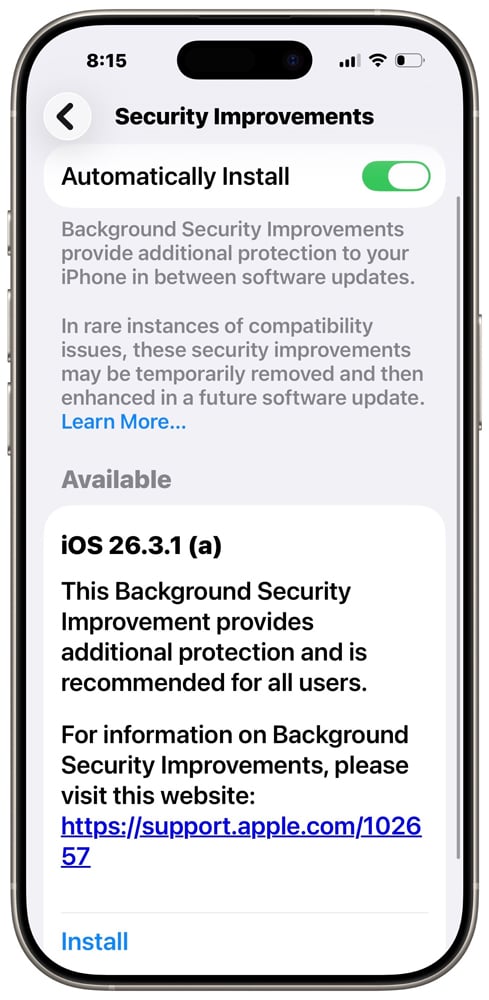
However, the mechanism introduces a new management consideration, detailed in Apple’s accompanying warnings. Users retain the ability to manually uninstall these background improvements via the device settings under the Privacy & Security menu. Apple strongly cautions against this practice. Uninstalling a Background Security Improvement effectively strips the device back to the security posture of the baseline OS version (e.g., iOS 26.3.1) before the rapid patch was applied.
This reversion means the user loses the protection afforded by CVE-2026-20643 until the next scheduled major OS update rolls in the fix permanently, or until the background update is reapplied. This creates a potential security gap if a user, for example, experiences a temporary compatibility hiccup with an obscure third-party application immediately following the patch deployment and decides to revert the security fix as a troubleshooting step. For the vast majority of users, the recommendation is clear: maintain the incremental security patches unless specific, verifiable issues arise.
Apple acknowledges the possibility of rare compatibility conflicts, stating, "In rare instances of compatibility issues, Background Security Improvements may be temporarily removed and then enhanced in a subsequent software update." This clause provides an official mechanism for Apple to roll back a faulty background patch if it destabilizes a critical system function, ensuring that the overall goal of rapid security delivery does not compromise overall system stability.
Future Trajectory: Expanding the Scope of Rapid Patching
The successful deployment against a WebKit vulnerability strongly suggests that Apple intends to utilize this framework for other high-exposure system components beyond Safari. Future candidates for Background Security Improvements likely include:
- CoreCrypto Frameworks: Patches for cryptographic library weaknesses, where delays can have widespread, systemic impact across all encrypted communications.
- Networking Stacks: Urgent fixes for vulnerabilities in Wi-Fi or cellular protocols that could be exploited remotely.
- System Libraries: Updates to fundamental system libraries underpinning critical security features like memory management or process isolation that might be targeted by sophisticated threat actors.
The future impact of this policy hinges on the industry’s response to evolving threats. As adversaries increasingly focus on exploiting supply chain vulnerabilities or rapidly weaponizing newly disclosed flaws (as seen with modern zero-day markets), the ability to deploy security patches within hours, rather than weeks, is becoming a fundamental requirement for platform integrity. Apple’s adoption of Background Security Improvements represents a structural commitment to this required velocity, moving their security posture from reactive to preemptive in key areas of the software ecosystem. This shift is not merely technical; it’s a strategic realignment in platform defense designed to maintain user trust in an increasingly hostile digital environment.
