

The landscape of modern transportation often moves in cycles, but rarely does the past converge with the future as vividly as it has this week. The headline-grabbing return of Travis Kalanick to the autonomous and robotics sector serves as a potent reminder that the ambitions of the mid-2010s never truly disappeared; they merely went underground to mature. Kalanick, the co-founder and former architect of Uber’s global dominance, has re-emerged with a new venture, Atoms. More strikingly, he is consolidating power by moving to acquire Pronto, the autonomous vehicle startup founded by his former collaborator Anthony Levandowski.
For industry observers, this reunion is laden with historical weight. In 2016, the acquisition of Levandowski’s startup, Otto, by Uber sparked one of the most high-profile intellectual property battles in tech history, culminating in a massive settlement with Waymo and Levandowski’s brief federal imprisonment. Today, the focus has shifted from the chaotic "move fast and break things" ethos of ride-hailing to the pragmatic, high-stakes world of industrial robotics and mining. Kalanick’s revelation that he is already the primary investor in Pronto suggests a calculated pivot toward specialized, geofenced autonomy—a sector where the variables are controlled, and the ROI is immediate.
This resurgence of the "class of 2016" coincides with a broader maturation of the mobility sector, characterized by a shift from speculative hype to software-defined execution. While Kalanick builds his robotics empire, established electric vehicle (EV) players and startups are grappling with the realities of scaling complex hardware and integrated software in a cooling global market.
Rivian’s R2: The Software-Defined Gamble at SXSW
Rivian has chosen the cultural and technological intersection of South by Southwest (SXSW) in Austin to plant its flag for the next generation of consumer EVs. The R2 SUV, the company’s bid for mass-market relevance, is more than just a smaller, more affordable sibling to the R1 flagship; it represents a fundamental architectural shift for the company.

The R2 Performance Launch Edition is slated to enter the market at $57,990, a price point that places it squarely in competition with the premium trims of the Tesla Model Y and the upcoming luxury offerings from European incumbents. However, the $45,000 base model—the "holy grail" for Rivian’s mass-adoption strategy—remains a distant prospect, not expected until late 2027. This delay underscores the immense difficulty of achieving price parity with internal combustion vehicles while maintaining the high-margin hardware required for advanced autonomy.
The true innovation of the R2 lies beneath the sheet metal. Rivian is moving toward a highly centralized, edge-computing architecture. While the current R1 platform relies on four separate Systems on a Chip (SoC) and leans heavily on cloud-based processing, the R2 will feature a singular, powerful SoC capable of 200 Tera Operations Per Second (TOPS). According to Wassym Bensaid, Rivian’s head of software, this shift to edge computing is critical for the implementation of local Large Language Models (LLMs). By processing data locally on the vehicle rather than in the cloud, Rivian can drastically reduce latency and improve the reliability of voice interfaces and autonomous decision-making.
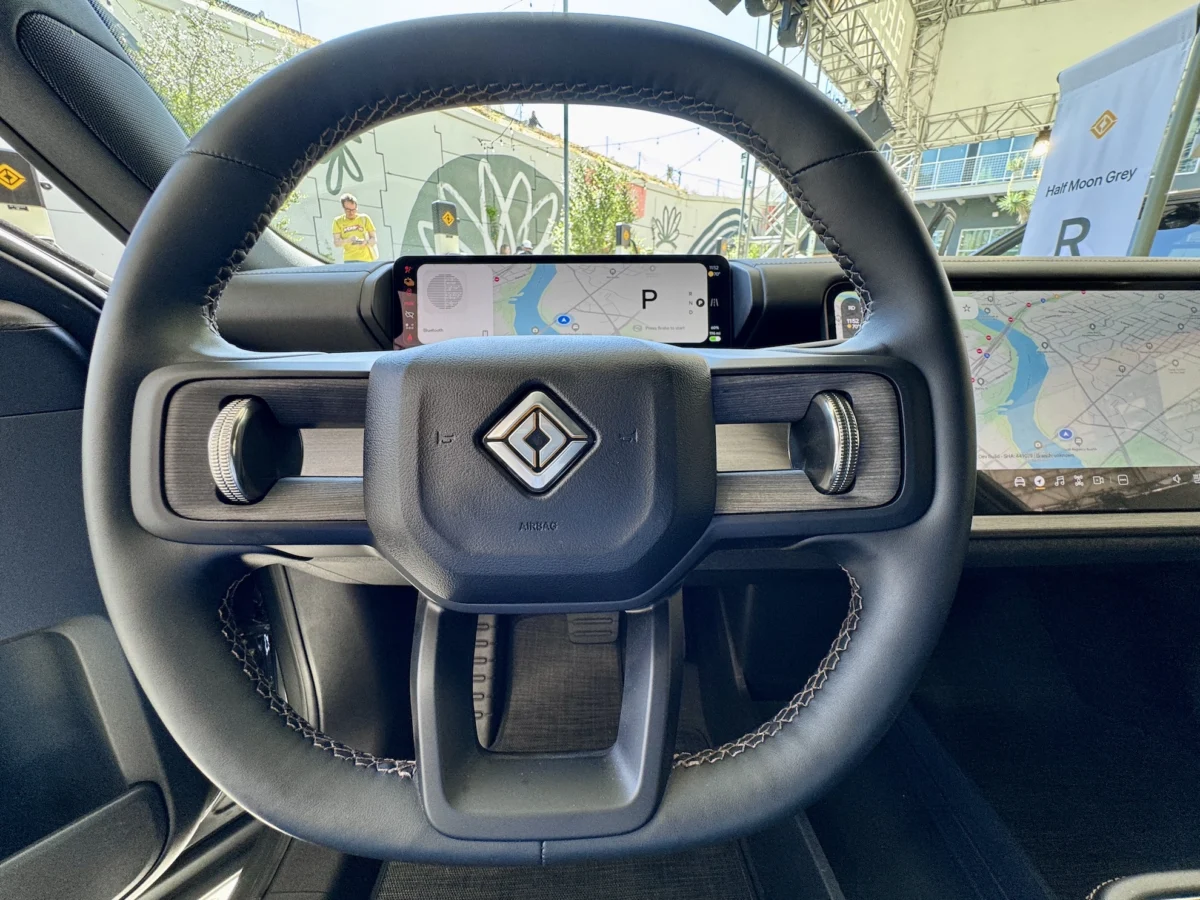
Furthermore, Rivian is addressing the growing consumer backlash against "screen-only" interfaces. The introduction of "halo wheels" on the steering wheel—haptic-feedback controllers that allow drivers to adjust temperature, volume, and fan speed without looking away from the road—is a sophisticated compromise between minimalist design and tactile utility. It is a sign that EV makers are finally listening to the ergonomic critiques of early adopters.
The Robotics Pivot: From Humanoids to Utility
Beyond consumer vehicles, the mobility sector is increasingly indistinguishable from the robotics industry. Rivian’s recent spin-off, Mind Robotics, has secured a staggering $500 million Series A round, valuing the industrial robotics lab at approximately $2 billion. Led by venture heavyweights Accel and Andreessen Horowitz, this investment highlights a growing consensus: the future of manufacturing lies in "intelligent hands" rather than "humanoid bodies."
RJ Scaringe, Rivian’s CEO, has voiced a contrarian view on the current obsession with humanoid robots. While companies like Tesla and Figure are racing to perfect bipedal movement and human-like biomechanics, Scaringe argues that such complexity is often a distraction in industrial settings. In his view, the "hand" is the most critical component of a robot. The rest of the robotic system—the arms, the base, the sensors—is merely a delivery mechanism to get those hands to the right location. By stripping away the "unnecessary complexity" of human-like motion, such as backflips or bipedal walking, Mind Robotics aims to create more efficient, reliable, and deployable automation for the factory floor.

The Robotaxi Ecosystem: Collaboration over Competition
The dream of the universal robotaxi is also entering a new phase of strategic consolidation. Rather than attempting to build proprietary ride-hailing networks from scratch, autonomous vehicle (AV) developers are increasingly plugging into Uber’s existing global infrastructure.
Uber has recently expanded its autonomous options in Las Vegas by integrating Motional’s self-driving Hyundai Ioniq 5 vehicles into its app. This follows a similar partnership with Zoox, the Amazon-owned AV firm, which plans to launch its purpose-built, "carriage-style" robotaxis on the Uber platform in Las Vegas later this year. Zoox is currently navigating the regulatory hurdles of the Federal Motor Vehicle Safety Standards, as its vehicles lack traditional controls like steering wheels.
Even Wayve, the UK-based AI startup, is joining forces with Uber and Nissan to pilot a robotaxi service in Tokyo by late 2026. This trend suggests that the "winner-take-all" mentality of the early AV race has been replaced by a "platform-as-a-service" model. Uber is positioning itself as the indispensable intermediary—the digital layer that connects various autonomous fleets to a massive, ready-made customer base.
Strategic Shifts and Market Volatility
As the sector matures, the divide between conceptual vision and operational reality is becoming clearer. Lucid Motors, for instance, recently teased a robotaxi concept called "Lunar." While the announcement generated headlines, the company later clarified that the project is in the conceptual phase with no active development. In a capital-intensive industry, the "concept-to-road" timeline is a critical metric for investors, and Lucid’s cautious stance reflects the sober financial environment of 2024 and 2025.
Similarly, the electric aviation sector is seeing a mix of regulatory progress and legal friction. The FAA has authorized eight pilot programs across 26 states for companies like Archer Aviation and Joby Aviation, signaling that electric vertical takeoff and landing (eVTOL) aircraft may begin widespread testing as early as this summer. However, the sector is also becoming increasingly litigious. Archer’s recent countersuit against Joby, alleging fraudulent claims regarding domestic manufacturing, highlights the fierce competition for government contracts and market dominance in the nascent "air taxi" space.

Infrastructure and the Return of the Pragmatic EV
On the infrastructure front, the industry is seeing significant advancements in battery chemistry and energy management. Group14 has commenced production of silicon battery materials in South Korea, a move that could potentially triple the energy density of standard lithium-ion cells and enable "flash-charging" for the next generation of long-range EVs. Meanwhile, Tesla’s official licensing as a utility in the United Kingdom marks its transition from a car company to a comprehensive energy ecosystem, setting the stage for a showdown with established green energy providers.
Finally, in a move that signals a return to pragmatism, General Motors is resurrecting the Chevrolet Bolt. Once seen as a "deep cut" in the EV world, the Bolt is being reimagined as a cost-effective, high-volume entry point into electric mobility. By leveraging an existing, proven platform rather than developing a new one from scratch, GM is navigating the current period of EV market uncertainty with a strategy focused on affordability and brand equity.
As we look toward the latter half of the decade, the mobility industry is no longer defined by the singular pursuit of a "magic bullet" technology. Instead, it is a complex web of edge computing, specialized robotics, and strategic platform partnerships. Whether it is the return of a disruptive founder like Kalanick or the software-led evolution of a startup like Rivian, the goal remains the same: transforming transportation from a hardware commodity into a seamless, intelligent service. The "2016 vibes" may be back, but the execution is finally catching up to the ambition.
