

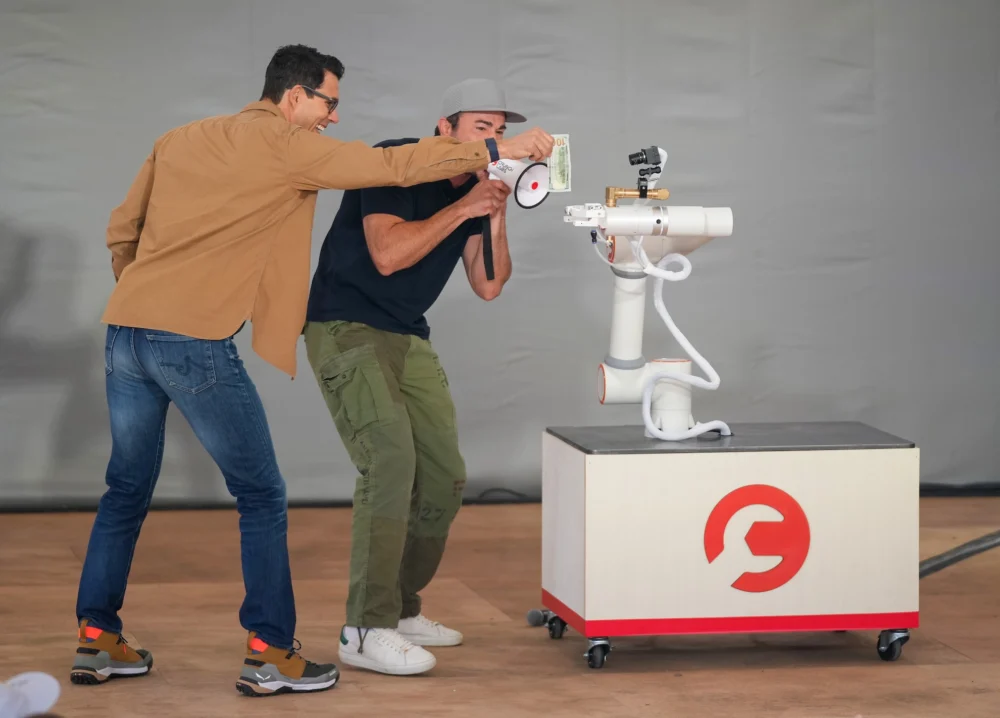
The trajectory of the modern electric vehicle industry has been defined by a handful of polarizing, visionary figures, but few have managed to balance the scales of high-concept innovation and industrial pragmatism as effectively as RJ Scaringe. While the world has watched the Rivian founder scale his automotive empire from a secretive "stealth" startup to a publicly traded powerhouse, Scaringe has quietly been architecting a broader ecosystem of technology companies designed to solve the most friction-heavy problems of the 21st century. His latest venture, Mind Robotics, represents more than just a foray into automation; it is a fundamental critique of how the technology sector has approached the development of artificial intelligence in the physical world.
Scaringe’s entrepreneurial journey is increasingly resembling a masterclass in vertical integration and strategic spin-offs. Following the success of Rivian’s flagship R1 platform, he successfully navigated the launch of Also, a micromobility startup that emerged from Rivian’s internal "skunkworks" programs. Backed by significant venture capital and a minority stake from the parent automaker, Also has already begun disrupting the urban logistics space with modular e-bikes and cargo quads. However, it is Mind Robotics—a company born not from within Rivian’s walls, but from Scaringe’s own observations of the manufacturing landscape—that may ultimately prove to be his most consequential contribution to the global industrial economy.
The genesis of Mind Robotics is inextricably linked to the upcoming R2 platform, the mid-sized SUV that serves as the linchpin of Rivian’s mass-market ambitions. As Scaringe looked toward the future of manufacturing for the R2—an EV designed to be produced at roughly half the cost of its predecessor—he identified a glaring inefficiency in the way factories are built and operated. The realization was stark: to build the four or five massive plants required for global scale over the next decade, Rivian and companies like it would need to spend billions in capital expenditure on automation that, in its current form, is rapidly reaching a point of diminishing returns.
Classic industrial robotics, the kind seen on the assembly lines of Ford, Tesla, or Rivian’s own Normal, Illinois plant, are masters of repetitive, high-force tasks. They are rigid, caged, and lack the nuance required for the final assembly stages where human dexterity remains king. On the other end of the spectrum, the venture capital world has been enamored with the "humanoid" robot—machines that mimic human biomechanics to perform domestic tasks like folding laundry or clearing a dinner table. Scaringe argues that both approaches are missing the mark for the industrial sector.
Mind Robotics was founded to bridge this gap, recently securing a staggering $500 million Series A round co-led by heavyweights Accel and Andreessen Horowitz. This funding brings the company’s total capital raised to $615 million since its inception in late 2025, vaulting its valuation to approximately $2 billion before a single commercial unit has even been deployed. The level of investor confidence reflects a growing appetite for Scaringe’s "industrial-first" philosophy—a strategy that prioritizes the "operational design domain" of the factory floor over the chaotic, unpredictable environment of the suburban home.
The philosophical core of Mind Robotics is a rejection of what Scaringe describes as unnecessary complexity. In recent years, the robotics industry has been dominated by viral videos of humanoid robots performing backflips or navigating parkour courses. While these displays are impressive feats of engineering, Scaringe views them as a distraction from the actual work of manufacturing. In a production environment, a robot does not need to perform a backflip; it needs to thread an M4 fastener into an aluminum casting or pick up a heavy steel pipe with precision.
Scaringe’s "hands-first" approach is a departure from the "body-first" mimicry of competitors like Boston Dynamics or Tesla’s Optimus program. He argues that in the biological world, evolution has created specialized biomechanics for specific tasks. A dolphin is optimized for swimming; a cheetah for sprinting. Humans are generalists, but our primary tool for interacting with the world is our hands. In a factory, the "body" of the robot exists merely to transport the hands to the work site. By focusing engineering resources and capital on high-dexterity, modular end-effectors—the "hands"—rather than complex leg joints and athletic locomotion, Mind Robotics aims to reduce failure modes, lower power consumption, and accelerate the "data flywheel" necessary for training industrial AI models.
This focus on the hand also addresses the "torque amplification" challenge. The dexterity required to manipulate a delicate wire harness is fundamentally different from the strength needed to hoist a chassis component. Scaringe’s vision involves a suite of robotic solutions that can be tailored to these specific industrial needs, avoiding the "one-size-fits-all" trap that has hampered the scalability of more generalized humanoid systems.
Furthermore, Scaringe identifies a critical "moat" that most robotics startups lack: a deep understanding of industrialization. Silicon Valley is littered with companies that can build a prototype but fail when tasked with building a supply chain or managing a global maintenance network. By positioning Rivian as a primary partner and potential first customer, Mind Robotics gains access to a real-world testing ground that functions as a high-fidelity laboratory. This allows for the rapid iteration of models based on actual manufacturing data—a luxury that startups focused on the domestic market do not have.
The branding of the company itself reflects this cerebral approach. Originally dubbed "Project Synapse"—a name inspired by Scaringe’s children’s school and the biological connection points within the brain—the name was eventually simplified to Mind Robotics. The goal is to create a system where the "mind" (the AI model) and the "hands" (the mechatronics) are seamlessly integrated, but housed within a form factor that is approachable rather than intimidating.
Scaringe is particularly critical of the "Terminator-esque" aesthetic that has permeated the robotics industry. Many modern humanoids feature lean, muscular, and overtly athletic designs that can feel out of place or even threatening on a crowded factory floor where they must interact with human workers. Drawing on the design language that made Rivian’s R1 truck feel friendly and inviting despite its 1,000-horsepower capability, Scaringe intends for Mind Robotics to adopt a UI and industrial design that prioritizes safety and cooperation. The robot should feel like a sophisticated tool, not a science-fiction antagonist.
The broader implications for the global economy are significant. We are currently entering the era of "Industry 4.0," where the integration of IoT, AI, and physical automation is expected to redefine productivity. However, the "labor gap" in manufacturing continues to widen. By creating robots that can perform "human-like" tasks—tasks that involve dexterity and perception rather than just raw force—Scaringe is targeting the most labor-intensive parts of the assembly line. This isn’t just about replacing workers; it’s about augmenting the manufacturing process to allow for the kind of volume production required to transition the world to sustainable energy.
If Scaringe is correct, the future of the factory floor won’t be populated by athletic humanoids doing gymnastics. Instead, it will be filled with specialized, high-dexterity machines that are "smart" enough to navigate a structured environment and "capable" enough to handle the nuanced assembly work that has, until now, remained the exclusive domain of human hands.
As Mind Robotics moves toward its first deployments, the industry will be watching closely to see if Scaringe can replicate his automotive success in the world of silicon and steel limbs. With a $2 billion valuation and a clear-eyed focus on the pragmatic realities of the factory floor, Mind Robotics is no longer just a "project." It is a declaration that the next phase of the industrial revolution will be won not by those who can make robots look like us, but by those who can make them work like us. The shift from "Project Synapse" to Mind Robotics marks the beginning of a new chapter in Scaringe’s career—one where the goal isn’t just to build the vehicles of the future, but to build the machines that build the future.
