

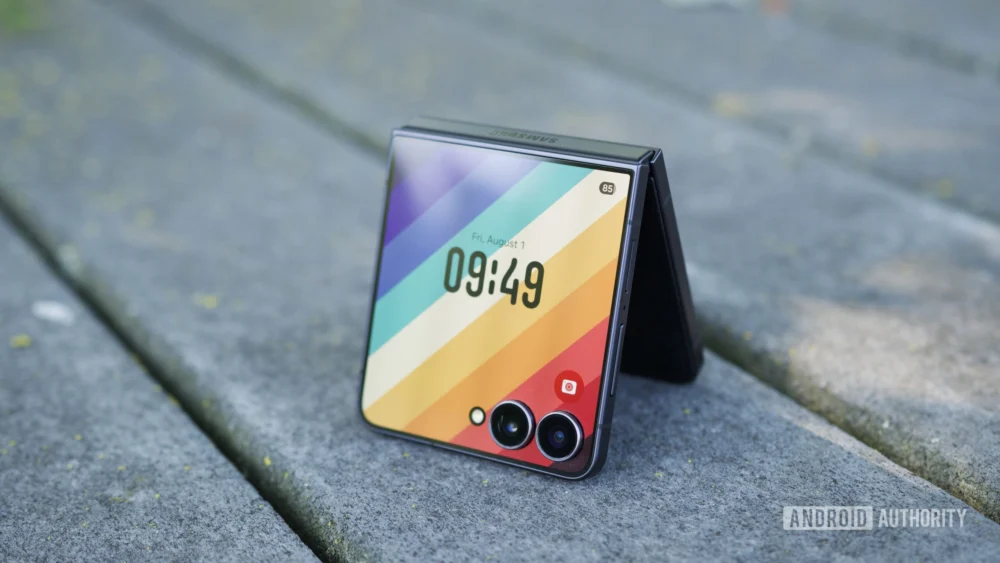
The perennial anticipation surrounding Samsung’s mid-year Galaxy Unpacked event often centers on the flagship innovations, particularly the evolving form factors like the rumored "Wide" Galaxy Z Fold. Yet, the clamshell contingent, represented by the forthcoming Galaxy Z Flip 8, commands significant attention as the gateway device into the foldable ecosystem for many consumers. Initial telemetry suggesting the battery specifications for the Z Flip 8, however, raises immediate questions about whether Samsung is allowing its crucial iteration of the flip phone to lag behind the pace of technological evolution in the highly competitive smartphone landscape.
Recent intelligence, traced back to diligent data monitoring, points toward the identification of two distinct battery components, designated EB-BF776 and EB-BF777, allegedly destined for the Galaxy Z Flip 8. When aggregated, these components yield a combined rated capacity of approximately 4,174mAh. This figure warrants immediate scrutiny because it mirrors almost exactly the established total capacity found in the preceding Galaxy Z Flip 7 model. While the specific breakdown of the individual cells may show minor internal adjustments—1,150mAh for one and 3,024mAh for the other—the resulting typical capacity figure, which consumers generally recognize, is projected to hover around 4,300mAh.
This perceived stagnation in raw battery capacity—a continuation of the status quo from the previous generation—is particularly noteworthy given the context of the smartphone industry’s relentless pursuit of endurance improvements. For a device operating in a market segment where battery life remains a primary determinant of purchase decisions, especially for power-hungry foldable displays, maintaining capacity parity rather than achieving a measurable increase can be interpreted as a missed opportunity, or perhaps, a critical design constraint.
The Context of Clamshell Constraints and Power Density
The fundamental challenge facing all foldable smartphones, and the Z Flip series in particular, is the physical limitation imposed by the hinge mechanism and the desire to maintain a slim, pocketable profile. Unlike traditional "candy bar" flagships, which can dedicate significant internal volume to larger, more energy-dense cells, flip phones must partition their limited chassis space between two distinct halves, connected by a complex, moving joint.
Historically, Samsung has navigated this by balancing the need for all-day use with the aesthetic goal of maintaining a compact form factor. The decision to stick to a familiar 4,300mAh total capacity suggests that either the physical space within the redesigned chassis has not expanded significantly, or the engineering team prioritized other upgrades—perhaps related to hinge durability, display efficiency, or camera module integration—over a risky, capacity-increasing battery swap.
However, the industry is rapidly advancing beyond mere milliampere-hour (mAh) counts. The introduction of advanced battery chemistries, such as silicon-carbon technology, has allowed manufacturers to pack significantly more energy into the same physical volume. While the leak suggests the Z Flip 8 might not adopt these cutting-edge chemistries this generation—a move often reserved for the very top-tier devices first—the expectation from power users is that every generation should offer some tangible benefit in longevity. If the capacity remains the same, the improvement in battery life must rely entirely on software optimization and chipset efficiency.
The Role of the System-on-a-Chip (SoC)
The saving grace for the Z Flip 8, if the battery numbers hold true, will undoubtedly be its accompanying silicon. Samsung is widely anticipated to pair the Z Flip 8 with the latest generation of Snapdragon 8-series processors, likely built on a more advanced manufacturing node (e.g., 3nm or a highly refined 4nm process). A generational leap in SoC efficiency can translate into measurable gains in battery runtime, even with an identical power source. For instance, better power management during idle states, reduced energy draw from the primary display panel, or optimized processing for common tasks can collectively eke out an extra hour or two of screen-on time.
Expert analysis suggests that Samsung must effectively leverage these efficiency gains. If the Z Flip 8 ships with a processor that is merely incrementally better than its predecessor, users accustomed to the endurance of conventional flagship phones will likely perceive the Z Flip 8’s battery life as a significant compromise, reinforcing the narrative that foldables remain inherently power-constrained devices.
Parallel Perceptions: Camera Hardware Mirrors the Battery Trend
This trend toward specification iteration rather than revolution appears consistent across other rumored hardware elements. Reports concerning the Z Flip 8’s imaging suite indicate a carry-over configuration: a 50MP main sensor, a 12MP ultrawide lens, and a 10MP internal selfie camera—the very same array found on the Galaxy Z Flip 7.
In the fiercely competitive premium smartphone segment, where rivals often introduce significant camera hardware upgrades year-over-year (e.g., larger sensors, improved optical zoom), maintaining the identical camera hardware alongside a static battery capacity paints a picture of cautious, iterative refinement. For Samsung, this strategy suggests a focus on perfecting the core foldable experience—improving the hinge mechanism, enhancing display crease minimization, and bolstering software features—rather than engaging in an expensive, high-stakes hardware arms race in areas where the Z Flip form factor already excels (portability and novel interaction).
Industry Implications: Segmenting the Foldable Market
The Z Flip series occupies a unique space: it is the style-focused, more accessible entry point into Samsung’s folding technology. The Z Fold series, by contrast, is positioned as the productivity powerhouse where compromises on thickness and battery size are slightly more tolerated because of the utility derived from the large inner display.
If the Z Flip 8 indeed offers only marginal internal upgrades commensurate with the Z Flip 7’s specifications, it solidifies Samsung’s current market segmentation: the Z Flip line prioritizes form factor and fashion over bleeding-edge specifications, while the Z Fold line carries the mantle of raw technological advancement. This risks alienating early adopters who expect annual performance parity with standard flagship phones in key metrics like endurance and photography. Competitors, particularly those challenging the clamshell space, could exploit this by offering a comparably priced or slightly more expensive device with superior battery longevity or a more versatile camera setup.
Pricing Strategy and Market Reception
Encouragingly for budget-conscious consumers, current speculation hints that the Galaxy Z Flip 8 might retain the pricing structure established by the Z Flip 7 in several key international markets. For a device that looks externally very similar to its predecessor, maintaining the price point is crucial for ensuring continued market adoption. A price increase alongside stagnant core specifications would be met with significant consumer backlash.
However, the current global environment presents additional variables. The ongoing pressures within the component supply chain, sometimes euphemistically referred to as a "RAM crisis," introduce volatility into final production costs. These macroeconomic factors mean that the preliminary pricing estimates should be treated with significant caution. The true cost—and thus, the final consumer price—will only crystallize as the official unveiling approaches, likely in the summer months around July.
Future Trajectories: The Inevitable Leap
While the Z Flip 8 appears poised to be an incremental update driven by efficiency gains rather than raw power capacity, the underlying technological trajectory suggests that substantial battery advancements are inevitable for the Z Flip series. The next major inflection point will almost certainly involve the adoption of higher energy density cells, likely enabled by advancements in solid-state or advanced silicon-anode technology, which are currently too costly or complex for mass-market integration into thin, folding devices.
For the Z Flip 8, the focus is clearly on refinement: making the existing package sleeker, more durable, and slightly more efficient. The battery specifications, if accurate, signal that Samsung is managing user expectations for this generation, banking on the appeal of the refined folding mechanism and ecosystem integration to drive sales, rather than presenting a revolutionary power upgrade. Consumers will need to weigh the known benefits of Samsung’s mature foldable technology against the potential frustration of having to reach for a charger before the end of a heavy usage day. The coming months will reveal whether this conservative approach is a shrewd strategic move or a sign of a technology briefly stuck in neutral.
