

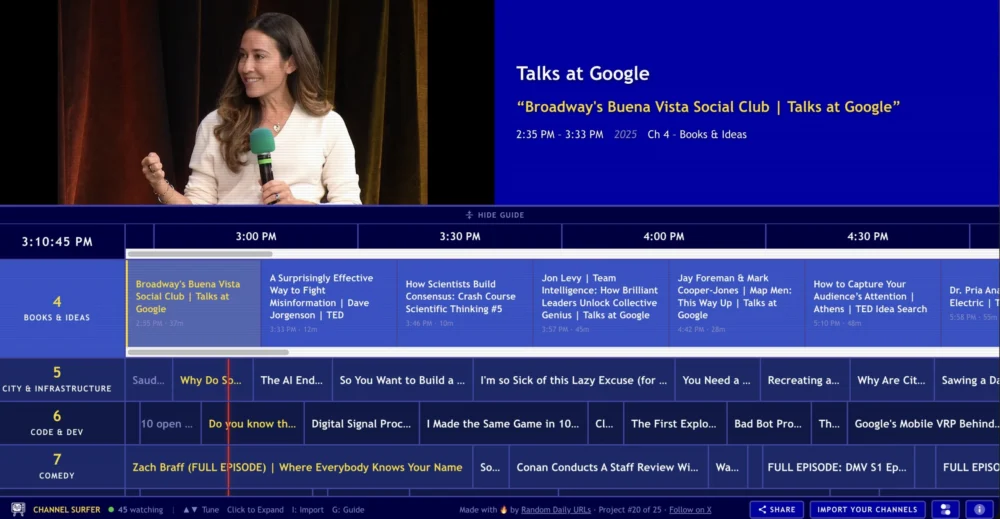
In an era defined by the infinite scroll and the relentless push of recommendation algorithms, the modern viewer is often paralyzed by the sheer volume of available content. We have moved from a world of scarcity to one of overwhelming abundance, where the act of choosing what to watch frequently takes longer than the viewing itself. This phenomenon, often termed "choice paralysis" or "indecision fatigue," has created a surprising cultural counter-movement: a longing for the structured, linear experience of old-school cable television. Enter Channel Surfer, a new web-based application that seeks to bridge the gap between YouTube’s vast library and the lean-back comfort of the 1990s television guide.
Developed by Steven Irby, a London-based industry veteran with over a decade of experience in the global tech scene, Channel Surfer is more than just a skin for a video player. It is a philosophical rejection of the modern digital experience, reimagining the world’s largest video repository through the lens of a retro "Electronic Programming Guide" (EPG). The premise is deceptively simple: instead of searching for a video, you tune into a channel. Instead of hitting play, you join a broadcast already in progress.
The Return of the "Lean-Back" Experience
The digital revolution of the 2010s was built on the promise of "on-demand" everything. The industry moved toward a "pull" model of consumption, where users were expected to know exactly what they wanted. However, as the novelty of on-demand content wore off, a segment of the audience began to miss the "push" model—the experience of turning on a device and having a curated stream of content immediately available without further input.
Channel Surfer taps into this nostalgia by offering 40 custom-built channels at launch, ranging from news and politics to lifestyle and sports. For the tech-savvy audience, the app provides specialized feeds like "AI & ML," "Code & Dev," "Space," "Retro Tech," and "Gaming." The user interface is a deliberate throwback, presenting a grid that informs viewers of what is playing now and what is scheduled for the next 24 hours.
By allowing users to join a video mid-stream, the app removes the pressure of the "beginning." In a standard YouTube environment, clicking a video is a commitment; you are starting a journey from zero. In Channel Surfer, you are stepping into a flow. This subtle psychological shift mimics the experience of flipping through channels on a lazy Sunday afternoon, where the stakes of "tuning in" are low, and the potential for serendipitous discovery is high.
The Technical Architecture of Nostalgia
While the user interface of Channel Surfer looks like something from the era of cathode-ray tubes, its underlying architecture is firmly rooted in modern web development. Irby, who describes himself as having escaped the "Jira ticket monkey" grind of corporate development, built the platform as a static site using Next.js.
To handle the real-time elements of the site—specifically the social feature that shows how many other people are watching a particular channel simultaneously—the app utilizes PartyKit. This allows for a lightweight, real-time presence without the overhead of a massive backend infrastructure. The entire project is hosted on Cloudflare, and the data is kept fresh through the use of GitHub Actions, which runs a daily script to update the programming schedules.

Interestingly, Irby has been transparent about his use of AI tools like Claude to assist in the coding process. However, he distinguishes his work from the burgeoning trend of "vibe-coding"—a term used to describe software generated almost entirely by AI prompts with little human oversight. Channel Surfer is a hand-crafted product, a "static" experience where the channels and music are personally curated by Irby himself. This human touch is a deliberate stand against the "mountain of slop" that many feel has buried the creative spirit of the early internet.
Fighting the Algorithm with Curation
The primary antagonist in the Channel Surfer narrative is the algorithm. Modern streaming platforms use complex machine learning models to keep users engaged for as long as possible, often leading viewers down "rabbit holes" that can feel repetitive or increasingly extreme. Irby’s motivation for building the app was a personal exhaustion with this automated gatekeeping.
"I built Channel Surfer because I’m tired of the algorithms and indecision fatigue," Irby stated. "I miss channel surfing and not having to decide what to watch."
This sentiment is echoed by a growing number of users who feel that their digital lives have become overly optimized. By returning to a curated, linear format, Channel Surfer restores the role of the "editor." Whether it is the 175 YouTube channels or the 25 music playlists available at launch, the content has been selected by a human being rather than a cold mathematical formula. This provides a sense of cohesion and thematic consistency that an algorithm often lacks.
Furthermore, the app offers a unique bridge for power users. Through a "bookmarklet" tool, users can import their own YouTube subscriptions into the Channel Surfer interface. This process converts a user’s personal "pull" library into a "push" linear network. It effectively allows a viewer to create their own private cable company, where every channel is something they already enjoy, but the delivery remains spontaneous.
The Social Synchronicity of Live Viewing
One of the most underrated aspects of traditional television was its communal nature. Before the era of the "spoiler alert," television was a synchronous experience. Everyone watched the same show at the same time, creating a shared cultural language. While the rise of DVRs and streaming fragmented this experience, Channel Surfer attempts to reclaim a small piece of it.
A small counter at the bottom of the screen indicates how many other users are currently tuned into the same "broadcast." There is a documented psychological comfort in knowing that you are watching something alongside others, even if you are not interacting with them directly. This "shared presence" is what makes platforms like Twitch so successful, and by bringing that element to curated YouTube content, Irby is tapping into a fundamental human desire for connection.
Industry Implications: The Rise of FAST Services
Channel Surfer does not exist in a vacuum. It is part of a much larger industry trend known as FAST (Free Ad-supported Streaming TV). Services like Pluto TV, Tubi, and Plex have seen explosive growth by offering exactly what Channel Surfer provides: a linear, "always-on" experience that is free to the user.

According to recent Nielsen reports, YouTube currently dominates TV streaming in the United States, often accounting for a larger share of "big screen" viewing time than Netflix or Hulu. However, YouTube’s native interface is still heavily optimized for mobile-style interaction—searching, clicking, and skipping. As more people move their YouTube consumption to the living room, there is a clear market gap for interfaces that treat YouTube like a traditional television network.
Irby has expressed interest in bringing Channel Surfer to dedicated TV platforms like Fire TV and Google TV. If successful, this could turn YouTube from a video-on-demand site into a massive infrastructure for thousands of niche, independent television stations. It would democratize the "cable" experience, allowing independent creators to have their own "channel" in a way that feels more prestigious and structured than a standard playlist.
Legal and Policy Considerations
Operating a service that wraps YouTube content is a delicate balancing act. Many third-party YouTube "clients" have been shut down for stripping ads or violating the platform’s Terms of Service. Irby has navigated this by ensuring that Channel Surfer uses standard YouTube embeds. This means that creators still get their views, and YouTube’s advertisements still play as intended.
By remaining within the ecosystem of YouTube’s official API and embedding tools, Channel Surfer acts as a "discovery layer" rather than a parasitic "alternative." This symbiotic relationship is crucial for the app’s longevity. It provides YouTube with a new way to keep users on the platform while offering those users a superior interface for long-form viewing.
The Future of the "Old Web"
Ultimately, Channel Surfer is a love letter to a version of the internet that many feel is disappearing. Irby’s mission to show that the "old web" is still alive—hidden under the aforementioned "mountain of slop"—is a rallying cry for independent developers. The project’s success, garnering over 10,000 views on its first day, suggests that there is a significant appetite for "small tech" projects that prioritize fun and utility over monetization and data harvesting.
As we look toward the future of digital media, the success of tools like Channel Surfer may signal a broader shift. We may be moving away from the "everything app" model toward a more fragmented, personalized, and human-centric web. In this future, the most valuable technology won’t be the one that gives us the most choices, but the one that helps us navigate the choices we already have.
For now, Channel Surfer remains a free, creative experiment. It is a reminder that sometimes, the best way to move forward in technology is to look back at what worked before we tried to optimize everything. Whether you are a "boomer" looking for the comfort of the cable guide or a Gen Z viewer tired of the TikTok scroll, the ability to simply "tune in" is a luxury that feels brand new all over again.
