


The routine process of password auditing stands as a cornerstone of modern organizational cybersecurity posture. These exercises are indispensable for satisfying regulatory mandates, establishing a baseline of risk reduction, and verifying the implementation of foundational security controls. However, an examination of numerous audit reports reveals a systemic disconnect: the vulnerabilities flagged often do not align with the entry vectors actively pursued by sophisticated threat actors. While compliance documentation may reflect adherence to established parameters, the true threat surface remains dangerously exposed.
The industry’s traditional reliance on superficial metrics—such as password length, character complexity, and mandatory rotation schedules—creates an illusion of security. These prescriptive rules, though necessary for demonstrating due diligence, are fundamentally insufficient against current adversarial methodologies. They systematically overlook the qualitative and contextual risks that truly unlock enterprise systems: the existence of dormant, over-privileged accounts, the persistence of legacy service credentials, and the simple reality that millions of passwords already exist in publicly indexed breach databases. To effectively fortify digital assets, security leadership must pivot from compliance-driven checklists to a threat-intelligence-driven understanding of account risk. This necessitates a deep dive into the inherent limitations of legacy auditing practices and the strategic adjustments required to bridge the gap between documented compliance and actual resilience.
The Illusion of Strength: Context-Free Complexity Fails Against Targeted Wordlists
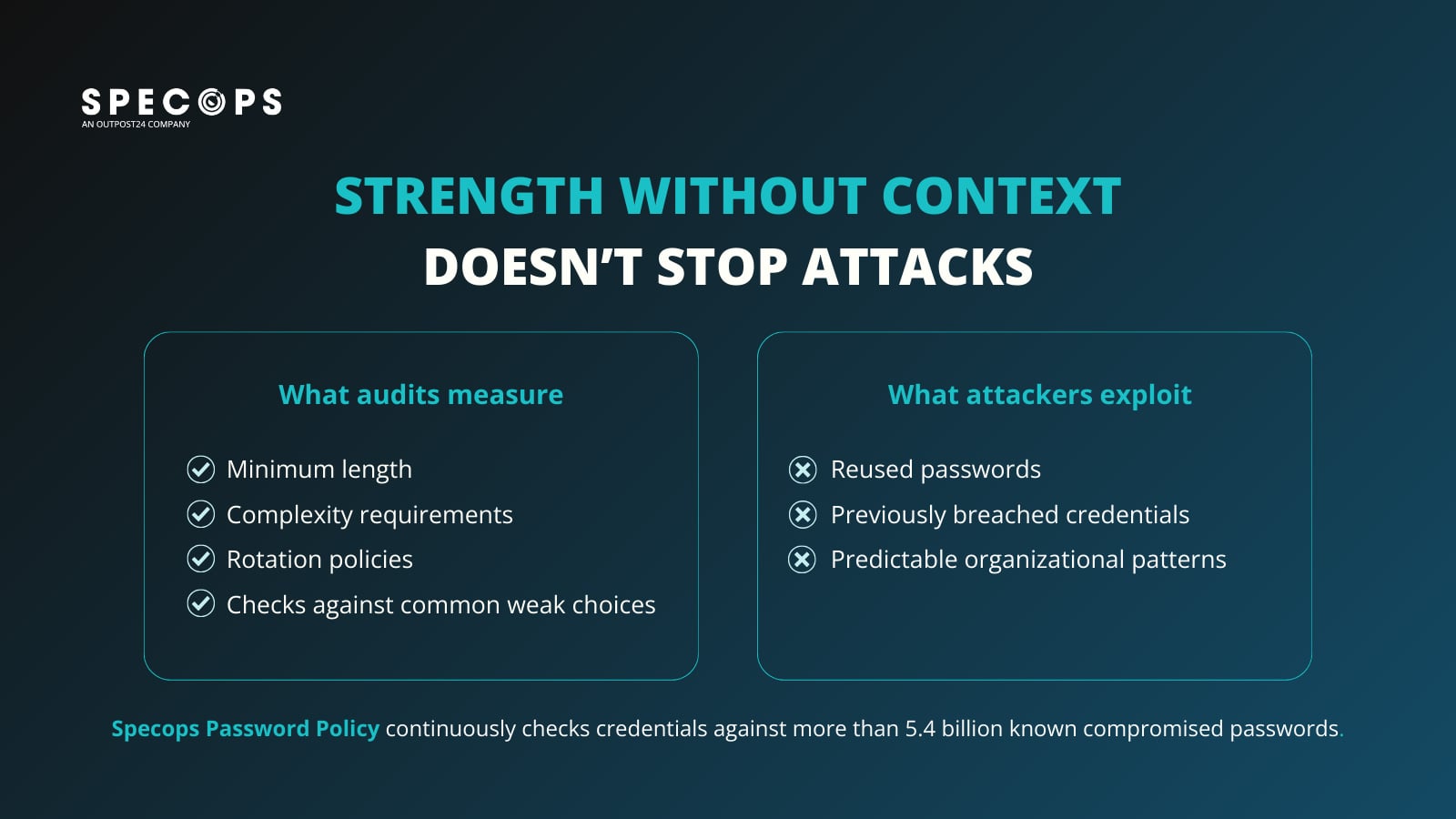
The initial phase of almost every compliance-driven password audit centers on strength validation. This typically involves verifying adherence to minimum length thresholds, enforcing a mix of character types, and flagging passwords found on commonly circulated weak lists. While these foundational checks are vital, they often represent the terminus of the audit process, leaving significant attack surfaces unaddressed.
The fundamental flaw here is the failure to apply contextual intelligence. A password can meticulously satisfy every complexity rule dictated by a policy document yet remain trivially guessable given the user’s role or industry. Consider the example of a healthcare administrator utilizing "HospitalSecure2024!"—a credential that easily passes complexity thresholds due to its length and character variation. For a human operator, it may seem robust. However, for an attacker leveraging industry-specific wordlists derived from public records or previous breaches, this password is a prime target for rapid dictionary or brute-force attacks. The context of the organization—its vertical, common terminology, or known internal naming conventions—renders the theoretical strength meaningless in practice.
The vulnerability deepens considerably when considering credential exposure. A password that appears strong during an internal check may already be fatally compromised. If an employee has reused a work password on a third-party consumer service that subsequently suffers a data breach, that credential is now circulating on the dark web. Attackers do not need to crack the password; they simply need to attempt the known-bad credential against the corporate perimeter. Empirical data starkly illustrates this danger: studies have shown that a staggering percentage—often exceeding 80%—of passwords identified as known compromised still successfully satisfy standard regulatory complexity and rotation requirements. This creates an unacceptable security gap where accounts appear defensible on paper but are, in reality, open books to external adversaries leveraging existing breach intelligence.
Without proactive, continuous screening against known compromised credential databases, the audit process actively validates assets that are already compromised. This is particularly perilous when dealing with high-value targets, such as accounts with administrative or domain-level access. A single successful login via a previously leaked password bypasses all perimeter defenses and grants the attacker an immediate, trusted foothold.

Strategic Recalibration: Modern credential hygiene programs must integrate real-time or near-real-time breached-password screening as a core component of policy enforcement. Security teams must shift prioritization based on actual risk exposure, focusing validation efforts on accounts where the credential has been demonstrably exposed. Advanced solutions utilize vast repositories of compromised data to continuously check user inputs, instantly blocking credentials that have already been compromised in external incidents. Furthermore, organizations must implement dynamic custom blocklists tailored to their specific environment, preventing the use of internal project names, executive names, or common product codes, thereby neutralizing context-specific dictionary attacks.
The Silent Threat of Dormant and Orphaned Accounts
Traditional password audits operate under a flawed assumption: that the only accounts requiring scrutiny are those currently mapped to active Human Resources personnel. This overlooks a pervasive and highly attractive vector for threat actors: "orphaned" or dormant accounts.
In complex enterprise environments—characterized by frequent staff turnover, reliance on third-party contractors, sprawling shadow IT infrastructure, and legacy test environments—the identity lifecycle management is rarely perfect. Accounts belonging to employees who departed weeks or months ago, contractors whose projects concluded last quarter, or service accounts created for temporary testing often persist long after their legitimate purpose has ended. Attackers actively probe for these entities precisely because they represent low-hanging fruit. These forgotten digital footprints often lack the rigorous security oversight applied to active user accounts. They frequently feature outdated password policies, have never been enrolled in multi-factor authentication (MFA), or possess default permissions that were never properly revoked during offboarding.
The danger of an orphaned contractor account, for instance, is subtle but devastating. An attacker successfully guessing or brute-forcing the password for such an account might gain initial access without triggering the high-alert monitoring associated with a sudden login attempt from a current, privileged executive. This allows for prolonged, stealthy reconnaissance and lateral movement within the network, often for months, before detection.
Strategic Recalibration: The scope of credential auditing must expand beyond the HR-verified active user roster. A comprehensive credential hygiene strategy mandates the inclusion of dormant, external, and accounts lacking direct HR linkage in every review cycle. This process must be symbiotically linked with robust identity governance and administration (IGA) processes. Automated deprovisioning workflows, triggered by HR status changes, are essential, but they must be complemented by periodic, deep-dive credential checks against these non-standard identity pools. Effective auditing, therefore, requires pairing password validation with regular, documented access reviews to eliminate these latent vulnerabilities.
Neglecting the Engine Room: High-Privilege Service Accounts
A significant failing in user-centric password audits is the near-total exclusion of service accounts. These non-human identities—used by applications, scripts, automated processes, and infrastructure components to communicate and perform background tasks—represent an elevated and often poorly managed risk factor.
Service accounts are intrinsically dangerous because they often possess broad, persistent permissions necessary for their operational function, frequently exceeding the "least privilege" principle. Compounding this risk is the pervasive practice of assigning them passwords that never expire, or rotating them on infrequent, irregular schedules. From an attacker’s perspective, compromising a service account is the equivalent of finding the master key to the infrastructure’s operational core. Unlike a compromised standard user account, a compromised service account can facilitate long-term persistence, enable the disabling of security services, or grant direct access to critical data stores without triggering the behavioral anomaly detection systems associated with a human user login. The organization might achieve a perfect score on its user password audit while simultaneously allowing its riskiest credentials to operate without modern security controls.
Strategic Recalibration: Explicit inclusion of service accounts in all credential auditing frameworks is non-negotiable, especially those associated with elevated or administrative roles (e.g., domain admins, database owners, cloud service principals). The remediation strategy must go beyond simple password checks. It must enforce credential vaulting where possible, mandate stringent rotation policies tailored to the account’s function, and aggressively enforce the principle of least privilege so that the account only possesses the exact permissions required for its intended task. Reducing the scope and privilege of service accounts drastically lowers the potential blast radius should their credentials be compromised.
The Static Snapshot vs. The Dynamic Threat Landscape
A fundamental limitation of any traditional audit methodology is its inherent "point-in-time" nature. An audit captures the security state at the precise moment the scan executes, generating a static report. However, credential-based attacks operate on a 24/7, instantaneous basis, meaning the risk posture can degrade significantly between audit cycles.
The proliferation of credential stuffing attacks perfectly illustrates this volatility. Attackers routinely harvest vast quantities of username/password pairs from breaches of unrelated external systems. They then automate the process of testing these known-bad credentials across corporate login portals (e.g., VPNs, SaaS applications, internal systems), capitalizing on widespread password reuse habits. An employee’s password might be perfectly compliant—meeting length, complexity, and age requirements—on Tuesday morning. If that same password is leaked in a breach of a small, unrelated e-commerce site by Tuesday afternoon, the corporate account becomes immediately vulnerable to automated credential stuffing attempts that evening.
This dynamic threat model renders static compliance checks inadequate, particularly for organizations with large external-facing authentication surfaces or extensive use of cloud identity providers. The adversary doesn’t need to violate internal policy; they are simply leveraging credentials already commoditized on the criminal market.
Strategic Recalibration: Effective password security requires transitioning from periodic verification to continuous monitoring. This involves establishing automated feedback loops that constantly check current credentials against evolving databases of known compromised data. Furthermore, security teams must implement intelligent anomaly detection around login patterns. This continuous posture management treats password hygiene not as a scheduled compliance task, but as an enduring operational control, capable of reacting to external credential leaks in near real-time rather than waiting for the next quarterly review.
Executing Truly Secure and Relevant Credential Assessments
To genuinely mitigate the risk of compromise—shifting the focus from satisfying auditors to thwarting attackers—credential assessments must mirror the operational reality of modern threats. A mature credential audit process must incorporate several essential, dynamic components:
- Breached Credential Screening: Mandatorily check all passwords against updated, comprehensive lists of known compromised credentials, prioritizing high-privilege accounts in this analysis.
- Contextual Strength Validation: Move beyond simple character counts to incorporate dictionaries derived from industry, internal naming conventions, and organizational structure to preempt targeted dictionary attacks.
- Comprehensive Account Scope: Ensure audits encompass all identity types, including all active users, dormant accounts, legacy accounts, and all service/machine accounts, irrespective of HR linkage.
- Privilege Mapping and Risk Scoring: Cross-reference password strength with the actual permissions assigned to the account. A weak password on a standard user is a low risk; a weak password on a Tier 0 administrator or service account is a critical, immediate risk.
- Continuous Feedback Loop: Integrate findings directly into policy enforcement engines to facilitate immediate remediation or force rotation when a high-risk credential is identified, rather than relying on manual follow-up reports.
Tools designed for modern identity management environments can perform read-only scans across Active Directory and related identity stores, specifically designed to flag these critical, context-dependent vulnerabilities—such as identifying inactive accounts holding domain administrative rights or flagging any credential found within global breach intelligence sets. By adopting this holistic, threat-informed approach, organizations transform the password audit from a bureaucratic exercise into a potent, proactive defense mechanism aligned with contemporary cyber risk realities.
