

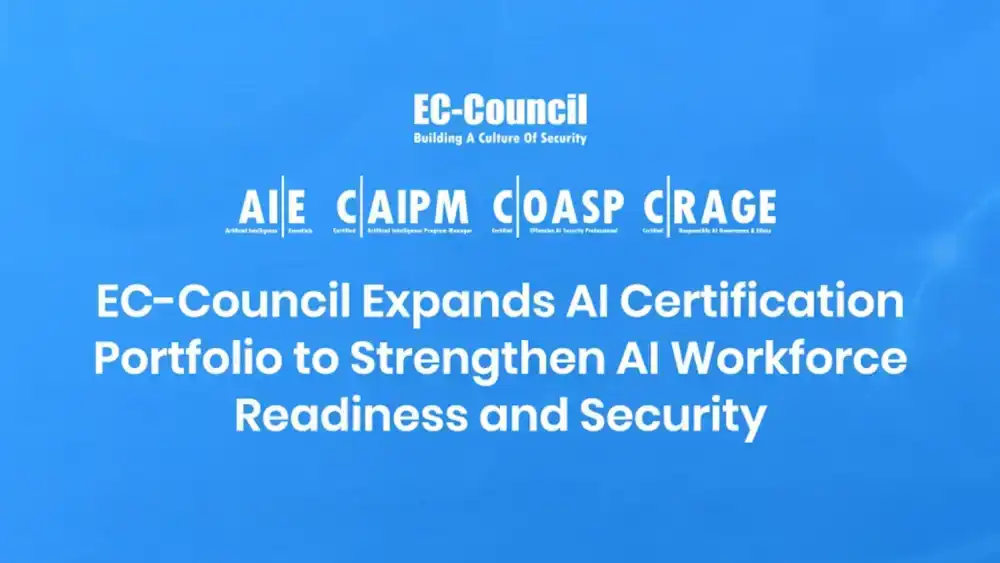
The rapid integration of Artificial Intelligence across global commerce is no longer a futuristic projection; it is a present-day reality fundamentally reshaping operational infrastructure. This transformative speed, however, has created a severe, documented lag in workforce preparedness, positioning human capital as the single greatest bottleneck to safe and effective AI deployment. In a decisive move aimed at fortifying the technological backbone of the nation, EC-Council, the organization renowned globally for establishing standards in applied cybersecurity through credentials like the Certified Ethical Hacker (CEH), has unveiled its most extensive portfolio expansion in its twenty-five-year history: the Enterprise AI Credential Suite, complemented by the updated Certified Chief Information Security Officer (CISO) v4 program.
This strategic curriculum overhaul directly confronts a burgeoning crisis where the velocity of AI adoption outpaces the availability of skilled personnel capable of managing, securing, and governing these complex systems. The implications are profound, extending beyond mere operational efficiency into matters of national economic stability and security posture.
Contextualizing the Urgency: Risk, Readiness, and Policy Alignment
The necessity for such focused educational intervention is underscored by staggering economic projections. Intelligence gathered by IDC suggests that the aggregate risk associated with inadequately managed AI deployments could balloon to a staggering $5.5 trillion globally. Closer to home, Bain & Company has quantified the domestic deficiency, projecting a shortfall of approximately 700,000 skilled professionals across AI and adjacent cybersecurity domains within the United States. This is not merely a technical talent gap; it is a systemic vulnerability that threatens to undermine the very benefits promised by generative and analytical AI technologies.
Furthermore, leading international bodies, including the International Monetary Fund (IMF) and the World Economic Forum (WEF), have explicitly identified workforce competency—rather than technological access—as the primary determinant of whether nations realize productivity gains from AI. As organizations transition AI models from isolated proof-of-concept trials into mission-critical, day-to-day decision-making frameworks, the margin for error shrinks dramatically.
This educational push is intricately timed to align with evolving federal mandates. The launch resonates directly with the workforce development pillars articulated in U.S. governmental directives, such as Executive Order 14179 and subsequent mandates like Executive Orders 14277 and 14278. These policies prioritize creating accessible, job-relevant educational pathways designed to imbue professionals across all sectors—from executive suites to skilled trades—with the necessary competencies to navigate the AI landscape responsibly.
The Escalating Threat Landscape
The imperative for security readiness is amplified by the concurrent surge in adversarial activity targeting these nascent systems. Data indicates that a significant majority—87%—of organizations are already contending with AI-powered cyberattacks. The sheer volume of traffic generated by Generative AI tools has reportedly spiked by an order of magnitude (890%), creating an expanded and often poorly understood attack surface. Defending against novel threats like model poisoning, sophisticated prompt injection, and attacks exploiting vulnerabilities within the AI supply chain requires expertise that traditional cybersecurity training often does not cover.
Compounding this threat environment is the pronounced geographic and demographic concentration of existing AI expertise. Statistics reveal that nearly two-thirds (67%) of current AI talent resides in a mere fifteen metropolitan hubs within the U.S., creating significant resource deserts elsewhere. Simultaneously, the AI workforce remains significantly imbalanced, with women constituting only about 28% of professionals in the field, underscoring persistent barriers to broad talent acquisition and equitable participation necessary for robust innovation.
Jay Bavisi, Group President of EC-Council, articulated the criticality of this inflection point: "AI is moving from experimentation to infrastructure, and the workforce has to move with it. These programs are built to give professionals practical capability across adoption, security, and governance, so organizations can scale AI with confidence and clear accountability."
Expert Analysis: Deconstructing the Enterprise AI Credential Suite
The centerpiece of this initiative is the Enterprise AI Credential Suite, deliberately architected to map directly onto the practical lifecycle of AI deployment within an enterprise setting. This structure moves beyond theoretical knowledge to focus on applied capability.
At the foundation lies the Artificial Intelligence Essentials (AIE) certification. This serves as the crucial entry point, designed to cultivate baseline AI fluency and promote responsible usage habits across diverse job functions, ensuring that non-specialists interacting with AI tools understand their inherent limitations and ethical boundaries.
Crucially, the entire suite is underpinned by EC-Council’s proprietary Adopt. Defend. Govern. (ADG) framework. This framework provides a comprehensive, operational blueprint for integrating AI safely at scale:
- Adopt: This pillar focuses on proactive deployment strategies. It trains personnel not just on how to use AI, but how to prepare their teams and systems—including data pipelines and model selection—with necessary readiness protocols and built-in safeguards before deployment. This mitigates risks associated with rushed implementation.
- Defend: This addresses the immediate security imperative. Training modules under this pillar are explicitly tailored to counter contemporary threats targeting AI models. This includes deep dives into mitigating prompt injection vulnerabilities, identifying and neutralizing data poisoning attempts used to corrupt training sets, recognizing model exploitation techniques, and securing the often-overlooked third-party components within the AI supply chain.
- Govern: Recognizing that technological controls alone are insufficient, the Govern pillar centers on organizational structure and compliance. It mandates the embedding of clear accountability frameworks, continuous oversight mechanisms, and rigorous risk management protocols directly into the AI system’s lifecycle, ensuring that decisions made by automated systems are traceable and auditable.
The four new role-based certifications emerging from this framework directly target specific gaps identified across this ADG spectrum, ensuring specialized training for engineers, compliance officers, security analysts, and product managers who own various stages of the AI lifecycle. (While the specific titles of the four new role-based certs were not detailed in the announcement, their creation within the ADG structure signals a granular approach to addressing deployment specialization.)
Elevating Executive Oversight: The CISO in the Age of Intelligence
The simultaneous release of Certified CISO v4 is equally significant, acknowledging that AI risk management cannot remain siloed within technical teams; it must be driven from the executive suite. The updated program recognizes that modern CISOs are now responsible for securing systems that possess autonomous learning capabilities and can influence core business outcomes at unprecedented speeds.
As Bavisi noted, "Security leaders are now accountable for systems that learn, adapt, and influence outcomes at speed. Certified CISO v4 prepares leaders to manage AI-driven risk with clarity, strengthen governance, and make informed decisions when responsibility is on the line."
This iteration moves the CISO focus from perimeter defense to intelligent system resilience. It incorporates modules on establishing AI governance boards, understanding regulatory liability related to algorithmic bias or failure, and integrating AI risk metrics directly into enterprise risk management (ERM) frameworks. For executive leadership, understanding the trade-offs between AI utility and inherent risk becomes a primary function, rather than a secondary technical consideration.
Industry Implications and Future Trajectory
The introduction of this robust, structured credentialing system has several critical implications for the technology sector and national security apparatus:
Standardization of Practice: By providing a standardized framework (ADG), EC-Council facilitates a common language for discussing AI risk across disparate corporate functions—legal, technical, operational, and executive. This standardization is vital for efficient cross-departmental collaboration, which is essential when combating complex, multi-stage AI attacks.
Democratization of Expertise: The emphasis on foundational certifications like AIE aims to broaden the pool of individuals capable of interacting safely with AI tools, thus alleviating the pressure on scarce, highly specialized AI/ML engineering talent. This approach treats AI literacy as a fundamental skill, much like basic data security awareness.
Alignment with Defense Readiness: The portfolio’s existing recognition within defense sectors (including adherence to DoD 8140 baselines) positions these new AI credentials favorably within government contracting and critical infrastructure environments. As national security concerns increasingly center on the trustworthiness and resilience of deployed AI, these accredited pathways become essential vetting mechanisms for personnel accessing sensitive systems.
Addressing Talent Concentration: By offering globally accessible, rigorous certification programs, EC-Council implicitly supports the development of skilled AI governance and security professionals in secondary markets, helping to gradually diffuse the concentration of talent currently bottlenecked in coastal tech hubs. This geographic diversification is crucial for national resilience.
Future Impact: Cultivating Responsible Innovation
The long-term impact of this educational expansion hinges on its ability to keep pace with the technology itself. Artificial intelligence development is characterized by rapid iteration—new models, new vulnerabilities, and new regulatory interpretations emerge constantly. Therefore, the structure of these certifications must incorporate mechanisms for continuous validation and updates.
The future success of organizations deploying AI will not be measured solely by the sophistication of their algorithms, but by the maturity of their supporting governance and security structures. If the skills gap is not aggressively addressed, the trillion-dollar potential of AI could be severely curtailed by security breaches, regulatory fines, or catastrophic operational errors stemming from human misunderstanding or misapplication.
EC-Council’s pivot demonstrates a recognition that cybersecurity is evolving from the defense of static digital perimeters to the assurance of dynamic, learning systems. By layering role-specific capabilities atop the foundational ADG methodology, the organization is attempting to build a scalable, auditable human defense mechanism against the unique threats presented by the age of artificial intelligence, ensuring that innovation proceeds with competence and accountability firmly in tow. For the U.S. enterprise, these credentials represent a tangible tool for transforming inherent AI risk into managed, measurable opportunity.
