


The multinational Dutch coatings and specialty chemicals conglomerate, AkzoNobel, has publicly acknowledged a significant cybersecurity breach targeting one of its operational sites within the United States. This confirmation follows the public disclosure and subsequent data exfiltration claimed by the emerging Ransomware-as-a-Service (RaaS) entity known as Anubis. While the company has moved swiftly to assert that the intrusion has been successfully contained and that the overall impact remains geographically and functionally limited, the nature of the stolen intellectual property and client data raises substantial concerns regarding supply chain integrity and corporate espionage risks inherent in the modern threat landscape.
A spokesperson for AkzoNobel relayed the situation to industry observers, stating, "AkzoNobel has identified a security incident at one of our sites in the United States. The incident was limited to the respective site and was already contained." The statement further emphasized the organization’s commitment to compliance and remediation efforts: "The impact is limited, and we are taking the appropriate steps to notify and support impacted parties, and will work closely with relevant authorities." This official response adheres to standard incident communication protocols, yet the shadow cast by the ransomware group’s actions speaks volumes about the vulnerabilities that persist even within major industrial players.
AkzoNobel represents a linchpin in the global chemical and materials sector. With a workforce numbering around 35,000 employees and generating annual revenues surpassing the $12 billion threshold, its operations span more than 150 countries. The portfolio includes globally recognized brands such as Dulux, Sikkens, International, and Interpon, making it a critical supplier across the automotive, aerospace, construction, and consumer goods industries. For a company operating at this scale, a breach is never merely an isolated IT failure; it represents a potential disruption to complex global supply chains reliant on the precise formulation and delivery of their specialized coatings.
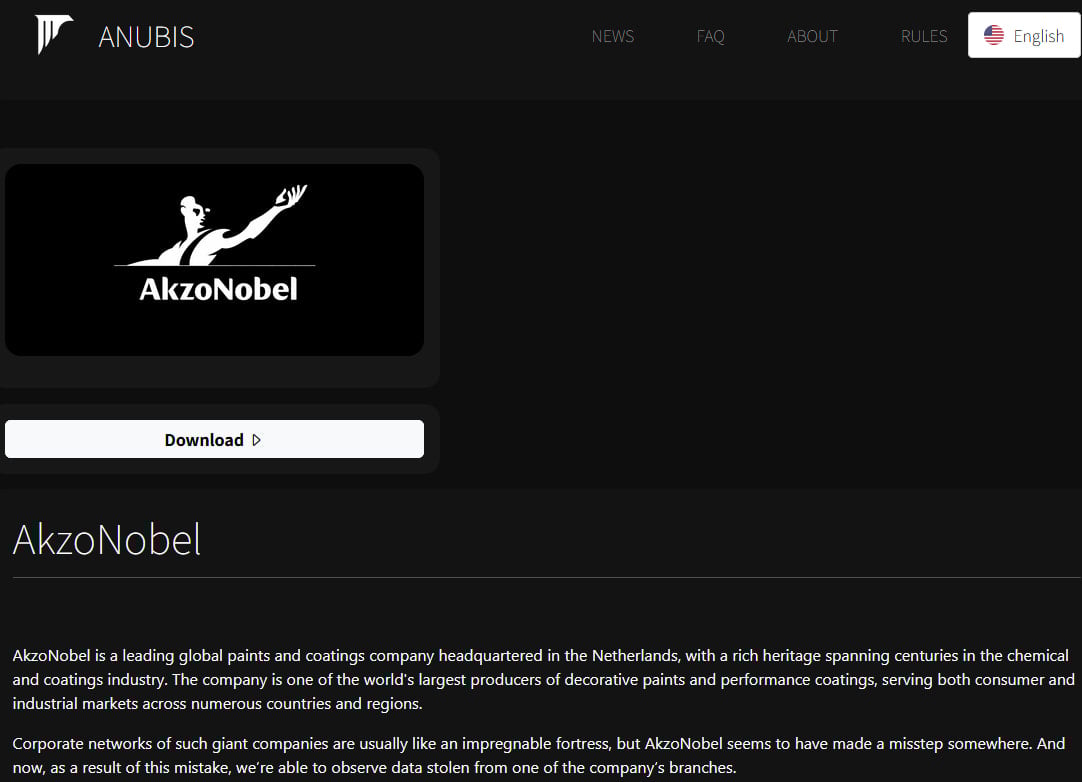
The severity of the situation is amplified by the claims made by the Anubis group. The threat actors assert they successfully exfiltrated a staggering volume of data—approximately 170 gigabytes, comprising nearly 170,000 distinct files—from the compromised U.S. facility. Samples of this purported data have been posted on Anubis’s dedicated dark web leak site, offering tangible proof of access, including internal documentation screenshots and comprehensive file manifests.
A forensic examination of the publicly available samples reveals the highly sensitive nature of the pilfered information. The compromised repository allegedly includes confidential contractual agreements involving high-profile enterprise clients, exposing pricing structures and service level agreements (SLAs). Furthermore, the attackers appear to have gained access to internal employee data, such as email addresses and phone numbers, alongside private email correspondence, which could be leveraged for sophisticated spear-phishing campaigns against remaining staff or partners. Most critically for an industrial entity, the leak contains highly proprietary technical documentation, including material testing reports and internal specification sheets—the very intellectual property that confers a competitive edge in the advanced coatings market. The presence of scanned passport copies within the stolen data also introduces significant risks concerning identity theft and regulatory non-compliance.
The Ascent of Anubis and Evolving RaaS Tactics
To contextualize the AkzoNobel incident, it is essential to understand the threat actor involved. Anubis is a relatively new, yet rapidly escalating, player in the Ransomware-as-a-Service (RaaS) ecosystem, having surfaced in December 2024. RaaS models democratize cybercrime, allowing less technically proficient affiliates to execute sophisticated attacks in exchange for a substantial cut of the ransom—Anubis reportedly offers affiliates an 80% profit share. This lucrative structure incentivized rapid growth.

The group’s operational maturity accelerated significantly in early 2025 when they formalized their structure by launching a dedicated affiliate recruitment program on the RAMP cybercrime forum, a known hub for sophisticated threat actors. This move injected new operational capacity and broadened their reach across various target sectors.
Perhaps the most alarming development concerning Anubis was the integration of a highly destructive data-wiping module into their toolkit by June 2025. While initial ransomware attacks focused solely on encryption for monetary extortion, the inclusion of a wiper module signifies an escalation toward pure sabotage. A data wiper, unlike standard ransomware, is designed to permanently overwrite or destroy data beyond any feasible recovery, regardless of whether a ransom is paid. This dual capability—extortion via data exposure combined with destructive potential—presents a maximal threat scenario for targeted organizations, forcing them to weigh the financial cost of ransom against the existential threat of permanent data loss.
Industry Implications: The Manufacturing Sector Under Siege
The targeting of AkzoNobel underscores a critical trend: cybercriminals are increasingly shifting focus from purely financial services and healthcare to the industrial and manufacturing sectors. These organizations, often characterized by legacy Operational Technology (OT) environments interconnected with modern Information Technology (IT) networks, present a softer target surface area for data exfiltration and operational disruption.
For the coatings industry specifically, the exposure of technical specifications is a profound concern. Unlike a generalized data breach, the theft of chemical formulations, proprietary curing processes, or material performance data provides state-sponsored actors or commercial rivals with the means to replicate products, undercut pricing, or intentionally engineer product failures in the field. This moves the threat beyond simple financial extortion into the realm of industrial espionage and competitive sabotage.
Moreover, the fact that the breach was confirmed to be confined to "one of our sites in the United States" suggests a segmentation failure. In large, globally distributed corporations, effective network segmentation is the primary defense against lateral movement. If Anubis gained entry through a localized vulnerability—perhaps in a U.S.-specific legacy system or an inadequately secured vendor connection—and was prevented from traversing to European or Asian headquarters, it indicates that, at least in this instance, critical containment measures held up across the broader corporate entity. However, the successful extraction of 170GB of data implies a significant period of undetected presence within the target environment, allowing ample time for reconnaissance and data staging.
Expert Analysis: The Persistence of Insider Threat Vectors
Security analysts often point out that RaaS groups like Anubis rely heavily on initial access brokers (IABs) or sophisticated social engineering to breach the perimeter. Given the sensitive nature of the data obtained (including passport scans and internal correspondence), it is highly probable that the initial vector involved either:
- Compromised Credentials: Stolen or weakly protected Remote Desktop Protocol (RDP) or VPN access sold on dark web marketplaces, potentially acquired from IABs.
- Supply Chain Weakness: Exploitation of a smaller, less secure vendor or contractor who had elevated access to the specific U.S. site’s network.
- Advanced Phishing: Highly targeted spear-phishing campaigns aimed at employees handling sensitive manufacturing or procurement data, leading to credential theft or malware execution.
The subsequent exfiltration of 170GB suggests the threat actors were operating with sufficient privileges for an extended duration. In many modern intrusions, the actual "encryption" phase is secondary; the primary goal for sophisticated groups is data harvesting, as the leverage provided by sensitive data exposure (often dubbed "double extortion") is more reliable than waiting for a ransom payment for encrypted files. AkzoNobel’s statement indicating containment suggests the attackers were discovered before they could deploy their destructive wiper module across the wider network, a key victory in incident response.
Navigating Future Security Landscapes
The AkzoNobel event serves as a stark reminder that cyber resilience is not about preventing all intrusions, but about minimizing dwell time and preventing data exfiltration. For multinational manufacturers, the lessons must be integrated into enterprise-wide policy adjustments:
Zero Trust Architecture (ZTA) Implementation: The incident underscores the necessity of moving beyond perimeter-based security. ZTA mandates that no user or device, inside or outside the network, is trusted by default. Access controls must be granular, based on continuous verification, which would have severely restricted an attacker’s ability to move laterally from a compromised single U.S. site to sensitive data repositories.
OT/IT Convergence Security: As industrial processes become digitized, the air gap protecting manufacturing floors is virtually eliminated. Security protocols must be tailored for the constraints of Operational Technology (OT), ensuring that IT security tools do not destabilize production systems while maintaining visibility into data flows crossing the IT/OT boundary.
Proactive Threat Hunting: Relying solely on automated detection systems proved insufficient, as the attackers managed to stage 170GB of data. Organizations must invest heavily in proactive threat hunting teams capable of searching for anomalous behavior—such as large, unusual data staging activities or unexpected lateral movement—that bypasses standard alert thresholds.
Regulatory Scrutiny: Given the confirmed theft of personal data (passport scans, contact information), AkzoNobel will face rigorous scrutiny from data protection authorities in jurisdictions where those individuals reside. The company’s handling of remediation, customer notification, and cooperation with law enforcement will be closely monitored, potentially setting precedents for how global industrial firms manage RaaS incidents involving proprietary information.
The confirmed breach at AkzoNobel signals a maturation in the tactics employed by RaaS operations like Anubis. They are targeting high-value, data-rich industrial entities, leveraging the complexity of global supply chains to maximize leverage. For the broader coatings and chemical sector, this incident is a clear warning: proprietary formulas and client agreements are now primary targets, requiring a fundamental reassessment of digital defense posture against adversaries equipped with both encryption and destructive capabilities. The true cost of this incident will be measured not just in remediation expenses, but in the long-term security of their competitive edge.
