


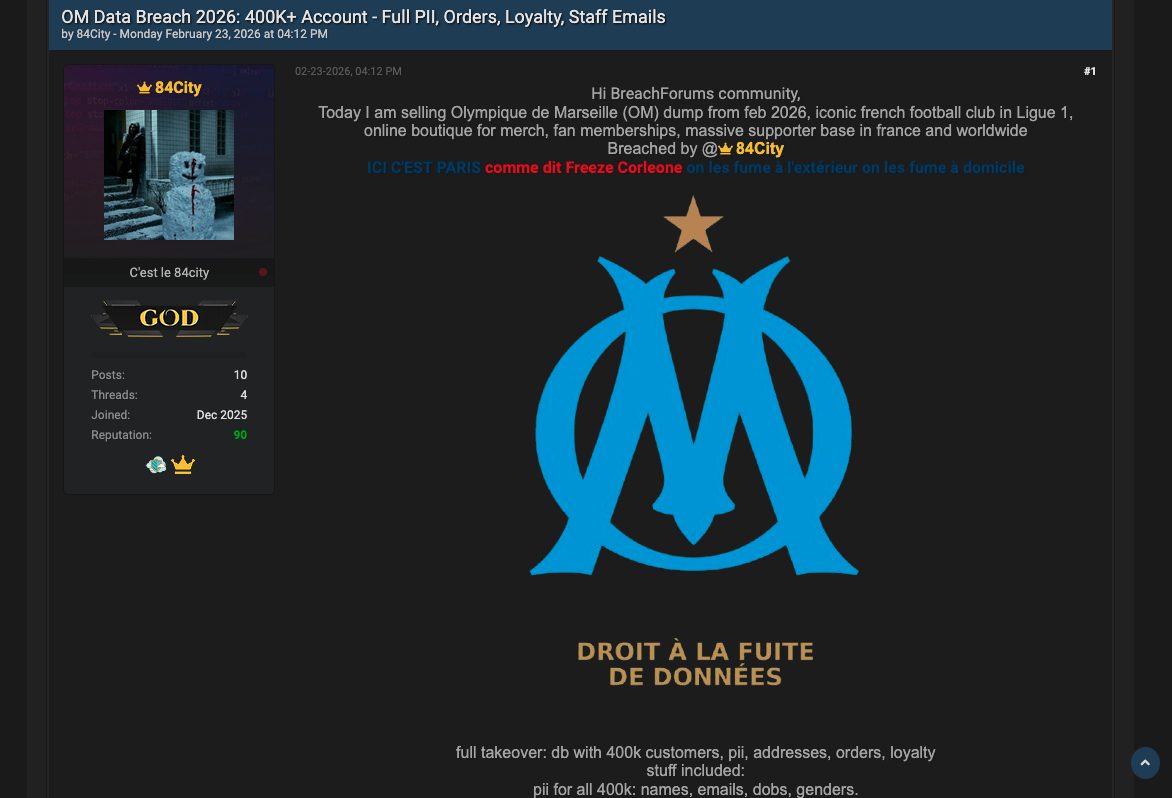
The venerable Olympique de Marseille (OM), one of France’s most decorated professional football clubs, has formally acknowledged a significant cybersecurity incident that appears to have resulted in the exfiltration of sensitive supporter and staff data. The confirmation follows public claims made by an adversarial group operating on underground hacking forums, alleging a successful infiltration of the Ligue 1 giant’s digital infrastructure earlier this month. OM, a storied institution founded 126 years ago and famously the first French club to capture the UEFA Champions League title in 1993, is now navigating the fallout of what it terms an "attempted cyberattack," even as evidence suggests data has already been compromised and offered for sale.
The communication from the club, released following the initial Monday assertions by the threat actor, detailed a rapid response protocol. In their official statement, Olympique Marseille indicated that "immediate mobilization of our technical teams and specialized service providers" allowed for the situation to be brought under control quickly. Critically, the club sought to allay immediate panic among its vast international fanbase by assuring the public that "no banking details or passwords have been compromised." This delineation between operational data and financial credentials is a standard, yet crucial, distinction made by organizations during crisis communications following data events.
However, the narrative presented by the threat actor paints a more comprehensive picture of the potential breach scope. The malicious entity claims to have successfully pilfered a substantial database encompassing personal identifiable information (PII) related to approximately 400,000 individuals. This alleged trove of data reportedly includes names, physical addresses, order histories pertaining to merchandise or ticketing, email addresses, and mobile contact numbers associated with supporters and potentially associated parties. Furthermore, the threat actor specifically targeted administrative access, claiming to have acquired credentials for over 2,050 accounts associated with the Drupal Content Management System (CMS) utilized by the club. Of particular concern within this CMS cache are the 34 identified staff accounts, alongside 1,770 accounts designated as contributors or moderators, suggesting access that could have allowed for manipulation of public-facing club web properties.
The motivation behind such an attack, as explicitly stated by the perpetrator, appears multi-faceted: financial gain through data sale and potentially reputational damage to an internationally recognized sporting brand. The threat actor is actively marketing the "dump" on hacking platforms, emphasizing OM’s status as an "iconic french football club in Ligue 1," its official online merchandise boutique, and its extensive supporter network across France and globally. This commodification of fan data is a hallmark of modern cybercrime targeting high-profile entities.
In adherence to European regulatory frameworks, particularly the General Data Protection Regulation (GDPR), Olympique Marseille has initiated formal procedures. The club has reported the security incident to the Commission Nationale de l’Informatique et des Libertés (CNIL), France’s independent data protection authority, and has filed a formal police complaint. Furthermore, the club has issued a proactive warning to its supporters, urging vigilance against subsequent phishing attempts and advising immediate reporting of any suspicious digital correspondence, a necessary step given the potential for threat actors to leverage compromised email lists for targeted social engineering campaigns.
Contextualizing the Threat Landscape in European Sports
The incident involving Olympique Marseille is not an isolated anomaly but rather symptomatic of a growing trend targeting the high-value data repositories held by major sports organizations across Europe. Professional football clubs, much like other large consumer-facing enterprises, operate as massive data aggregators. They manage intricate ecosystems involving ticketing systems, loyalty programs, e-commerce platforms for merchandising, player and staff HR records, and extensive marketing databases. This confluence of data makes them highly attractive targets for financially motivated threat actors.

For years, the focus in sports security was often perceived to be on protecting physical assets or intellectual property. However, the digitalization of fan engagement—accelerated significantly by the global pandemic necessitating reliance on digital channels for ticket sales, communication, and revenue generation—has drastically expanded the attack surface. Data concerning season ticket holders, VIP clientele, and international fan demographics is highly sought after on dark web markets, often fetching premium prices due to the richness of the PII included.
The fact that the breach involved a specific CMS, Drupal, also underscores a common vulnerability vector. While Drupal is a robust platform, like any software, it requires diligent patching and configuration management. Attacks often exploit known vulnerabilities (CVEs) in outdated modules or misconfigurations that expose administrative interfaces. The claimed compromise of over 2,000 CMS accounts strongly suggests that the threat actor either found an easily exploitable pathway into the administrative backend or successfully harvested credentials through credential stuffing or phishing targeting OM personnel before pivoting to the database layer.
Expert Analysis: The Implications of Compromised PII and CMS Access
From a cybersecurity perspective, the distinction OM attempts to draw between compromised PII and financial data is important but must be viewed cautiously. While the immediate threat of unauthorized credit card transactions might be mitigated (if payment processing adheres to strict PCI DSS compliance and is handled by a third-party gateway), the loss of 400,000 names, addresses, emails, and phone numbers creates a profound risk for the individuals involved.
Identity Theft and Social Engineering: This level of PII is the bedrock for sophisticated identity theft and tailored social engineering attacks. Threat actors can craft highly convincing phishing emails—spear-phishing—that reference actual purchase histories or personal details (like an address), lending immediate credibility to fraudulent requests for further sensitive information. For high-profile supporters or club staff, the risk of extortion or targeted business email compromise (BEC) increases significantly.
The Drupal Vector: The compromise of a large number of Drupal accounts points toward a failure in access management or perimeter defense concerning the content management infrastructure. If the threat actor possesses the credentials of 34 staff members, the potential for long-term, persistent access (a "backdoor") remains a critical investigation point, even if the initial entry vector has been neutralized. Security experts often emphasize that CMS environments are prime targets because they sit at the intersection of public-facing content and internal operational systems. A breach here can cascade rapidly through integrated systems.
Regulatory Scrutiny: As the incident is reported to CNIL, OM faces intense regulatory scrutiny. GDPR imposes significant penalties for inadequate protection of personal data. While OM’s swift containment action may mitigate the maximum penalty, the public disclosure of nearly half a million records places the club under the microscope regarding its due diligence in data governance and security architecture. The focus will shift to demonstrating that appropriate technical and organizational measures were in place before the incident occurred.
Industry Implications and Future Security Posture
The OM incident sends a clear message to the broader sports and entertainment industry: legacy infrastructure and reliance on standard web platforms must be paired with rigorous, layered security defenses.
Vendor Risk Management: Many large clubs outsource aspects of their IT infrastructure, ticketing, or e-commerce operations. A critical component of the ongoing investigation will be determining if the intrusion originated from a direct OM server or a third-party vendor integrated with OM systems. The fallout from the November incident involving the French Football Federation (FFF), which reportedly involved compromised administrative software used across various clubs, highlights systemic vulnerabilities within the national football ecosystem’s shared service layers. OM must scrutinize every integration point.
The Need for Proactive Threat Hunting: The club’s statement suggests they reacted to external claims, although they claim rapid containment. In the modern threat landscape, relying solely on perimeter defenses (firewalls, antivirus) is insufficient. Major organizations like OM require continuous threat hunting capabilities—actively searching for indicators of compromise (IOCs) within their networks, rather than waiting for alerts or public claims. This proactive posture is necessary to detect lateral movement and privilege escalation before large-scale data exfiltration occurs.
Zero Trust Architecture in Sports: Future-proofing against such threats necessitates moving toward Zero Trust principles, especially concerning internal administrative access like CMS portals. Every access request, regardless of origin (internal network or external login), must be authenticated, authorized, and encrypted. For privileged accounts, this means mandatory multi-factor authentication (MFA) implemented universally, a measure that, if absent, often proves to be the weakest link exploited by attackers targeting administrative interfaces.
The Long-Term Impact on Fan Trust and Operational Security
For Olympique Marseille, the immediate operational continuity is positive news, but the long-term challenge lies in rebuilding and maintaining fan trust. Sporting success is built on community loyalty, and data security breaches erode that foundation. Fans entrust the club with personal details in exchange for the privilege of supporting their team. A breach of 400,000 records signifies a severe breach of that implicit contract.
The club must transparently communicate the findings of the CNIL investigation and the corrective actions taken. Simply stating that financial data was safe is insufficient when non-financial PII is exposed, as the consequences of identity fraud can be devastating for individuals.
Looking ahead, this event underscores the inevitability of security incidents in a hyper-connected world. For high-profile entities like OM, the expectation is no longer to prevent all attacks, but to achieve rapid detection, effective containment, and resilient recovery. The cost of bolstering security—investing in advanced threat detection platforms, enhancing staff training against social engineering, and modernizing legacy CMS environments—must now be weighed against the far greater financial, regulatory, and reputational costs associated with a successful, publicly acknowledged data compromise. The digital pitch is now as critical as the turf, and security deficiencies here carry penalties that extend far beyond the scoreboard.
