


The annual cycle of mobile processor releases consistently generates significant fanfare, particularly concerning peak performance metrics. The arrival of the latest silicon, such as the highly anticipated Qualcomm Snapdragon 8 Elite Gen 5, is invariably accompanied by benchmark charts showcasing massive generational leaps. Qualcomm’s marketing materials highlight substantial improvements—in this case, boasting a claimed 23% uplift in graphics processing capability and an impressive 20% reduction in power draw compared to its immediate predecessor, the Snapdragon 8 Elite. On paper, these figures suggest a seismic shift in mobile gaming capabilities, positioning this year’s top-tier smartphones lightyears ahead of devices released just twelve months prior.
However, the transition from synthetic benchmarks to sustained, real-world application—especially in graphically intensive mobile gaming—often reveals a more nuanced reality. The core question for the savvy consumer is whether these advertised gains translate into a tangibly superior experience when rendering complex 3D environments at high frame rates. As devices shrink and thermal envelopes tighten, the pursuit of ever-increasing raw speed runs headlong into the immutable laws of thermodynamics. This dynamic leads to intense scrutiny regarding sustained performance versus peak theoretical output. Are we reaching an inflection point where year-over-year SoC improvements offer diminishing returns for the average user engaged in high-fidelity mobile entertainment?
To move beyond the abstract numbers and quantify the actual performance delta, a direct, side-by-side comparison between the current generation and the immediately preceding flagship is essential. For this investigation, we pitted the newer Xiaomi 17 Ultra, housing the Snapdragon 8 Elite Gen 5, against its direct ancestor, the Xiaomi 15 Ultra, powered by the original Snapdragon 8 Elite. Both devices were meticulously updated to their latest available software builds, ensuring optimal driver performance, before being subjected to a gauntlet of demanding, commercially successful Android titles designed to push GPU utilization to its limits. This comparative analysis seeks to determine if the financial incentive to upgrade based purely on gaming prowess is justified, or if last generation’s high-end offerings still represent an almost identical level of capability.
Analyzing Peak Performance in Commercial Titles
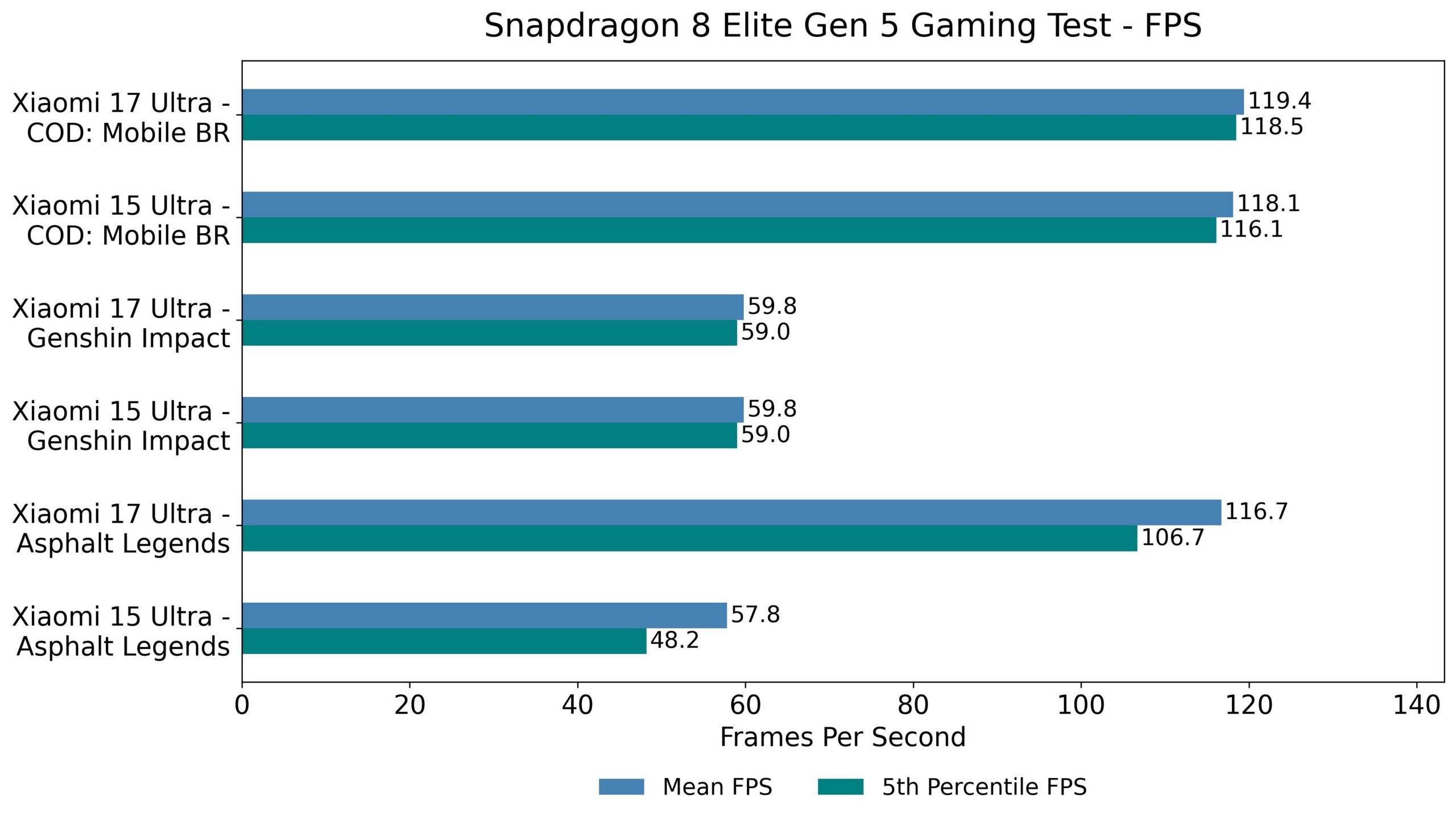
The initial battery of tests focused on widely adopted, high-profile games known for their demanding graphics pipelines and frame rate ceilings. Our selection included Call of Duty: Mobile (Battle Royale mode set to medium graphics to enable the 120fps refresh ceiling), Asphalt Legends, maxed out with all visual enhancements and a 120fps lock (a feature sometimes restricted to newer hardware), and the notoriously demanding open-world title, Genshin Impact, running at its maximum graphical preset, albeit capped at a more achievable 60fps due to its GPU-heavy rendering requirements.

In the context of COD Mobile, both the Snapdragon 8 Elite Gen 5 and the standard Elite demonstrated an immediate ability to maintain the 120fps target without significant difficulty. While rigorous frame timing analysis revealed sporadic micro-stutters on both devices—a common artifact in fast-paced mobile shooters—these instances were infrequent, with the frame rate bottoming out near 80 fps before rapidly recovering. More significantly, both devices exhibited periods of sustained frame drops lasting several seconds. This behavior strongly suggests activation of thermal management protocols or power throttling mechanisms inherent to the operating system or manufacturer tuning. These sustained dips consistently initiated once the device chassis temperature stabilized around the 40°C mark. Reaching this thermal threshold required approximately 20 to 30 minutes of continuous, intense gameplay across back-to-back matches. Crucially, both generations of the chipset proved equally susceptible to this form of throttling under sustained load, and neither device demonstrated an unusually rapid rate of heating during this particular workload.
Moving to Genshin Impact, the results further underscored the parity between the generations. With visual fidelity cranked to the maximum settings, both the 17 Ultra and the 15 Ultra maintained a largely consistent 60 fps experience. The thermal profile here was even milder; peak temperatures barely exceeded 35°C across both units. This suggests that for many popular, well-optimized Android titles, the workload is sufficiently lightweight that even a year-old flagship SoC can manage the maximum sustainable frame rate without engaging aggressive throttling. The perceived difference in moment-to-moment gameplay fluidity was negligible.
The only tangible divergence in the commercial gaming suite appeared during testing with Asphalt Legends. Despite meticulous verification confirming that the 120fps setting was toggled on in the in-game menu for both phones, the older Xiaomi 15 Ultra remained stubbornly locked at 60fps. While the average frame rate was stable at this lower ceiling, analysis of the 5th percentile frame delivery suggested the previous generation chip experienced marginally less consistent frame delivery compared to the Gen 5 model, which, when permitted, easily surpassed 100fps. This specific limitation highlights a common industry quirk: sometimes, game developers intentionally restrict graphical features or frame rate ceilings based on the detected chipset version, often favoring the newest hardware or, conversely, struggling to fully utilize nascent capabilities on older hardware due to initialization issues. It serves as a reminder that performance is dictated not just by hardware capability but by software optimization and arbitrary developer decisions.
Pushing the Limits with Emulation Workloads
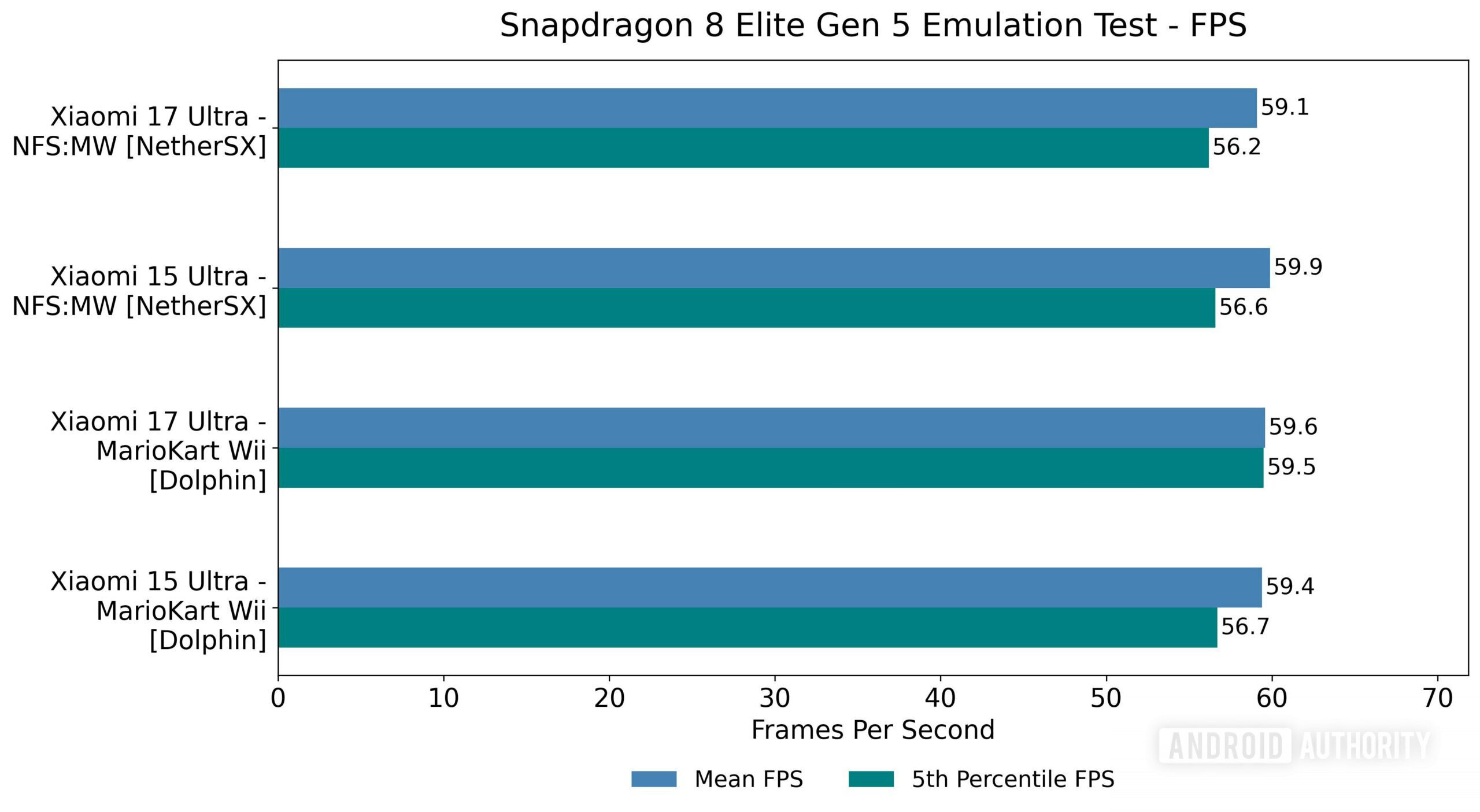
To circumvent potential game-level restrictions and probe the raw computational headroom of the respective GPUs and CPUs, the test shifted toward high-fidelity emulation—a workload known for stressing underlying hardware architecture more uniformly. We selected two notoriously demanding emulators: NetherSX (for PlayStation 2) running Need for Speed: Most Wanted at 3x native resolution, and Dolphin (for GameCube/Wii) running Mario Kart Wii at 4x native resolution, utilizing the OpenGL backend for consistency (as opposed to the sometimes more volatile Vulkan API).
In emulation, driver maturity plays a disproportionately large role compared to native Android applications. While the Snapdragon 8 Elite Gen 5 has had several months for driver refinement post-launch, the comparison remains valid for evaluating the current state of performance. Intriguingly, the testing environment required an unusual adjustment on the newer hardware: the multi-core speed-up feature in the Mario Kart Wii emulator had to be disabled on the Xiaomi 17 Ultra to prevent severe graphics synchronization errors—a potential sign of the newer chip executing calculations slightly too quickly or in a different sequence than the emulator expected.
Despite this driver hiccup, the results were overwhelmingly favorable for both devices. Both chips managed to keep both demanding emulated titles hovering close to a locked 60 fps. The 5th percentile frame rates remained robust, indicating that consistent, smooth play, free from distracting judder, was achievable across the board. While minute analysis of the full frame timeline suggested the Snapdragon 8 Elite Gen 5 delivered marginally smoother temporal consistency, the subjective experience during actual gameplay was virtually indistinguishable to the human eye.
A more significant differentiation emerged in the power consumption metrics during these emulation tests. The newer Gen 5 chip demonstrated its architectural efficiency gains clearly. In the NFS emulation test, the Gen 5 chip averaged 5.4W, contrasting sharply with the 7.6W draw from the previous generation Elite. Similarly, in the Mario Kart Wii test, the Gen 5 drew approximately 5.0W versus 5.6W for the older chip. This disparity is considerable; the newer hardware is achieving equivalent or marginally superior performance while expending substantially less energy. This directly translates to better thermal headroom and potentially longer battery life during sustained heavy use. However, both devices exhibited brief, extreme power spikes exceeding 12W, coinciding with sharp, momentary CPU usage peaks, the source of which—be it background OS activity, manufacturer telemetry, or specific emulation thread behavior—remains ambiguous without deeper system logging.
Industry Implications and Consumer Economics
The empirical data strongly suggests that for the vast majority of mobile gaming scenarios—even those pushing modern graphics settings—the year-over-year performance leap from the Snapdragon 8 Elite to the 8 Elite Gen 5 is not transformative enough to warrant an immediate upgrade based solely on frame rate performance. The practical difference between the two flagship chipsets, once thermal realities are accounted for, compresses significantly.
This finding carries profound implications for consumer electronics valuation and upgrade calculus. The industry has often relied on marketing incremental performance gains as justification for the annual flagship refresh cycle, encouraging consumers to trade in perfectly capable devices for marginal benefits. If a device utilizing last year’s top-tier silicon can deliver 95% of the current flagship’s gaming performance, the economic incentive to purchase the newest model evaporates for performance-focused buyers. Last-generation flagships, once their initial depreciation cycle settles, become highly attractive value propositions, offering near-peak mobile computing power at a considerable discount. This reinforces a growing sentiment within the tech community: the bottleneck in mobile performance is shifting from raw silicon speed to thermal dissipation capabilities and, perhaps more pressingly, the escalating cost of these high-end components. The demand is not necessarily for more power, but for efficiently delivered power at a more accessible price point.
Future Trajectories and Longevity Considerations
While the current parity is striking, the Snapdragon 8 Elite Gen 5 does offer a quantifiable advantage in one critical area: future-proofing. As game developers begin targeting the next wave of ultra-high-resolution textures, more complex physics simulations, or new platform-specific features (like advanced ray tracing implementations that are just beginning to appear on mobile), the 23% theoretical GPU headroom of the Gen 5 chip will eventually translate into longer viable high-setting gameplay longevity. The newer architecture is better positioned to handle the increasing demands of titles scheduled for release two to three years down the line, where last year’s hardware might be forced to drop graphical settings to maintain acceptable frame rates.
Furthermore, the efficiency gains observed in the power consumption tests are a persistent advantage. Lower wattage requirements mean less heat generated for the same output, which in turn permits the chip to maintain higher clock speeds for longer periods before thermal throttling kicks in—a subtle but meaningful edge during marathon gaming sessions. Beyond raw graphics, these new SoCs often integrate more advanced Neural Processing Units (NPUs) dedicated to accelerating on-device Artificial Intelligence tasks, which are becoming increasingly integral to modern game features, from smarter NPCs to dynamic environment generation.
In conclusion, the data confirms that for consumers prioritizing excellent, high-refresh-rate gaming today, delaying an upgrade and opting for a premium handset from the previous generation offers an almost identical, highly satisfying experience. The performance delta is not substantial enough to justify the significant price premium associated with the absolute newest silicon. However, for the enthusiast who intends to keep their device for three or more years and wants to ensure maximum compatibility with future high-demand titles without compromising visual quality, the incremental advancements offered by the latest flagship processor, particularly in efficiency, do provide a tangible, albeit currently understated, long-term benefit.
