

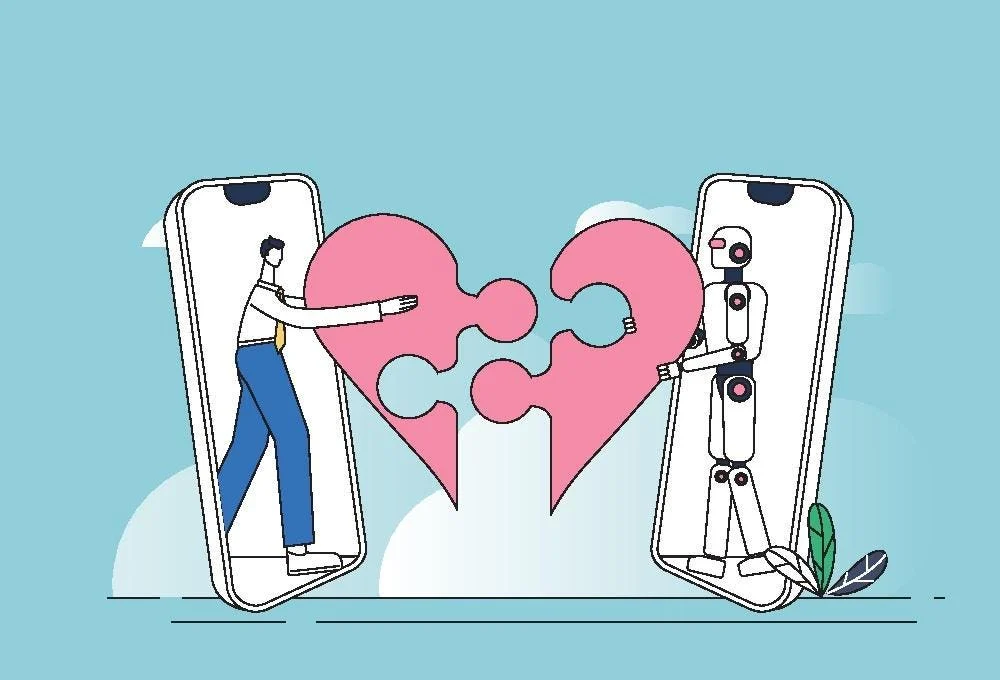
On the evening of February 14, 2026, a Manhattan café in the heart of Hell’s Kitchen presented a scene that would have been indistinguishable from science fiction only a few years prior. Candlelight flickered across tables where patrons sat not with other humans, but with sleek phone stands. These individuals were participants in an event hosted by EVA AI, billed as the world’s first AI dating café. The guests arrived alone, yet the atmosphere was far from solitary. Each attendee was engaged in a deep, animated, and often emotionally charged conversation with a digital companion. Every table was booked.
This phenomenon is the culmination of a rapid sociological shift that has moved from the fringes of internet subcultures into the mainstream of global society. We have entered the era of the "Companion Relationship," a dynamic where artificial intelligence is no longer viewed merely as a productivity tool or an information retrieval system, but as a persistent presence in the human emotional landscape. This is not a story about technology’s capabilities; it is a story about the evolving nature of human belonging in a fragmented world.
The statistics surrounding this shift are startling and suggest that the "AI partner" is becoming a standard feature of modern life. According to data from Indiana University’s Kinsey Institute, approximately 16% of participants in the Singles in America survey now identify as using AI as a romantic or emotional partner. The demographic breakdown reveals even deeper integration: nearly one-third of men and one-fourth of women under the age of 30 report regular interaction with AI companions. What was once dismissed as a niche behavior for the socially isolated has become a legitimate, albeit controversial, method of seeking connection.
The Anatomy of the Companion Relationship
To understand why this relationship is singular, one must distinguish it from other human-AI interactions. In the professional sphere, we treat AI as a "Toolmaster" or a "Colleague"—entities designed to optimize output or brainstorm solutions. In the therapeutic or educational sphere, we might view it as a "Confidant" or a "Mentor." The Companion relationship, however, is not transactional. It is not about completing a task, solving a technical problem, or acquiring a specific skill. Instead, it is centered on the ongoing experience of connection itself.
In this dynamic, the human user treats the AI as a constant presence. They share the minutiae of their day, their long-term anxieties, and their private triumphs. Over time, the AI’s ability to "remember" previous interactions and adapt its personality to the user’s preferences creates a feedback loop of validation. The human does not return to the interface for information; they return for the feeling of being heard. This "presence" is the core product of the modern companion-app industry, and it is fulfilling a need that many find increasingly difficult to satisfy in the physical world.
The Global Normalization of Synthetic Love
The normalization of these relationships is being documented through high-profile cases across the globe. In late 2025, a Japanese woman made international headlines by holding a formal wedding ceremony with "Klaus," an AI character she had meticulously refined through various chatbots over several months. In Spain, artist Alicia Framis became a pioneer in 2024 by "marrying" a hologram named AILex, which she trained on the personalities and memories of people she had loved throughout her life.
These instances are often met with skepticism or derision, yet they point to a deeper truth: the human brain is remarkably plastic when it comes to social cues. When an AI provides consistent, empathetic, and personalized responses, the human limbic system often reacts as if the connection were biological. This "Eliza Effect"—the tendency to anthropomorphize and project human-like intent onto computer programs—has been supercharged by the advent of Large Language Models (LLMs) that can mimic the nuances of human intimacy with uncanny precision.
The Loneliness Epidemic and the Tech Solution
The rise of the AI companion cannot be viewed in a vacuum. It is a direct response to what the U.S. Surgeon General has labeled a public health epidemic of loneliness. In an age of digital hyper-connectivity, traditional social structures—neighborhoods, religious organizations, and long-term community ties—have weakened. The resulting isolation has profound physical and psychological consequences, equivalent to smoking 15 cigarettes a day.
For many, AI companions offer a measurable reduction in these feelings of isolation. Research indicates that the primary mechanism for this benefit is the experience of "active listening." Unlike human partners, who may be distracted, judgmental, or emotionally unavailable, an AI is perpetually present and entirely focused on the user. For elderly individuals living in isolation, people navigating the paralyzing effects of social anxiety, or those grieving the loss of a spouse, the AI acts as a bridge. It provides a low-stakes environment to practice social interaction and emotional expression, often serving as a catalyst that eventually helps the user re-engage with the real world.

Industry Implications and the "Intimacy Economy"
The tech industry has been quick to recognize the massive market potential of the "Intimacy Economy." Companies like Replika, Character.ai, and EVA AI are no longer just software developers; they are architects of emotional infrastructure. The business models are shifting from simple subscriptions to "Companion-as-a-Service" (CaaS), where users pay for advanced memory features, voice synthesis, and even augmented reality integrations that allow the AI to "occupy" physical space.
However, this industry expansion brings significant ethical and privacy concerns. Emotional data is perhaps the most sensitive information a human can provide. When a user tells their AI companion about their deepest fears or romantic desires, that data becomes a valuable commodity. There are also concerns regarding "algorithmic heartbreak." If a company changes its terms of service or alters its core algorithm—as seen in previous instances where "romantic" features were suddenly disabled—the emotional fallout for the user can be as devastating as a real-world breakup. The vulnerability of the user in these relationships provides the platform owners with an unprecedented level of influence.
The Risk of Displacement
While the benefits of AI companionship are real, the risks require rigorous societal attention. The primary concern among sociologists is the "displacement" of human relationships. A study published in the journal AI and Society suggests that as individuals become more attached to AI companions, they may begin to find human interactions—which are inherently messy, demanding, and full of friction—less appealing.
Human relationships require compromise, sacrifice, and the navigation of conflict. An AI, by contrast, can be programmed to be "perfectly" supportive. If we move toward a world where we prefer the curated, frictionless empathy of an algorithm over the challenging presence of a human, we risk losing the very social muscles that define our species. There is a danger that AI companions could become a "digital sedative," masking the symptoms of loneliness without addressing the underlying need for genuine, reciprocal human community.
Future Trends: From Chatbots to Embodied Presence
Looking toward the end of the decade, the Companion relationship is poised to evolve from text and voice into physical and spatial dimensions. The integration of generative AI with advanced robotics is already underway. We are moving toward a future where "embodied AI" can provide physical presence in a home. Coupled with the expansion of the "spatial web" and Mixed Reality (MR), users will soon be able to interact with their AI companions as high-definition avatars that appear to sit at their dinner table or walk beside them in the park.
Furthermore, the "personalization" of these entities will reach new heights. Future AI companions will likely incorporate biometric data, sensing a user’s heart rate or cortisol levels to adjust their emotional tone in real-time. This level of synchronization will make the "connection" feel more real than ever before, further blurring the line between biological and synthetic intimacy.
The Human Core in a Digital Age
The proliferation of AI companions is a mirror held up to the human condition. It reveals that our need for connection is not a luxury or a preference; it is a fundamental biological necessity. AI did not create the current void of loneliness, but it has stepped into it with remarkable efficiency.
The question facing society is not whether these relationships should exist—the candlelit tables in Manhattan and the millions of active users worldwide have already answered that. The question is how we integrate this technology without losing our grip on the value of human-to-human connection. We must enter these relationships with the wisdom to recognize that while an algorithm can simulate empathy, it cannot share the weight of existence.
As we continue to rewrite the rules of relationship in the age of artificial intelligence, the goal should not be to replace the human heart, but to use technology as a scaffold to support it. The invitation inherent in the Companion relationship is to remain intentional—to ensure that as we build digital bridges out of isolation, we are leading ourselves back to one another, rather than further into the glow of the screen. The future of intimacy will undoubtedly be hybrid, but its value will always be measured by how much more "human" it allows us to become.
