

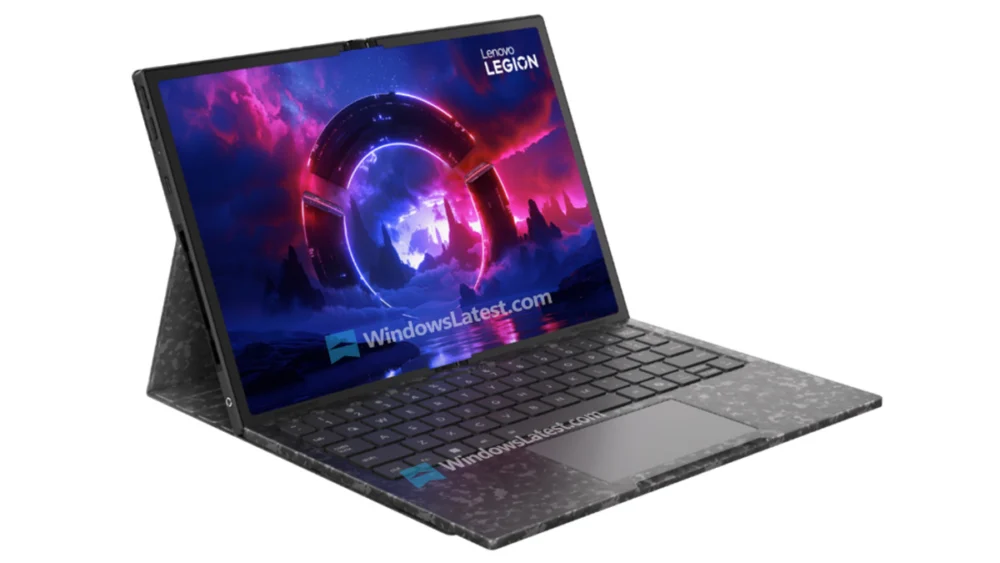
The technological landscape is poised for a significant shift as major players prepare for the impending Mobile World Congress (MWC) 2026 in Barcelona. While the event promises a showcase of anticipated releases, such as HONOR’s debut of the Magic V6 and its foray into robotics, Lenovo is reportedly targeting a far more disruptive unveiling: a novel concept device poised to blur the lines between portable gaming hardware and full-fledged personal computing. This rumored entrant, tentatively dubbed the Legion Go Fold, suggests a radical evolution in multifunctional hardware, moving beyond simple tablet-and-keyboard pairings toward a truly adaptive ecosystem.
Leaked preliminary details, circulating just days before the MWC commencement on March 2nd, paint a picture of a device engineered for maximum versatility. The core innovation lies in its foldable POLED display, which transitions dramatically in size, offering a compact 7.7-inch form factor when folded and expanding to an expansive 11.6-inch canvas when fully deployed. This architectural flexibility is not merely a gimmick; it underpins four distinct operational modes designed to cater to disparate user needs, from intense gaming sessions to productivity tasks.
The Four Pillars of Adaptability
The operational philosophy of the Legion Go Fold appears centered on contextual transformation, acknowledging that a single device must serve multiple masters in the modern digital workflow.
1. Handheld Mode: In its closed configuration, the device reverts to the familiar form factor of a dedicated gaming handheld. Leveraging the 7.7-inch screen, this mode is augmented by detachable controllers, signaling Lenovo’s commitment to tactile, low-latency input essential for competitive gaming. This preserves the immediate accessibility of existing portable consoles while housing far more powerful internal components.
2. Split-Screen Mode: Upon partial unfolding, the device adopts a tent or upright orientation, dividing the screen vertically. This split interface is a nod to multitasking efficiency, allowing simultaneous engagement with two applications—for instance, running a streaming service on one half while engaging in lighter gameplay or communication on the other. This mode targets media consumption scenarios where peripheral engagement is desired alongside the primary focus.
3. Horizon Full-Screen Mode: When completely unfurled, the device offers the full 11.6-inch display area. This maximizes immersion, particularly for gaming, where the larger real estate can showcase more detailed environments or provide a broader field of view. This configuration positions the device as a premium, large-format portable gaming tablet.
4. Expanded Desktop Mode: Perhaps the most ambitious transition, this mode aims to supplant traditional laptops. By connecting the unfolded tablet to an accompanying wireless keyboard unit, complete with an integrated touchpad, the Legion Go Fold transforms into a clamshell-style PC experience. This suggests the underlying operating system—likely a highly customized version of Windows or a bespoke mobile OS tuned for desktop environments—must seamlessly transition from a touch-centric interface to a cursor-driven workflow.
Deep Dive into Hardware Specifications and Controller Innovation
The specifications hinted at for this concept suggest a powerhouse residing within the chassis. Central to its computational muscle is the rumored Intel Core Ultra 7 258V processor, indicating Lenovo is targeting the high-performance segment, capable of handling demanding applications and modern AAA games, not just mobile titles. This is further supported by a substantial 32GB of RAM, a figure typically reserved for high-end ultrabooks and workstations, underscoring the desktop aspirations of the device. Powering these operations is a 48Whr battery, a necessary, albeit potentially conservative, capacity given the expansive screen and high-power components.
The controllers represent another area of significant engineering focus, borrowing cues from previous successful detachables while introducing novel input methods. While they retain the essential detachable nature for handheld play, the right controller is highlighted for its unique dual functionality. Beyond standard controls, it reportedly integrates a small, dedicated screen that can function as a touchpad, an informative display for real-time performance metrics (such as clock speeds, temperatures, or battery status), or even serve as a bank of customizable hotkeys. Furthermore, its ability to operate as a vertical mouse in a specific configuration—dubbed "FPS Mode"—is a critical insight into Lenovo’s understanding of PC gaming ergonomics, offering precise aiming control often preferred over joystick input for first-person shooters.
Industry Implications: Convergence and the Post-PC Era
Lenovo’s exploration with the Legion Go Fold is symptomatic of a broader, accelerating trend within the consumer electronics industry: the quest for ultimate device convergence. For years, the market has been segmented between powerful, stationary desktops, portable productivity laptops, and dedicated mobile gaming handhelds. Foldable technology, now maturing beyond its initial iterations in smartphones, offers the most viable pathway to collapsing these categories.
The primary challenge for any device attempting this level of functional duality is software optimization. A handheld running a mobile OS struggles with desktop applications, while a full desktop OS running on a small, folded screen is inherently unwieldy. Lenovo’s rumored approach—combining high-end PC architecture (Intel Core Ultra) with a form factor that can emulate both mobile and laptop interfaces—suggests they are banking on an operating system capable of dynamically scaling its UI and performance profiles based on the physical configuration.
If successful, the Legion Go Fold could exert significant pressure on established market segments. For the handheld gaming sector (currently dominated by Valve’s Steam Deck and ASUS’s ROG Ally), Lenovo introduces a massive value proposition: a device that not only plays the same PC games but can become the PC itself, eliminating the need for a separate laptop for non-gaming tasks. For the ultraportable laptop market, it offers superior portability when folded, while delivering a larger-than-average internal display when deployed, potentially making compromises on thickness or weight more palatable to the consumer seeking a single device solution.
Expert Analysis: The Engineering Hurdles of True Adaptability
While the concept is compelling, the transition from proof-of-concept to a commercially viable product is fraught with engineering challenges that require expert-level navigation.
1. Hinge Durability and Crease Management: The hallmark of any foldable is the hinge mechanism. For a device intended to be frequently manipulated between handheld, tented, and flat desktop modes—and crucially, one designed for the rigors of PC gaming—the hinge must withstand exponentially more stress cycles than a standard smartphone. Furthermore, the visibility and tactile feel of the screen crease under high-resolution gaming or detailed productivity work remains a significant aesthetic and functional hurdle. Lenovo’s success hinges on engineering a hinge that is robust, thin, and virtually invisible in use.
2. Thermal Management Under Load: The Intel Core Ultra 7 processor demands substantial cooling, especially when running full-fat desktop applications or complex games on an 11.6-inch chassis that must also accommodate a folding mechanism. Traditional handhelds often utilize vapor chambers or complex fan arrays. Integrating effective, quiet cooling into a device designed to fold flat without compromising its thin profile requires significant thermal engineering breakthroughs. In desktop mode, leveraging an external keyboard base might allow for passive cooling solutions, but handheld mode demands active, self-contained thermal dissipation.
3. Battery Life Compromise: A 48Whr battery is adequate for a standard 7-inch handheld, but potentially insufficient for driving an 11.6-inch POLED display at high refresh rates using a high-TDP Core Ultra processor for extended gaming sessions. The software must be masterful at power gating components based on the mode. For instance, the device must aggressively throttle the CPU/GPU in handheld mode while offering full access to both when connected to a power source in desktop mode, creating a distinct performance tiering system that users must understand.
4. Input Ecosystem Cohesion: The detachable controllers, particularly the one with the integrated screen/touchpad, are complex peripheral systems. Ensuring zero-latency communication and seamless OS recognition across all modes—handheld, split-screen, and desktop—requires deep integration with the host operating system, potentially involving custom driver architecture beyond standard plug-and-play standards.
Future Impact and Emerging Trends
If the Legion Go Fold successfully navigates these engineering complexities and reaches the market, it signals the maturation of the "PC replacement" device. This concept isn’t just about a foldable screen; it’s about modularity redefining ownership. Consumers may soon ask why they need a dedicated tablet, a gaming handheld, and a compact laptop when one highly flexible device, paired with a couple of smart accessories (the keyboard and perhaps an external monitor dock), can cover all bases.
This trajectory aligns with broader industry shifts toward edge computing and decentralized work environments. As cloud gaming services mature and remote desktop solutions become more robust, the emphasis shifts from the raw processing power inside the device to the device’s adaptability in connecting to necessary resources. The Legion Go Fold appears designed to thrive in this transitional period: powerful enough to run local applications when necessary, yet flexible enough to serve as the ultimate client for cloud-streamed experiences.
Furthermore, the emphasis on the right controller’s multi-functionality—mouse, touchpad, display—suggests Lenovo is anticipating the continued convergence of input methods. The traditional distinction between touch input (mobile) and precision input (PC) is dissolving. Future high-end devices will likely require integrated solutions that offer the best of both worlds simultaneously, allowing a user to precisely position a cursor while keeping an eye on system telemetry, all within the constraints of a portable peripheral.
The MWC unveiling will be crucial. While the specifications listed are based on early reports of a concept, they set a high bar. If Lenovo can translate this vision into a durable, high-performance commercial product, the Legion Go Fold could serve as the vanguard for the next generation of personal computing devices—those defined not by their static form factor, but by their ability to instantly morph to the user’s immediate requirement. The age of dedicated single-purpose gadgets may be drawing to a close, replaced by dynamically reconfigurable digital hubs.
