

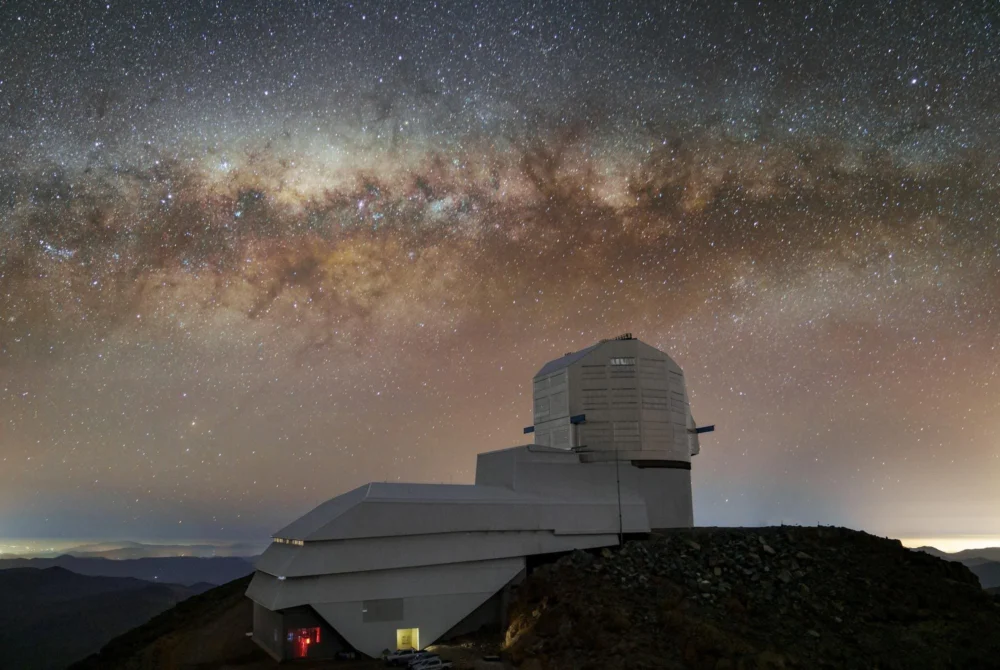
The dawn of "time-domain" astronomy has officially arrived, marked by a singular night of observations that has fundamentally altered our approach to cataloging the cosmos. On Tuesday, February 24, 2026, the Vera C. Rubin Observatory, perched high in the Chilean Andes, achieved a critical operational milestone by detecting 800,000 individual cosmic changes during a single session. This feat was made possible by the activation of its near-real-time alert system, a sophisticated digital engine capable of identifying and broadcasting astronomical transients—ranging from flickering stars to hurtling asteroids—within just 120 seconds of the initial shutter click.
This achievement represents more than just a successful hardware test; it signals a paradigm shift in how humanity monitors the universe. For centuries, astronomy was a discipline of static snapshots—long-exposure images of distant, seemingly unchanging nebulae and galaxies. The Rubin Observatory, however, treats the sky as a living, breathing cinematic production. By utilizing the world’s largest digital camera to scan the Southern Hemisphere sky repeatedly, it is transforming the "great beyond" into a high-definition, ten-year-long motion picture.
The Engineering Behind the Eye
At the heart of this $473 million facility is the Simonyi Survey Telescope, an 8.4-meter wide-field instrument designed for speed and breadth. Unlike the James Webb Space Telescope, which peers deeply into tiny, specific patches of the sky to see the dawn of time, the Rubin Observatory is built for "synoptic" surveying. It aims to see as much as possible, as often as possible. Its field of view is staggering, covering an area roughly 40 times the size of a full moon in a single exposure.
To capture this vast expanse without sacrificing detail, engineers at the SLAC National Accelerator Laboratory spent years perfecting the LSST (Legacy Survey of Space and Time) Camera. This 3,200-megapixel behemoth is the largest digital camera ever constructed for the field of astronomy. To put its resolution into perspective, displaying just one of its full-size images would require a grid of 1,500 high-definition television screens. The focal plane of the camera consists of 189 individual 16-megapixel Charge-Coupled Device (CCD) sensors, arranged in "rafts" that are cooled to nearly -150 degrees Fahrenheit to minimize electronic noise.
The camera’s operational cadence is a marvel of mechanical and optical synchronization. Every 39 to 40 seconds, the telescope slews to a new position—a move that takes a mere five seconds despite the massive weight of the structure—and captures a new image through one of its six optical filters. These filters allow scientists to view the universe across different wavelengths, from near-ultraviolet to near-infrared, providing a multi-spectral understanding of every object detected.
The Computational Deluge: From Chile to California
The detection of 800,000 changes in a single night highlights the project’s most significant challenge: data management. The Rubin Observatory generates approximately 20 terabytes of raw data every night. This information is funneled through high-speed fiber-optic cables from the 8,900-foot summit of Cerro Pachón to supercomputing hubs in the United States.
The real magic happens in the "Alert Production Pipeline." To find the 800,000 changes reported on Tuesday, sophisticated software algorithms performed "difference imaging." This process involves taking a fresh image of a patch of sky and mathematically subtracting a "template" image—a historical record of that same patch. Anything that remains after the subtraction is a "transient"—a new source of light or a moving object.
In the early stages of commissioning, the system flagged 800,000 such events. However, as the observatory reaches full operational capacity, this number is expected to balloon to seven million alerts per night. Managing this "firehose" of data requires a level of automation never before seen in the physical sciences. These alerts are distributed globally to "community brokers"—software platforms that use artificial intelligence to categorize the alerts and decide which ones merit immediate follow-up by other telescopes.
Planetary Defense and the Search for "The Killer Rock"
While the Rubin Observatory has profound implications for deep-space physics, its most immediate impact may be closer to home. One of the primary mandates of the Legacy Survey of Space and Time is the identification of Near-Earth Objects (NEOs). The solar system is populated by millions of asteroids and comets, many of which remain undocumented.

The Rubin Observatory is expected to identify approximately 90% of potentially hazardous asteroids larger than 140 meters in diameter—objects capable of wiping out a major metropolitan area. By tracking these rocks over a decade, scientists can calculate their orbits with extreme precision, providing decades or even centuries of lead time if an impact is projected. Furthermore, the telescope’s sensitivity allows it to find "Interstellar Immigrants"—objects like ‘Oumuamua or Comet Borisov that have traveled from other star systems, offering a rare glimpse into the chemistry of distant solar systems.
Probing the Dark Sector: The Legacy of Vera Rubin
The observatory is named in honor of Vera C. Rubin, the astronomer whose pioneering work on galaxy rotation rates provided the first robust evidence for the existence of dark matter. It is fitting, then, that her namesake facility is designed to solve the very mystery she uncovered.
By imaging billions of distant galaxies, the Rubin Observatory will allow cosmologists to measure "weak gravitational lensing." This phenomenon occurs when the gravity of invisible dark matter warps the light of galaxies behind it. By mapping these distortions across the entire Southern sky, researchers can create a 3D map of the dark matter distribution in the universe.
Simultaneously, the observatory will tackle "dark energy"—the mysterious force driving the accelerated expansion of the universe. By cataloging millions of Type Ia supernovae (which serve as "standard candles" for measuring cosmic distances), the LSST will provide the data necessary to determine if dark energy is a constant property of space or a dynamic field that changes over time.
Industry Implications: The Rise of the Data-Driven Astronomer
The success of the Rubin Observatory signals a major shift in the professional landscape of the space industry. We are moving away from the era of the "lone observer" at a telescope and into the era of the "astrophysical data scientist."
The sheer volume of the LSST dataset—estimated to reach 500 petabytes over ten years—is driving innovation in big data and machine learning. Tech companies and research institutions are collaborating to develop "citizen science" portals and AI-driven classification tools. This "open data" approach means that a high school student with a laptop could potentially discover a supernova or a new planet before a professional astronomer does, simply by writing a more efficient search algorithm.
This democratization of data is also influencing the aerospace and defense sectors. The techniques developed for the Rubin alert system—identifying fast-moving, faint objects against a cluttered background—have direct applications in space situational awareness (SSA) and the tracking of orbital debris (space junk), which has become a critical concern for satellite operators and national security.
A Decade of Discovery
As the Rubin Observatory transitions from commissioning to full-scale operations, the global scientific community is bracing for an era where the "unexpected" becomes a daily occurrence. Within its first year, the facility will capture more images of the cosmos than all previous optical surveys combined.
The 800,000 alerts recorded this Tuesday are merely the first ripples of a coming tide. Over the next decade, the Legacy Survey of Space and Time will provide the most comprehensive inventory of our solar system, the most detailed map of our galaxy, and the most profound insights into the fundamental physics of the universe. In an age where we often feel we have mapped every corner of our world, the Vera C. Rubin Observatory reminds us that the vast majority of the story is still being written, one megapixel at a time.
