

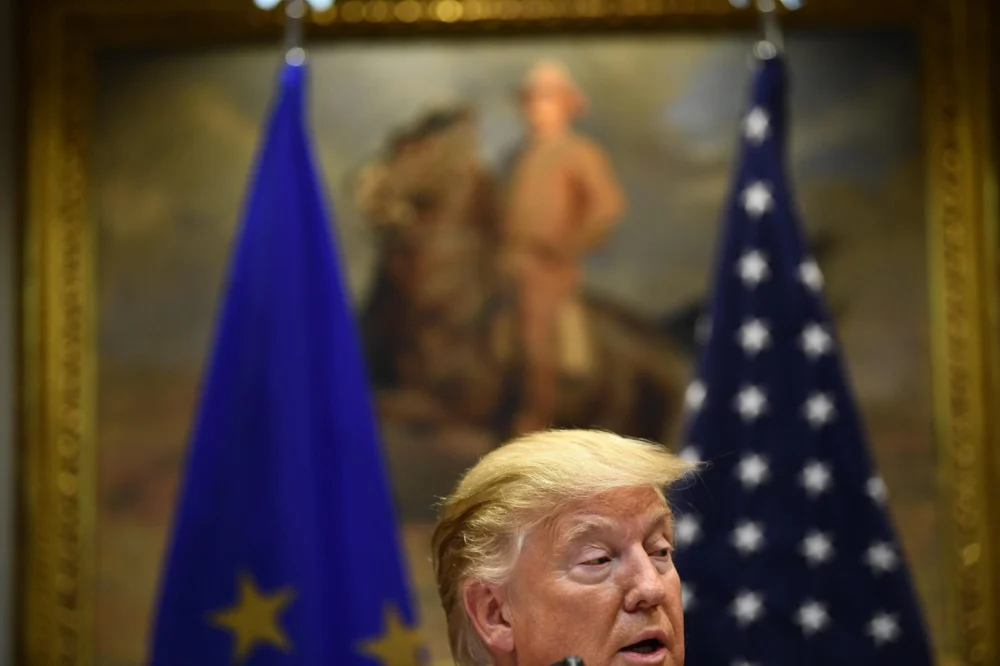
The digital frontier, once envisioned as a borderless "Global Village," is rapidly transforming into a fractured landscape of competing jurisdictions and ideological strongholds. In a move that signals a profound shift in the geopolitical management of the internet, the U.S. State Department has reportedly initiated the development of a sophisticated online portal designed to bypass the content restrictions and moderation protocols of foreign governments. This initiative, centered on the domain freedom.gov, represents a direct challenge to the regulatory frameworks of some of America’s closest allies, most notably the European Union, and threatens to ignite a new era of "digital brinkmanship" between Washington and Brussels.
As of late February, the freedom.gov landing page remains cryptic but pointed. Visitors are greeted by an animation of Paul Revere—a symbol of revolutionary warning—galloping across a stylized Earth. The accompanying text is unambiguous: "Freedom is Coming. Information is power. Reclaim your human right to free expression. Get ready." While the site currently lacks functional tools, its existence marks the first time the United States has signaled an intent to deploy "circumvention technology" against democratic partners, a tactic historically reserved for bypassing the firewalls of authoritarian regimes like China, Iran, and Russia.
The Philosophical Schism: First Amendment vs. The Digital Services Act
At the heart of this escalating tension lies a fundamental, perhaps irreconcilable, difference in how the United States and Europe define the limits of acceptable speech. In the American legal tradition, the First Amendment provides a nearly absolute shield against government interference. The U.S. Supreme Court has historically maintained a high bar for restriction, requiring that speech must pose an "imminent lawless action" before it can be suppressed. This "marketplace of ideas" philosophy operates on the assumption that the remedy for bad speech is more speech, not enforced silence.
Conversely, the European perspective is shaped by a history of extremist ideologies and the catastrophic consequences of unchecked propaganda. This has birthed a legal doctrine often referred to as "militant democracy," where the state has an affirmative duty to protect the democratic order by restricting speech that incites hatred, denies historical atrocities like the Holocaust, or promotes terrorism.
This philosophy reached its zenith with the implementation of the EU’s Digital Services Act (DSA) and the UK’s Online Safety Act. These frameworks do not merely suggest moderation; they mandate it. They require "Very Large Online Platforms" (VLOPs) to proactively mitigate "systemic risks," which includes the removal of content deemed to be illegal under national or EU law. For European regulators, this is a matter of public safety and "digital sovereignty." For the current U.S. administration, it is a "censorship regime" that unfairly targets conservative viewpoints and infringes upon the global reach of American constitutional values.
A New Cold War Tactic for a Digital Age
The development of freedom.gov draws uncomfortable parallels to the Cold War era, specifically the operations of Radio Free Europe and Radio Liberty. During the 20th century, these organizations broadcast news and Western perspectives into the Soviet bloc to undermine the Kremlin’s information monopoly. By adopting a similar posture today, the U.S. State Department is effectively categorizing European content moderation as a form of digital authoritarianism.
However, the irony of this move is not lost on observers of U.S. domestic policy. Even as the State Department prepares to launch a tool for global internet freedom, internal shifts in Washington have seen significant funding cuts to the U.S. Agency for Global Media’s Internet Freedom program. The Department of Government Efficiency (DOGE) has targeted these initiatives, leading to a paradoxical situation where the U.S. is dismantling its traditional support for global VPNs and circumvention tools while simultaneously building a bespoke portal to challenge European law.
Critics argue that this transition shifts the focus from "promoting democracy" to "weaponizing speech." While traditional internet freedom tools were designed to help dissidents in Tehran or Beijing communicate safely, freedom.gov appears aimed at ensuring that political content—which might be flagged as "hate speech" or "disinformation" under the DSA—remains accessible to European audiences.
The Economic Dimension: Content Moderation as a Trade Barrier
Beyond the lofty debates over human rights and free expression lies a gritty economic reality. The Trump administration and its allies have increasingly characterized European digital regulations not as safety measures, but as sophisticated trade barriers. High-ranking U.S. officials have described the DSA’s aggressive fining structure—which can reach up to 6% of a company’s global annual turnover—as a "digital speed trap" designed to extract wealth from American tech giants like Meta, Google, and X (formerly Twitter).
In December 2024, the EU’s decision to fine X 120 million euros for non-compliance served as a catalyst for this narrative. From Washington’s perspective, these fines are essentially "extortionate tariffs" on the U.S. tech sector. If the U.S. government provides a portal that allows users to bypass the very moderation requirements that trigger these fines, it creates a massive legal loophole. It essentially dares European regulators to block a U.S. government-hosted domain, a move that would constitute a major diplomatic rupture.

French President Emmanuel Macron has already warned that the U.S. is likely to "attack" the EU over digital regulation in the coming months, possibly through the imposition of retaliatory tariffs. The freedom.gov portal could be the opening salvo in a broader trade war where data, algorithms, and speech are the primary commodities at stake.
Industry Implications: The "Splinternet" Becomes Reality
For the tech industry, the emergence of freedom.gov is a nightmare scenario of conflicting compliance requirements. Currently, global platforms must engage in "geofencing"—the practice of making certain content unavailable in specific regions to comply with local laws. If a user in Germany attempts to access content that violates German anti-hate speech laws, the platform blocks it.
If the U.S. government provides a "freedom portal" that effectively acts as a proxy to serve that blocked content, the legal status of the platform becomes murky. Does the platform remain in compliance because it "blocked" the content, or is it liable because it allowed the U.S. government to mirror that content?
This conflict accelerates the move toward a "Splinternet," where the internet is no longer a unified global network but a series of regional silos governed by local politics. Companies may be forced to choose between "U.S.-aligned" internet standards and "EU-aligned" standards. This fragmentation increases operational costs, complicates global engineering, and degrades the user experience by creating a patchwork of accessible and inaccessible information.
Expert Analysis: The Risk of Unintended Consequences
Digital policy experts are raising alarms about the potential for freedom.gov to become a conduit for truly dangerous material. Nina Jankowicz, a prominent disinformation researcher and former U.S. official, has noted that by bypassing European content bans, the U.S. government might inadvertently facilitate access to more than just "political speech."
European authorities often use the DSA to remove content related to terrorist recruitment, child sexual abuse material (CSAM), and coordinated "inauthentic behavior" from foreign intelligence services. If freedom.gov is designed to be a broad circumvention tool, it could potentially be used by bad actors to circumvent legitimate public safety protections. The challenge for the State Department will be creating a filter that allows "protected political speech" while still blocking "universally illegal" content—a task that has proven nearly impossible for even the most sophisticated AI-driven platforms.
Furthermore, the European Commission has remained steadfast in its defense of its "digital sovereignty." Commission President Ursula von der Leyen has made it clear that "what is forbidden offline is forbidden online" in the EU. This suggests that Europe will not quietly accept a U.S.-led effort to undermine its laws. The EU could respond by requiring Internet Service Providers (ISPs) to block freedom.gov entirely, or by escalating legal action against U.S. companies that fail to prevent their content from being routed through the portal.
Future Outlook: A Digital Iron Curtain?
The next phase of this conflict is expected to unfold in early March, when Michael Rigas, a high-ranking State Department official, is scheduled to visit Brussels. This visit is likely to be a high-stakes negotiation where the U.S. will attempt to leverage the threat of freedom.gov to force a relaxation of DSA enforcement.
If negotiations fail, the launch of a functional freedom.gov could mark the end of the "Transatlantic Data Privacy Framework" and other cooperative tech agreements. We may see the emergence of a "Digital Iron Curtain," where the U.S. and Europe—traditional allies in the physical world—become adversaries in the digital realm.
In the long term, this dispute highlights the inadequacy of current international law to handle the complexities of the digital age. There is no "Geneva Convention" for the internet, no global consensus on where one nation’s sovereignty ends and an individual’s right to information begins. Until such a framework exists, portals like freedom.gov will continue to serve as both a symbol of the desire for unbridled expression and a catalyst for global instability.
The "Freedom is Coming" slogan on the freedom.gov website is a promise to some and a threat to others. As the portal nears its functional launch, the world watches to see if the U.S. will truly attempt to "liberate" the European web, and what price both sides of the Atlantic will pay for such a provocation. The battle for the soul of the internet has moved from the server rooms to the halls of state power, and the consequences will be felt by every user who clicks a link in a divided world.
