

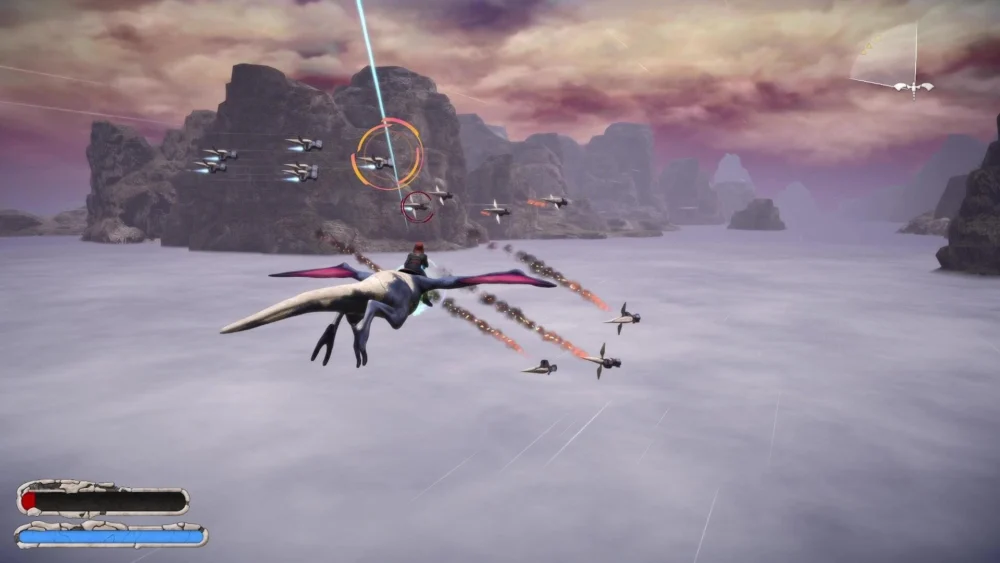
The release of a playable demo for the remake of Panzer Dragoon Zwei on Steam marks a pivotal, if polarizing, moment for one of the most storied franchises in video game history. For a generation of gamers who came of age during the 32-bit era, the Panzer Dragoon series represents more than just a collection of rail shooters; it is a testament to the avant-garde spirit of Sega’s internal development teams during the mid-1990s. As this new iteration moves from the show floors of major industry events into the hands of the general public, it carries the heavy burden of legacy, technical expectation, and the complex economics of modern "AA" game publishing.
To understand the current discourse surrounding the Panzer Dragoon Zwei remake, one must first look back at the Sega Saturn. Released in 1996, the original Panzer Dragoon Zwei (officially titled Panzer Dragoon II Zwei) was a masterclass in technical optimization. Developed by the legendary Team Andromeda, it pushed the Saturn’s notoriously difficult dual-processor architecture to its absolute limits. It introduced a branching path system, a morphing dragon that evolved based on player performance, and a cinematic scale that few games of the era could match. It wasn’t just a sequel; it was a refinement of an aesthetic—a blend of Jean "Moebius" Giraud-inspired art, post-apocalyptic biological sci-fi, and a haunting, orchestral-electronic score.
The new Steam demo offers the first widespread look at how the modern development team is handling this sacred text. While early impressions from industry events like the Tokyo Game Show suggested a project making steady mechanical progress, the public reaction on digital storefronts has been a stark reminder of how high the bar is set for nostalgic revivals. The "Discussion" sections of Steam are currently a battlefield of critique, where the most dedicated fans of the franchise are dissecting every frame of animation, every particle effect, and the fundamental "weight" of the dragon’s movement.
This friction highlights a growing trend in the gaming industry: the "Budget Remake" paradox. Unlike the high-budget, "AAA" reimagining of titles like Resident Evil 4 or Final Fantasy VII, the Panzer Dragoon remakes are produced under more modest financial constraints. Often licensed by Sega to external partners, these projects must balance the desire for modern visual fidelity with the reality of limited resources. When a developer takes on a title as beloved as Zwei, they are not just competing with other modern games; they are competing with the player’s "memory" of the original, which is often more vivid and polished than the actual 1996 software.
The criticism leveled at the developer often overlooks the role of the publisher. In the modern ecosystem, Sega has frequently opted for a hands-off approach with its classic IPs, allowing smaller studios to take the lead. This democratizes the revival of niche genres, but it also means these studios are often caught in the crossfire when fans feel the "soul" of the original hasn’t been perfectly captured. The previous remake of the first Panzer Dragoon followed a similar trajectory—launching to mixed reviews and technical concerns, only to be significantly improved through a series of post-launch patches that eventually won over much of the community. The hope among enthusiasts is that the Zwei remake will follow an even more aggressive path of refinement, using the feedback from the current Steam demo to iron out the kinks before a full release.
One of the most significant challenges in remaking a Team Andromeda game lies in the specific technical wizardry of the original creators. Figures like Yuji Yasuhara, who worked on the enemies and bosses of Zwei before moving on to Sony to create the PlayStation classic Omega Boost, possessed a deep understanding of how to evoke a sense of speed and scale within the limitations of 90s hardware. Yasuhara’s work, in particular, was characterized by a specific type of kinetic energy—a "mecha-anime" fluidity that felt both heavy and agile. Replicating that specific "feel" in a modern engine like Unity or Unreal requires more than just high-resolution textures; it requires a deep dive into the mathematics of flight physics and camera behavior that defined the Saturn originals.

Furthermore, the industry implications of this remake extend far beyond a single title. The Panzer Dragoon series is often viewed as a trilogy (the original, Zwei, and the legendary RPG Panzer Dragoon Saga), with the spin-off Panzer Dragoon Orta arriving later on the Xbox. Of these, Panzer Dragoon Saga is considered the "Holy Grail" of retrogaming—a masterpiece that was produced in limited quantities and has never been ported or remade due to the loss of its original source code. The success or failure of the Zwei remake is widely seen as a litmus test for the viability of a Saga remake. If the community and the market do not support these rail-shooter revivals, the chances of a massive, expensive RPG remake being greenlit become increasingly slim.
The technical analysis of the demo reveals a game that is trying to bridge the gap between retro authenticity and modern standards. In a rail shooter, the relationship between the player’s reticle and the dragon’s movement is the core loop. Any perceived latency or "floatiness" in the controls can break the immersion. The original games were designed for CRT televisions with near-zero input lag; modern PC environments, with varying refresh rates and controller types, present a much more chaotic environment for a precision shooter. The developers are tasked with creating a "locked-in" feeling that satisfies both the veteran who remembers the Saturn controller and the newcomer playing on a Steam Deck.
Looking toward the future, the trend of remaking cult classics from the 32-bit and 64-bit eras is likely to accelerate. We have seen success with titles like the Klonoa Phantasy Reverie Series and the Tomb Raider I-III Remastered collection. These projects suggest that there is a middle ground between a simple port and a ground-up reimagining. The Panzer Dragoon Zwei remake sits squarely in this space. It is an attempt to preserve the artistic vision of the past while utilizing the lighting and shading capabilities of the present.
However, the "brutal" feedback mentioned in early Steam discussions shouldn’t be dismissed as mere toxicity. In many ways, it is a form of passion-driven quality assurance. The fans pointing out issues with the lock-on sound effects, the timing of the "Berserk" attack, or the transparency of the water in the Episode 1 canyon are providing a roadmap for the developers to achieve greatness. In an era where "Early Access" has become a standard development phase, a public demo serves as a vital bridge between the studio’s internal milestones and the audience’s expectations.
The broader gaming landscape also plays a role in how this remake is received. The rail shooter is a genre that has largely migrated to virtual reality (VR) or disappeared into the indie scene. By bringing Panzer Dragoon Zwei to Steam, the developers are attempting to prove that this specific brand of cinematic, linear action still has a place on a standard monitor. It is a gamble on the idea that players still crave a curated, authored experience over the endless expanse of open-world games.
As we await the final release date, the importance of this demo cannot be overstated. It is an invitation for the community to participate in the final stages of the game’s evolution. Whether the developers can pivot based on the current "litany of change requests" remains to be seen, but the transparency of providing a demo is a step in the right direction. It acknowledges that Panzer Dragoon does not belong to the developers alone, but to a global community that has kept the fire burning for nearly thirty years.
In conclusion, the Panzer Dragoon Zwei remake is a fascinating case study in the modern gaming industry’s relationship with its own history. It represents the intersection of nostalgic reverence, "AA" development realities, and the uncompromising standards of a dedicated fanbase. While the road to release appears to be turbulent, the mere fact that we are once again talking about the world of the Ancient Age, the cool blue of the dragon’s wings, and the soaring melodies of the Saturn era is a victory in itself. The skies are open once again; now, it is up to the developers and the players to decide how high this dragon will fly. Regardless of the final verdict, the journey of this remake serves as a vital reminder that some legacies are too powerful to stay grounded, and the quest to perfect them is a testament to the enduring power of Sega’s golden age.
