

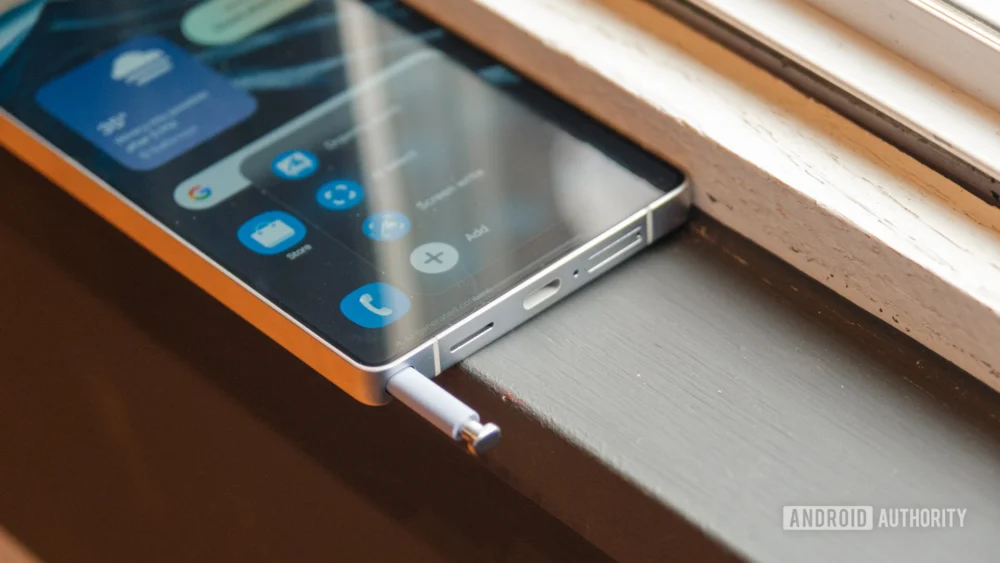
The perennial question surrounding Samsung’s flagship Ultra series—the symbiotic relationship between the handset and its integrated S Pen—appears to be heading toward a contentious conclusion for power users. Fresh, albeit unverified, pre-release footage purportedly showcasing the Galaxy S26 Ultra suggests that a critical feature stripped from its predecessor, the S25 Ultra, will not be making a return: integrated Bluetooth connectivity within the stylus. This signals a potential strategic pivot by Samsung, prioritizing internal component consolidation or cost reduction over advanced remote stylus interaction capabilities.
The foundation of this concern stems from a video circulating across social media platforms, purportedly captured by an individual who acquired an early unit of the S26 Ultra in Dubai for a significant premium. The critical observation revolves around the S Pen’s integrated button functionality. In the demonstration captured, repeated presses of the S Pen’s solitary button while the stylus is held mere centimeters from the device fail to elicit any discernible response on the smartphone interface.
To contextualize this observation, one must recall the evolution of the S Pen. For several generations, the stylus has housed a discreet Bluetooth Low Energy (BLE) module, enabling what Samsung terms "Air Actions." These functions transform the S Pen from a mere input tool into a versatile remote control. Users could trigger the camera shutter from across a room, advance slides during a presentation without touching the phone, or use gesture controls within specific applications like media players or gallery viewers. This capability was a defining differentiator for the Ultra line, positioning it as a productivity powerhouse beyond simple note-taking.
The previous generation, the Galaxy S25 Ultra, marked the first major regression in this area when Samsung reportedly opted to remove the Bluetooth radio from the S Pen. This move was met with considerable backlash from the segment of the user base that heavily relied on these remote control features. The prevailing industry speculation at the time centered on component scarcity, design constraints related to battery size or internal layout, or perhaps a desire to streamline the S Pen’s feature set to focus purely on latency and pressure sensitivity. Whatever the justification, the utility of the stylus was immediately curtailed for remote operations.
The current leak surrounding the S26 Ultra—if accurate—indicates that this removal was not a temporary measure or a one-off compromise but rather a deliberate, sustained design choice. The absence of the expected "wobble" or activation of the Air Command menu upon button press, which is reliably observed on older, BLE-equipped models such as the Galaxy S23 Ultra, strongly suggests the necessary transceiver hardware is missing from the S26 Ultra’s stylus.
Industry Implications: The Calculus of Consolidation
This trend raises significant questions about Samsung’s long-term strategy for the Note lineage successor. The S Ultra series has long been the spiritual successor to the beloved Galaxy Note, and the S Pen is its soul. While Samsung continues to champion the stylus for its core functions—ultra-low latency writing, drawing, and precise screen navigation (which rely on Wacom EMR technology, entirely separate from Bluetooth)—the sidelining of Air Actions suggests a segmenting of the market Samsung is willing to accept.
From an engineering standpoint, removing BLE from the S Pen yields several potential benefits for the manufacturer. Firstly, it reduces the complexity of the stylus assembly. Secondly, it eliminates the need for a separate, albeit tiny, battery within the S Pen dedicated solely to powering the Bluetooth transmitter, potentially allowing for a smaller footprint or perhaps diverting that internal volume to other components if the phone chassis itself is being refined. Thirdly, and perhaps most importantly for mass production, it mitigates the regulatory hurdles and certification processes associated with wireless communication devices across various global markets.
However, the user experience implication is severe. For professionals, educators, and content creators who valued the S Pen’s ability to function as a true wireless peripheral, this decision effectively renders the S26 Ultra’s stylus functionally inferior to its predecessors in terms of remote control capabilities. It forces users into a binary choice: embrace the newest processing power, charging speeds, and camera arrays, or retain the legacy S Pen functionality they depend on.
Expert Analysis: The Feature Pruning Phenomenon
In the hyper-competitive smartphone landscape, feature pruning is an unavoidable reality. Manufacturers are constantly balancing user demand against manufacturing costs, thermal management, and the relentless pursuit of thinner designs. When a feature, even a niche one like S Pen remote control, is used by a small percentage of the total user base—even if those users are highly engaged—it becomes a candidate for removal if it complicates the engineering matrix.
Technically, the S Pen relies on Wacom’s Electromagnetic Resonance (EMR) technology for proximity detection and input registration. This is passive and requires no internal power source in the stylus itself, which is why the S Pen can operate without charging for basic writing. The Bluetooth functionality, conversely, requires an active battery and transmitter. If the S26 Ultra’s internal architecture necessitated a redesign—perhaps accommodating a larger battery for the rumored Snapdragon 8 Elite Gen 5 for Galaxy chipset or improved camera sensors—sacrificing the BLE module in the stylus becomes a pragmatic engineering sacrifice.
The data point from the purported hands-on video—the lack of Air Command activation when the button is clicked remotely—is the strongest evidence we have, as it directly tests the hardware interaction. While Samsung has yet to officially comment or release specifications, the consistency across early leaks strongly suggests the status quo established with the S25 Ultra will continue.
Future Impact and Emerging Trends
The potential sidelining of advanced S Pen features forces an examination of the broader stylus market. If Samsung is moving away from integrated wireless control, it opens the door for third-party accessory makers to fill the void, or perhaps for Samsung itself to pivot the S Pen strategy entirely.
One future direction could involve shifting remote control functionality to near-field communication (NFC) tags or requiring the S Pen to maintain a direct, short-range RF connection that is separate from traditional Bluetooth. However, these alternatives introduce new complexities regarding battery drain or required proximity, often failing to match the seamless, low-power nature of BLE Air Actions.
Another possibility lies in leveraging the Ultra device’s software ecosystem more deeply. Could future software updates enable gesture controls recognized by the phone’s camera sensors or ultrasonic fingerprint reader to mimic remote shutter functionality? This seems less elegant than the dedicated S Pen button but is a potential workaround if hardware integration is permanently removed.
For the consumer, this news dictates purchasing decisions for the next 12 to 18 months. Users invested in the full productivity suite offered by older S-series flagships who cannot afford to lose the remote control capability will likely retain their Galaxy S24 Ultra or S23 Ultra devices, effectively pausing their upgrade cycle until Samsung reverses course or offers a compelling, feature-parity replacement.
The S26 Ultra, meanwhile, is rumored to feature substantial internal upgrades, including the aforementioned next-generation Snapdragon silicon, potentially faster 60W wired charging speeds, and incremental improvements to the camera module configuration. These advancements are aimed at the bulk of the market concerned with raw performance and multimedia consumption. The decision to omit the S Pen’s wireless module thus appears to be a calculated risk: trading high-value, low-volume feature engagement for streamlined hardware and focusing resources on performance metrics that appeal to the broader flagship audience.
Ultimately, the durability of the S Pen’s legacy rests on its unique writing experience. If the S Pen remains the best stylus on the market for tactile input, many users will tolerate the loss of Air Actions. However, for a device branded "Ultra," the removal of a signature ‘ultra’ feature suggests a recalibration of what the company defines as essential for its top-tier offering moving forward. We await official confirmation, but the initial signals suggest that the age of the fully-featured, wirelessly connected S Pen may be drawing to a close.
