

The arrival of the 2026 Cadillac Escalade IQ marks a pivotal moment in the American automotive landscape, representing the ultimate collision between traditional luxury excess and the inevitable shift toward electrification. With a starting price of $130,405 and a curb weight tipping the scales at 9,000 pounds, this vehicle is less a car and more a rolling statement of intent. General Motors has effectively taken its most recognizable brand icon and reimagined it for a world that demands zero emissions but refuses to compromise on scale. For a week-long excursion to the snow-covered peaks of Tahoe, I stepped behind the wheel of this four-and-a-half-ton monument to engineering to determine if such a massive battery-electric vehicle (BEV) is a functional masterpiece or a logistical nightmare.
At first glance, the Escalade IQ—often referred to in its long-wheelbase form as the IQL—is an exercise in visual gravity. Measuring 228.5 inches in length and 94.1 inches in width, it possesses a physical footprint that rivals some metropolitan apartments. When it was first dropped off at my residence, the sheer scale was disorienting. Parked next to standard sedans and mid-sized crossovers, the Escalade IQ makes everything else look like a scale model. The hood is so high that navigating steep driveways or hilly urban terrain requires a leap of faith; from the driver’s seat, objects directly in front of the bumper simply vanish into a blind spot created by the vehicle’s massive vertical presence. Yet, despite this gargantuan scale, there is a surprising elegance to the design. Cadillac’s designers have managed to avoid the bloated look that plagues many large SUVs, opting instead for a "strapping" silhouette that feels intentional and balanced.
Stepping into the cabin is an entry into a world of digital maximalism. The centerpiece is a staggering 55-inch curved LED display with 8K resolution that spans the entire width of the dashboard. It feels less like an automotive interface and more like a tactical command center. For the driver, the information is crisp and comprehensive, while the front-seat passenger enjoys a dedicated screen equipped with polarized technology. This "privacy" feature is a marvel of modern tech; it allows a passenger to stream content from apps like Hulu without a single frame of the video bleeding into the driver’s peripheral vision.

The interior luxury extends well beyond the screens. The cabin is designed to ensure that even a full contingent of seven adults feels unburdened by proximity. Legroom is generous across all three rows, with the front offering 45.2 inches and the second row providing a palatial 41.3 inches. In the top-tier trims, the second-row passengers are treated to individual 12.6-inch screens, stowable tray tables, and massage seats that rival high-end furniture. The auditory experience is equally impressive, powered by a 38-speaker AKG Studio sound system that provides an immersive soundstage, effectively insulating the occupants from the outside world.
However, the transition from internal combustion to electric power brings a new set of challenges, particularly regarding efficiency and infrastructure. The Escalade IQ is powered by a massive 205 kWh battery pack—nearly double the size of many standard EV batteries. This scale is a necessity because the vehicle is, by any metric, "thirsty." It consumes roughly 45 kWh per 100 miles, a figure that reflects the immense energy required to move 9,000 pounds through the air. While Cadillac estimates a total range of 460 miles, real-world conditions—specifically the frigid temperatures and steep climbs of the Sierra Nevada—tell a different story.
The limitations of current non-Tesla charging infrastructure became glaringly obvious during my trip to Tahoe City. Despite the Escalade’s sophisticated navigation, which uses Google Maps to integrate charging stops, the reality on the ground was a comedy of errors. A Tesla Supercharger that appeared compatible in the MyCadillac app failed to deliver a charge. A nearby EVGo station had been decommissioned, and the local ChargePoint units were either broken or non-functional. Eventually, a late-night trek to an Electrify America station twelve miles away saved the trip, but not before an hour of fighting exhaustion in a freezing parking lot. This experience highlights a critical industry implication: as manufacturers produce larger, more energy-dependent EVs, the fragility of the public charging network becomes a significant barrier to adoption for anyone living outside of ideal temperate zones.
Furthermore, the software experience remains a point of contention for those accustomed to the seamless integration found in Tesla vehicles. While Cadillac’s interface is visually stunning, it lacks the frictionless execution of its Silicon Valley rivals. Small annoyances, such as a "frunk" (front trunk) that requires a sustained button press to operate and a rear hatch that follows a different set of logic, create a sense of mechanical clunkiness. On two occasions, the vehicle even refused to power down after I exited, requiring a strange sequence of shifting gears and opening the frunk to reset the system.

The driving experience itself is dominated by GM’s Super Cruise, a hands-free driving assistant. While the system is highly regarded by many critics, my experience was more anxious. The vehicle occasionally drifted within the lane, triggering a sequence of haptic seat pulses and visual warnings—what GM calls a "driver takeover request." It is a reminder that while we are nearing the age of autonomy, the responsibility of piloting a 4.5-ton machine still rests heavily on the human operator.
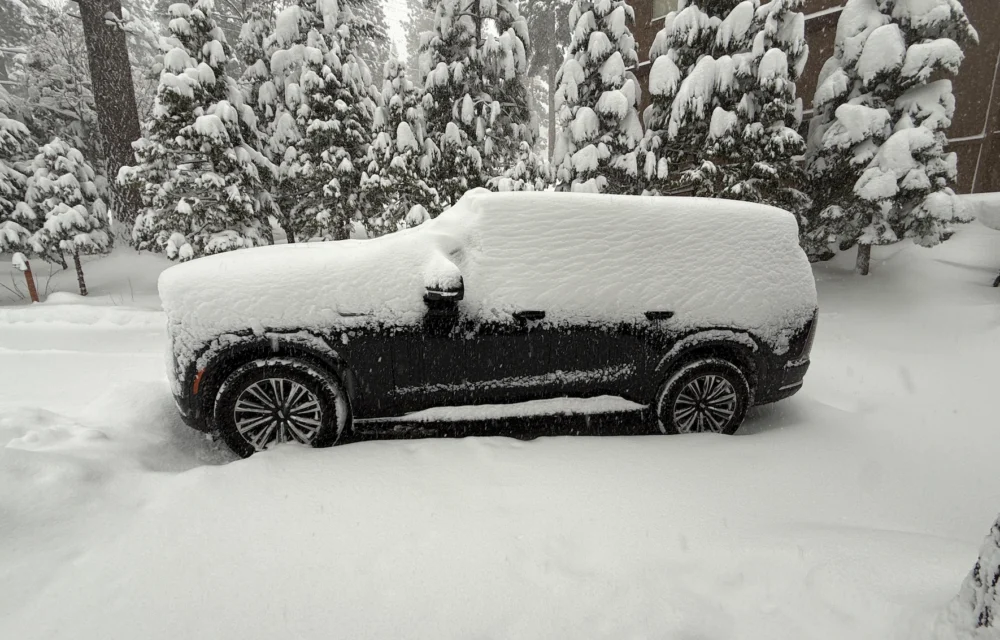
Despite these technological and logistical hurdles, the Escalade IQ redeemed itself during a historic weather event. A massive winter storm dumped eight feet of snow on Tahoe in just two days, rendering most vehicles useless. In these conditions, the Escalade’s greatest liability—its weight—became its greatest asset. While other cars slid and struggled, the Escalade felt like a tank. It moved through deep drifts with a serene, unstoppable force. The harrowing environment outside was completely neutralized by the vehicle’s mass and sophisticated all-wheel-drive system. It was in this moment of crisis that the "monster" became a sanctuary.
From an industry analysis perspective, the Escalade IQ represents a fascinating gamble by General Motors. By utilizing the Ultium platform, GM is betting that the luxury consumer’s desire for status and size will outweigh the inherent inefficiencies of a heavy EV. There is a socio-economic dimension to this vehicle as well; its design philosophy suggests that the owner is someone who does not wait in line, someone who commands space, and someone who values the "light show" of an approaching vehicle as much as its carbon footprint. The vertical LED headlamps and "choreographed" tail lamps provide a theatrical entrance that appeals to the "Boss" persona that the Escalade brand has cultivated over decades.
Looking toward the future, the Escalade IQ raises important questions about urban infrastructure. Can our roads and parking garages handle a proliferation of 9,000-pound vehicles? The tire pressure alone is a maintenance hurdle; the Escalade requires nearly 70 PSI to support its weight, and a small drop in temperature can trigger alerts that require immediate attention. As solid-state battery technology matures, we may see the weight of these giants decrease, but for now, Cadillac is leaning into the "more is more" philosophy.

In conclusion, the 2026 Cadillac Escalade IQ is a vehicle of profound contradictions. It is an engineering marvel that provides unparalleled comfort and security in extreme conditions, yet it is burdened by the realities of a still-developing charging ecosystem and the sheer physics of its own mass. It is a car for people who deal with existential crises by surrounding themselves with 8K screens and 38 speakers. While I entered the week skeptical of its excess, I left with a begrudging admiration for its capability. It is a "monster," certainly, but in the middle of a blizzard or on a long highway stretch, it is exactly the kind of monster you want on your side. When the time came to return the vehicle, I found myself contemplating the logistics of hiding it under a very large tarp, a testament to the seductive power of Cadillac’s electric titan.
