

In a significant blow to the clandestine financial networks supporting the Democratic People’s Republic of Korea (DPRK), a U.S. federal court has sentenced Oleksandr Didenko, a 29-year-old Ukrainian national, to five years in federal prison. The sentencing follows Didenko’s pivotal role in a sophisticated, multi-year identity theft and fraud operation designed to infiltrate U.S. corporations and funnel high-value salaries back to the North Korean regime. This case serves as a stark reminder of the evolving nexus between cybercrime, remote work vulnerabilities, and international state-sponsored espionage.
The conviction of Didenko, a resident of Kyiv, marks a milestone in the Department of Justice’s ongoing effort to sever the revenue streams that fuel Pyongyang’s internationally sanctioned nuclear weapons and ballistic missile programs. By facilitating fraudulent employment for North Korean operatives, Didenko provided the logistical infrastructure necessary for the regime to bypass global financial restrictions and tap into the lucrative U.S. technology sector.
The Architecture of the Infiltration: Upworksell and Identity Laundering
At the heart of Didenko’s operation was a website he managed called "Upworksell." Far from a legitimate freelance marketplace, Upworksell functioned as a digital clearinghouse for stolen identities. According to federal prosecutors, Didenko managed a repository of more than 870 stolen identities belonging to U.S. citizens. These identities were then sold or rented to overseas workers, primarily North Koreans, who used the credentials to create fraudulent profiles on popular remote-work platforms and job boards.
The sophistication of the scheme lay in its ability to mimic the profile of a domestic American IT professional. North Korean workers, often operating from hubs in China, Russia, or Southeast Asia, would adopt the names, Social Security numbers, and backgrounds of real Americans. By leveraging Didenko’s service, these operatives were able to secure positions at dozens of high-profile U.S. companies, ranging from Fortune 500 tech giants to sensitive defense and financial services firms.
Didenko’s role was not merely that of a passive seller. He actively curated the identities to ensure they could pass basic background checks and verification protocols. For North Korean operatives, who are barred from the U.S. job market by a litany of federal sanctions, Didenko’s platform was an essential gateway. It transformed them from sanctioned foreign nationals into "vetted" domestic contractors, allowing them to earn six-figure salaries that were subsequently laundered through a complex web of accounts before arriving in the hands of the North Korean government.
The Technical Backbone: Domestic "Laptop Farms"
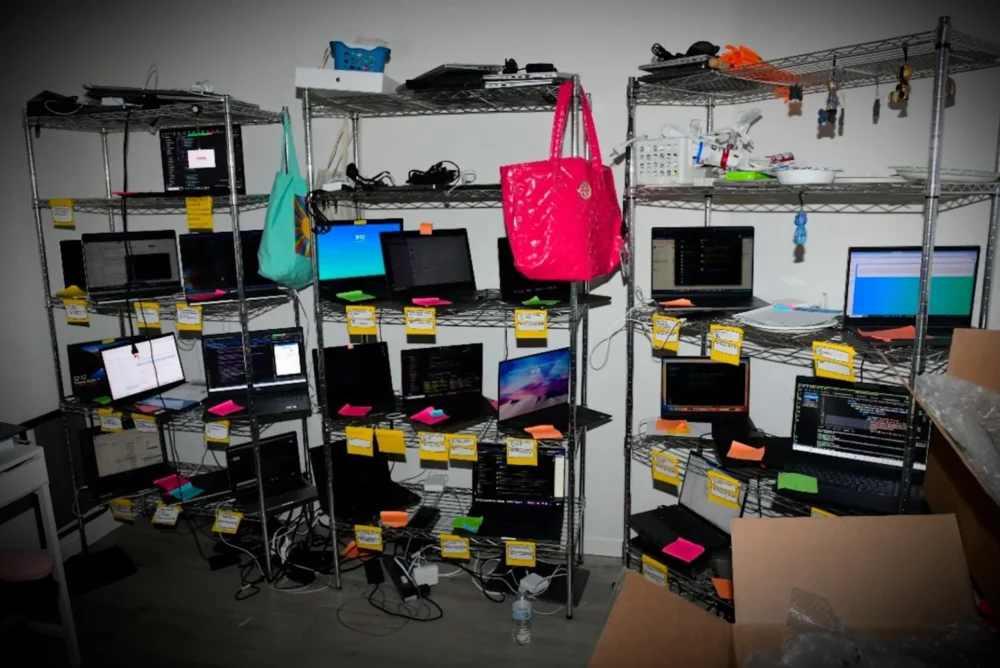
Securing a job offer is only the first hurdle in a remote work scheme; maintaining the illusion of domestic residency is the second. To overcome the geographic barriers of IP address tracking and corporate security monitoring, Didenko established what investigators call "laptop farms."
These farms were physical locations—often nondescript residential homes—in California, Tennessee, and Virginia. Didenko recruited and paid individuals in these states to host racks of laptops that were permanently connected to the internet. When a North Korean worker in Pyongyang or Dalian logged into their "office" environment, they would remote-desktop into these physical machines located on U.S. soil. To the employer’s IT security team, the employee appeared to be working from a suburban home in Virginia rather than a state-sponsored hacking hub in Asia.
This infrastructure allowed the workers to bypass the geofencing and VPN-detection tools that many modern enterprises use to verify employee locations. By maintaining a persistent physical presence within the U.S. network infrastructure, the operatives could operate with a degree of impunity, participating in Zoom calls, accessing sensitive repositories, and submitting code as if they were local hires.
The Triple Threat: A New Paradigm of Corporate Risk
Security analysts and federal investigators have categorized the influx of North Korean IT workers as a "triple threat" to the corporate world. The risks are not merely financial or regulatory; they are existential for the companies involved.
First, there is the issue of sanction violations. Any U.S. company that inadvertently hires and pays a North Korean national is in direct violation of the International Emergency Economic Powers Act (IEEPA). This exposes the company to massive federal fines, reputational damage, and potential criminal liability.
Second, the threat of data exfiltration is constant. Once these workers gain access to a company’s internal systems, they are positioned to steal proprietary software, customer data, and intellectual property. Unlike traditional hackers who must break in through a firewall, these operatives are invited in through the front door. They possess valid credentials, access to internal Slack channels, and a deep understanding of the company’s internal architecture.
Third, the scheme often culminates in extortion. Security researchers have documented numerous cases where North Korean workers, after being terminated or sensing they are about to be discovered, pivot from "employees" to "extortionists." They use the sensitive data they gathered during their tenure to threaten the company with public leaks unless a ransom—typically in cryptocurrency—is paid. This "exit strategy" ensures that even if the employment fraud is foiled, the North Korean regime still extracts value from the target.

Industry Implications and the Crisis of Verification
The Didenko case highlights a growing crisis in the remote work era: the failure of traditional "Know Your Employee" (KYE) protocols. As companies shifted to remote-first models during and after the pandemic, the rigor of identity verification often lagged behind the speed of hiring.
For the HR and cybersecurity sectors, this case is a wake-up call. The reliance on digital copies of Social Security cards or driver’s licenses is no longer sufficient when those documents are being traded in bulk on sites like Upworksell. Furthermore, the use of "laptop farms" suggests that hardware-based location tracking is also fallible.
Industry experts are now advocating for more robust, multi-factor identity verification that includes live, AI-resistant video interviews and the use of biometric data. However, even these measures are being challenged. Recent reports suggest that North Korean operatives are beginning to use generative AI and deepfake technology to bypass video interviews, appearing as the person whose identity they have stolen in real-time.
Expert Analysis: The Geopolitical Context
From a geopolitical perspective, Didenko’s conviction is part of a broader "cat-and-mouse" game between the U.S. intelligence community and North Korea’s Reconnaissance General Bureau (RGB). As traditional avenues for currency generation—such as coal exports or counterfeit currency—have been squeezed by sanctions, Pyongyang has turned to the digital economy.
The "IT worker" scheme is particularly attractive to the regime because it provides a steady, high-volume stream of "clean" money. Unlike high-profile bank heists or crypto-exchange hacks, which can trigger immediate international alarms, a thousand workers earning $100,000 a year each creates a $100 million annual revenue stream that is much harder to track and freeze in real-time.
Didenko’s five-year sentence reflects the severity with which the U.S. legal system now views these facilitators. By targeting the middlemen like Didenko, the DOJ aims to increase the cost and risk of doing business with North Korea, making it harder for the regime to find the technical talent and logistical support it needs in the West.
The Global Investigation and Extradition
The takedown of Upworksell was an international effort. In 2024, the FBI successfully seized the domain, diverting its traffic to government-controlled servers to gather intelligence on the site’s users and infrastructure. Didenko himself was apprehended by Polish authorities, a move that underscores the critical nature of international law enforcement cooperation in the digital age.
Following his arrest in Poland, Didenko was extradited to the United States to face charges. His decision to plead guilty was likely a result of the overwhelming digital evidence gathered from the seized servers and the laptop farms. The five-year sentence, while significant, is seen by some as a deterrent to others who might consider selling their technical expertise to rogue states for a quick profit.
Future Trends: The Evolution of the Threat
As the Didenko chapter closes, the threat landscape continues to shift. Law enforcement agencies are warning that North Korean operatives are becoming more aggressive. They are no longer just looking for developer roles; they are increasingly targeting positions in human resources, IT administration, and DevOps—roles that grant them "keys to the kingdom" access.
Moreover, the impersonation of venture capitalists and recruiters has become a common tactic to target high-net-worth individuals in the cryptocurrency space. By posing as legitimate professionals on LinkedIn, these state-sponsored actors initiate relationships that eventually lead to the deployment of malware or the theft of private keys.
For U.S. companies, the message is clear: the hiring process is now a primary front in national security. The era of "trust but verify" has been replaced by an era of "verify, then verify again." Companies must invest in specialized threat hunting that looks specifically for signs of North Korean infiltration, such as unusual network traffic patterns associated with remote desktop protocols or discrepancies in payroll bank accounts.
The sentencing of Oleksandr Didenko is a victory for the rule of law, but it is unlikely to be the end of the story. As long as North Korea remains isolated from the global economy, it will continue to seek out digital vulnerabilities, and as long as there are middlemen willing to trade in stolen identities, the digital pipeline to Pyongyang will remain a persistent threat to global security.
